
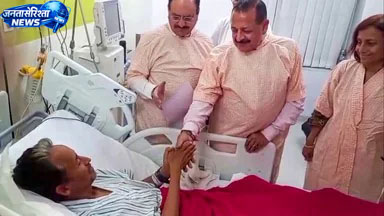
New Delhi: Climate activist and social thinker Sonam Wangchuk has ended his hunger strike regarding the NEET paper leak issue. Explaining the reason for ending the fast on Friday, he stated that the government has agreed not to register new cases against the protesters and to provide compensation to the families of victims who allegedly died by suicide due to the mental stress associated with the NEET paper leak scandal. However, he clarified that there has been no concrete or immediate assurance from the government regarding the demand for the resignation of Union Education Minister Dharmendra Pradhan.
Sonam Wangchuk stated that his hunger strike was not for any personal or political motive but was aimed at securing the future of students and ensuring transparency and accountability within the education system. He mentioned that several rounds of talks were held with the government during the agitation, leading to a positive stance on some key demands. It was in light of these assurances that he decided to call off his hunger strike for the time being.
He noted that the government has assured that no new cases would be filed against the students, youth, and other participants involved in the protest. Furthermore, an agreement was reached to show sensitivity towards families who lost their children following the NEET paper leak controversy. Wangchuk remarked that while financial assistance and compensation in such cases might offer some relief to the affected families, the irreparable loss they suffered cannot truly be compensated.
Sonam Wangchuk also mentioned that the resignation of Union Education Minister Dharmendra Pradhan was one of the movement’s primary demands. He argues that moral responsibility must be fixed regarding the alleged irregularities and the paper leak in the country’s largest medical entrance examination. However, the government provided no immediate agreement or assurance on this specific demand. He affirmed that the struggle on this issue would continue and the demand for accountability would not be abandoned.
Expressing gratitude to his supporters and students across the country, he stated that this movement is not merely about a single examination but is an effort to restore faith in the nation’s entire education system. He stated that if the integrity of competitive examinations is called into question, the morale of lakhs of hardworking students would be affected, and the credibility of the education system would be undermined.
Widespread debate and protests have been taking place across the country for several months regarding the NEET paper leak issue. Students, parents, and various social organizations have demanded transparency in the examination process, strict action against the guilty, and robust mechanisms to prevent the recurrence of such incidents in the future. This issue has influenced political and social discourse, extending from Parliament to the streets.
Sonam Wangchuk stated that ending his fast does not mean the movement has come to an end. He clarified that if the government fails to implement its assurances within a stipulated timeframe or does not take concrete steps towards educational reforms, the next phase of the movement could be launched in the future. He urged the government to undertake comprehensive reforms to make competitive examinations completely transparent, secure, and free from corruption.
Meanwhile, several student organizations associated with the movement have welcomed Wangchuk’s decision. They view the government’s positive stance on key demands as a significant achievement for the movement. However, they have reiterated their demands for the Education Minister’s accountability and for sweeping reforms in the examination system.
Reactions to these developments are also emerging from political circles. Opposition parties have emphasized the need for reforming the education system and taking strict action against the guilty, while the government maintains that necessary steps are being taken to uphold the integrity of competitive exams and to act firmly against any irregularities.
Education experts believe that transparency and security must be the top priorities for national-level examinations like NEET. They argue that technical improvements in the examination process, strengthened monitoring systems, stringent legal provisions to prevent paper leaks, and effective mechanisms for ensuring accountability are essential to prevent such incidents in the future.
For now, the conclusion of Sonam Wangchuk’s fast has marked a new turn in the movement, yet the demands for reforming the education system, protecting students’ interests, and ensuring accountability remain unresolved. All eyes are now fixed on how and how quickly the government implements the assurances it has given, and what further steps it takes to restore the credibility of competitive examinations.


