
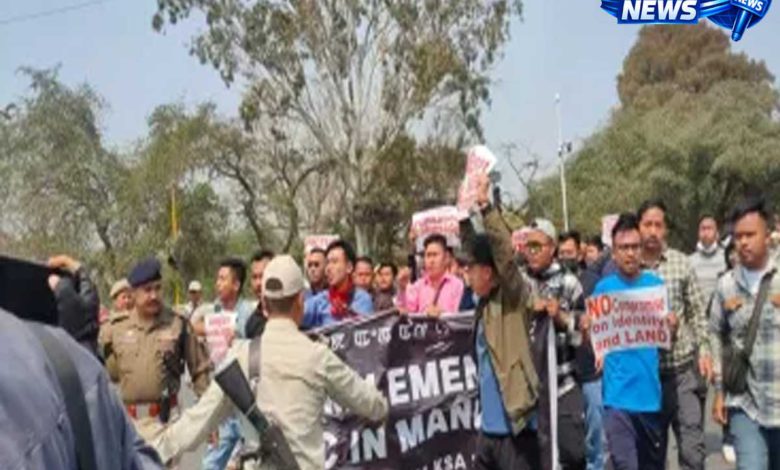
Manipur: As Manipur grapples with multi-ethnic violence, with recent Naga-Kuki clashes that killed six Naga civilians in Senapati district, a notable political alliance is quietly taking shape in the backdrop, signalling a closer convergence between the Meitei and the Naga community over shared territorial- political aspirations and continuing conflicts with the Kuki-Zo community.
This emerging alliance between the Meiteis and the Nagas has manifested in joint protests, public meetings and joint committees, framed by participants as a common fight of “indigenous communities” against “outsiders”, driven by shared concerns over perceived illegal immigration, land encroachment, poppy cultivation and militancy-related issues.
As the alliance expands, Kuki organisations and scholars view it as a strategic realignment that could consolidate Meitei and Naga political interests while isolating and shrinking the Kuki community’s space in any future political settlement.
Common ‘Adversary‘
“We have a great demographic threat from the Kuki people, who have now started to demand a separate administration in order to safeguard their illegal immigrants and ‘so called’ refugees,” said Ashang Kasar, convenor of the Native People’s Committee, Manipur (NPCM), a joint Meitei Naga civil body formed on May 26, and a Naga himself while speaking about what promoted the alliance.
He further added: “When they started fighting us, the Nagas and the Meiteis being the main owners of the state realised that if the land owners are not defending the people and the land, then somebody will come and occupy it, and therefore we sat together and finally formed this joint committee.”
Santa Nahakam, spokesperson of the Coordinating Committee on Manipur Integrity (COCOMI), the apex body of the Meiteis, echoed the remarks, stating that it is a common fight for both the communities. “It is not like Kukis are fighting with the Nagas or with the Meiteis and we remain silent. It is a very common fight,” he added.
Nahakam stated that the mobilisation is not against any Kuki group, but against what he called the ‘Narco terrorists’.
He, however, maintained that the common Kukis are under their influence: “The villages of Nagas and the Meiteis have realised that the common Kuki folks who were living or residing with them for ages are now being controlled by narco-terrorists, or you can say SoO groups.”
Janghaolun Haokip, information secretary of Kuki Inpi, the apex body of the Kuki-Zo community, saw the Meitei-Naga convergence which has now become more visible, as built on a longer political alignment and propaganda, which even predate the 2023 conflicts.
He suspected that former CM Biren Singh had a role in “building an entente between the Meiteis and Nagas and realigning their strategies.” and is largely built around territorial and land dominance motives.
“To my mind, this is a strategic alliance that was forged from around 2010 onwards; there is a very uncanny convergence of territorial as well as indigenous politics between the Nagas and the Meiteis,” said Dr Kham Khan Suan Hausing, a leading expert on ethnopolitics in Northeast India and Professor of Political Science at the University of Hyderabad.
He noted, “it is with a strategic interest in mind to leave a political narrative in ways that otherize and exclude the cookies as unwanted, as illegal immigrants.”
Prof Hausing referred to social media posts by the Meitei Hindu nationalist figure Pramot Singh ahead of the 2023 violence as an old ideological reflection of such alliance, where he urged followers to create a strategic alliance between the Nagas and the Meiteis with the “the enemy of our enemy” connotation, arguing that they carried the implication that “the annihilation of the Kukis would happen once this strategic alliance is forged.”
“In that sense,” he said, “it is far deeper and is driven by a very xenophobic politics.”
Indignity, illegal immigration and NRC
One of the key objectives of the alliance is the safeguarding of ‘indignity’ and land rights. Kasar stressed historic primacy: “The Nagas and the Meiteis are the first settlers in the state of Manipur; they are the only indigenous people and the owners of the Manipur state; the others came later.”
He tied this to illegal immigration figures, claiming that there has been an influx of Kuki immigration from 1500 in the 1950s from Myanmar, which, according to him, has increased to “more than three lakhs” in the state. “We want to deport this,” he added.
Prof. Hausing critiqued the premise of defining indignity through “first occupancy”, arguing it was ahistorical and conceptually difficult to establish who the original settlers were.
“This attempt to draw a distinction between the so-called indigenous and non-indigenous communities goes against the grain of historical records,” he said, adding that multiple waves of migration across the Northeast made such claims difficult to sustain. “If you try to apply this across the board in the Indian subcontinent, the idea of indignity is going to fall flat.”
He also questioned claims of a large-scale influx of illegal immigrants from Myanmar, saying there was “no reliable empirical evidence” to support such assertions.
“The idea of otherising the Kukis has been put into political service by the former chief minister Biren Singh and his majoritarian politics; suddenly, since 2019, we have an aggressive stance on trying to otherise Kukis with a very exclusive political discourse.”
Kasar suggested NRC as the path: “Although the Kukis are outsiders, there is some condition. Nagas and Meiteis are demanding the updation of the NRC with base year as 1951 or 1961; if it reflects that some Kukis were there before this year, then we don’t object to it; they will be included.” He, however, noted, “Once NRC is updated, there will be no Kuki picture in Kangpokpi, Moreh and Chandel districts.”
Hausing questioned the practicalities of such an exercise: “As per RTI, Manipur does not have census data or the various village directories of 1951 or 1961. Much of the political narrative around NRC has been insistent on using those records as the baseline. But how can that be sound legal documentation when the documents themselves are conspicuous by their absence?” He argued that such an NRC would rest on “imaginative presumptions.”
“Such a political project is uncalled for. It is potentially very dangerous,” he added.
SoO Abrogation and ‘Narco terrorism‘
The emerging Meitei-Naga alignment has strongly pushed for abrogation of the Suspension of Operations (SoO) agreements with Kuki armed groups, viewing them as enabling militancy, village expansion, and narco activities.
COCOMI explained: “Since the agreement of 2005 and 2008, the common Kuki folks who were living or residing with them for ages are now being controlled by narco-terrorists, or you can say SoO groups. Even some of the non-SoO groups are involved… They have taken control of the indigenous villages or native villages. And they started doing poppy cultivation and so many other things.”
Nahakam claimed that Kuki armed groups have issued dictates allowing the use of tribal chiefs’ land for poppy cultivation and are taking revenue from it.
“The hills and mountains of Manipur are being spoiled by poppy plantation and cultivation,” claimed Kasar, alleging that the SoO militants extort money on highways and are engaged in vehicle destructions and killings.
Kuki Inpi spokesperson challenged the rhetoric of narco terrorism as pointless, stating “all communities in Manipur have militant groups, and all communities engage in narcotics-related activities.”
He clarified: “The Kuki-Zo civil bodies have consistently appealed to our people to refrain from poppy cultivation and other narcotics-related activities. We extend full cooperation to the law enforcement authorities in controlling this menace, as long as the Kuki-Zo community is not specifically targeted.”
“A major player in this narco-terrorism is a complex web of transnational players in connivance with the powers that be in Manipur,” stressed Hausing. “Not just the political, but also the bureaucrats and the military, who are posted on the border. And it’s a very insidious network in which all levels of political elites are involved.”
“Remember that poppy cultivation began in the Naga-inhabited areas, much before it travelled down south. It’s a very interesting coincidence that this violence happened at a time in which the major concentration of poppy cultivation got shifted to Churachanpur district (Kuki-dominant region),” he added, highlighting the selective targeting of the Kukis on poppy cultivation.
Hausing emphasised that the Meitei-Naga alliance’s emphasis on SoO groups as the primary perpetrators of violence, who in effect swear by the Constitution of India for a political settlement, is misplaced. “Much of this violence in Manipur, even before 2023, stems from the insurrectionists’ challenge posed by the valley-based insurgent groups (VBICs), who boycott Indian independence as well as Republic Day,” he argued.
Ultimately, the structural source of violence in Manipur remains the failure of the state to maintain law and order.