
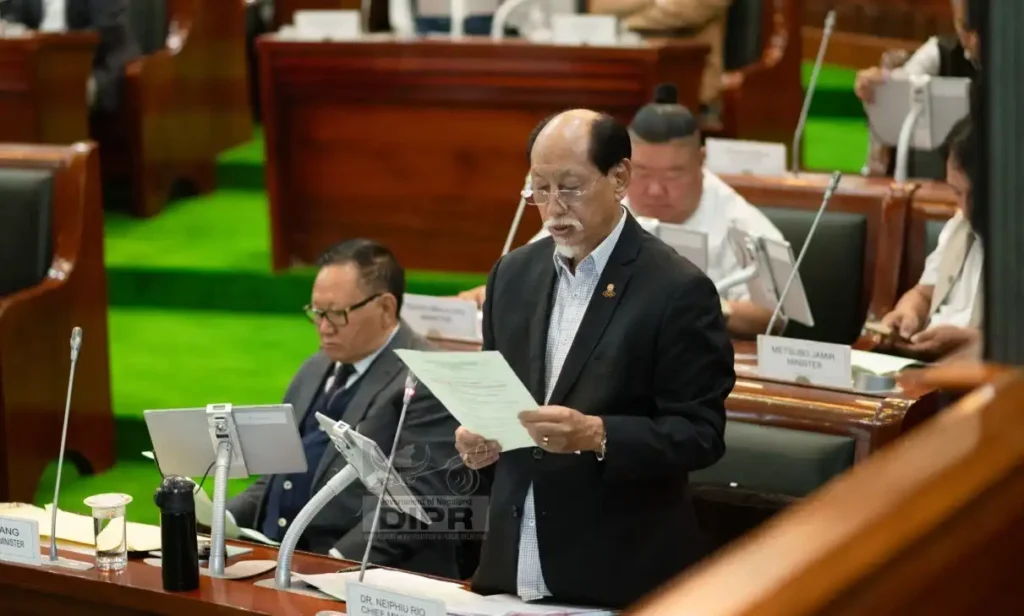
Nagaland: Nagaland Chief Minister Rio announced that the government will implement a biometric system and Aadhaar linkage to eliminate multiple entries during the upcoming census operation in the state. He warned that those attempting to manipulate the data will face legal consequences.
Rio described the 2001 census as “abnormal,” noting that while India’s national population growth was around 20%, Nagaland recorded a staggering 64.58%. He pointed out that some districts recorded growth rates of over 100%, a figure he argued was statistically impossible.
Rio said the state requested another exercise to verify the data, but the Census Office did not allow such an exercise. The Chief Minister said that census data in the past few years had been inaccurate and that he had repeatedly raised this issue.
The issue was discussed in the House on Tuesday when NPP MLA Nuklutoshi expressed concern over the upgrading of government schools without adequate enrollment. Responding to the member, Leader of the House and Chief Minister Dr. Neiphiu Rio detailed the state’s demographic record over several decades.
Dr. Rio expressed serious concerns about the historical inaccuracies in census data in the state and its negative impact on the state’s planning and educational infrastructure.
To ensure accuracy in the future, a full-day consultative meeting will be convened involving MLAs and the Chief Electoral Office, with the Chief Minister urging MLAs to include the District Planning Board, church, and community leaders.
Rio explained that the state did not conduct a proper census in 1961 because it coincided with the peak period of the insurgency, and many people were unwilling to register their names. He said that census coverage in 1971 was slightly over 40%, while in 1981 and 1991 it was slightly over 50%. However, referring to the 2001 census, Rio said that while India’s overall population growth rate was around 20%, Nagaland recorded a growth rate of 64.58%, which he described as unusual. Some districts saw growth rates exceeding 100%, while others ranged between 80% and 90%, resulting in a total growth rate of 64.58%.
With the support of civil society organizations and the Church, Rio said that the 2011 census recorded a negative decadal population growth rate of -0.58% between 2001 and 2011, with the population declining by less than 11,800. He said this was a historic development because both the growth rate and the decadal growth rate became negative.
The Chief Minister emphasized that these disparate figures raised “serious concerns” in the education sector. He said that the then Human Resource Development Ministry, relying on inflated data from 2001, issued orders under the Right to Education (RTE) Act, allowing unnecessary school construction and upgrades.
This resulted in a surplus of teachers and institutions with single-digit or zero student enrollments. Consequently, the state cabinet initiated a rigorous process of consolidating schools and redeploying staff to address these deficiencies.
He said that the Education Department, with the support of the full cabinet, was holding frequent meetings, forming committees, and investigating schools with no students, single-digit enrollments, and cases where the number of teachers exceeded the number of students. Consequently, the government had begun consolidating schools and redeploying teachers.
Speaking on administrative reforms, Rio acknowledged that political compulsions and persistent demands for new districts and backward status have made Nagaland “over-administered.” He confirmed that a committee has been formed to review the reservation policy and administrative criteria to ensure that governance remains sustainable and truly provides justice to backward groups within the state. Rio also warned that the growing demands for new districts and backward status must adhere to strict criteria to prevent administrative degradation. He stated that while political compulsions have led to an “over-administered” state, governance requires sustainable limits. Earlier, Nuklutoshi stated that despite highly qualified teachers in government schools, there are often no students. Therefore, he called for a thorough audit of both government and private schools and suggested that, with the support of the village council and community, government schools that lack students should be merged, while others with low enrollment may need to be closed. Regarding reservation policies, he also pointed out that even in districts considered highly privileged, there are underprivileged groups whose concerns need to be addressed.


