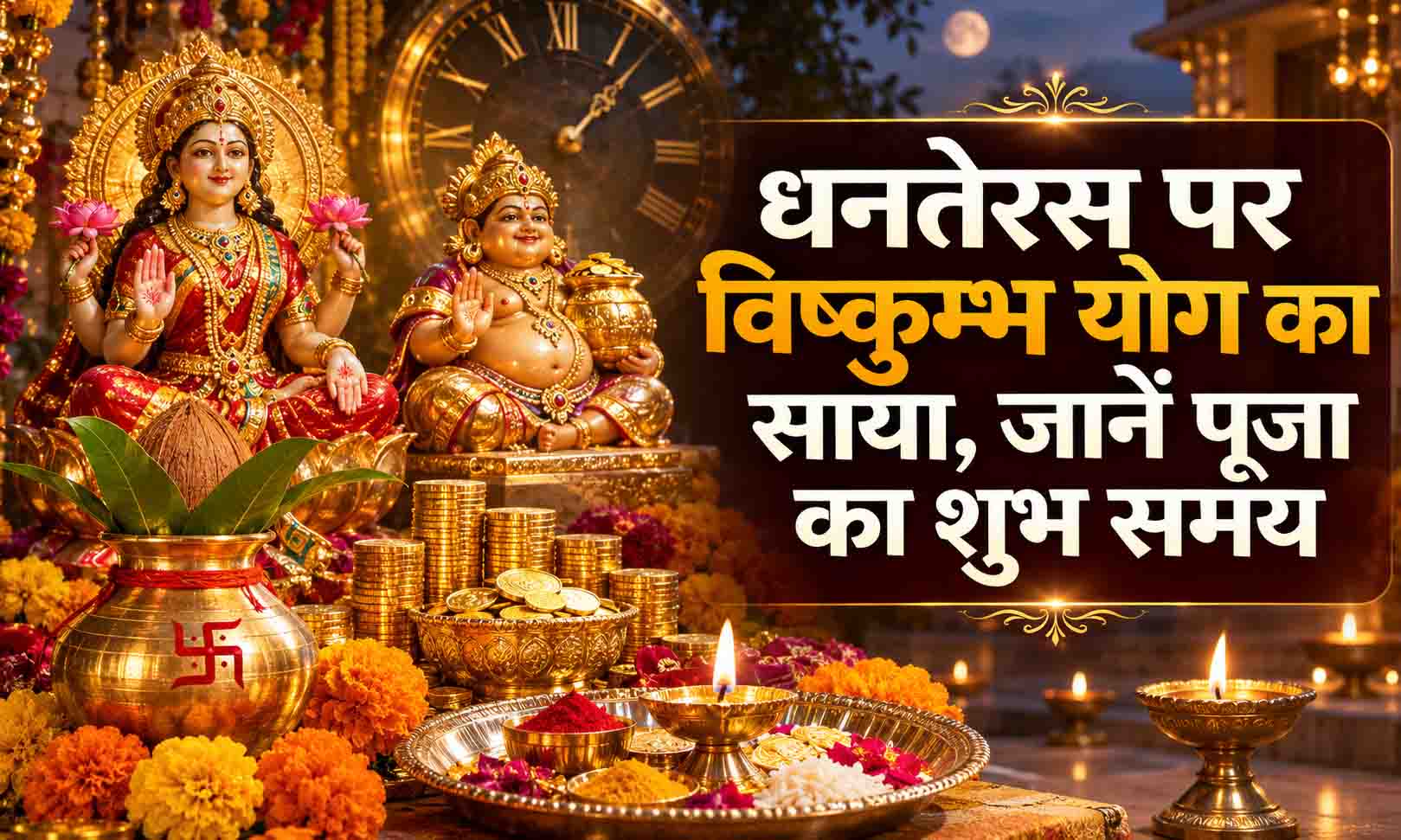
Religion: The auspicious festival of Dhanteras is being celebrated across the country today, Friday, with great devotion and enthusiasm. Dhanteras marks the beginning of the five-day Diwali festival. It is customary to worship Lord Dhanvantari, Goddess Lakshmi, and Kubera, the deity of wealth, on this day. According to religious beliefs, performing rituals during the auspicious timing (muhurta) on Dhanteras brings happiness, prosperity, and positivity into the home. However, this year, Dhanteras coincides with ‘Vishkumbha Yoga’ and ‘Rahukaal’ (an inauspicious period). Given this, it is important for devotees to be aware of the correct timing for worship.
According to the ‘Panchang’ (Hindu calendar), Dhanteras is being celebrated this year on Friday, November 6, 2026. The ‘Trayodashi Tithi’ (thirteenth lunar day) of the Krishna Paksha in the month of Kartika begins around 10:30 AM on Friday and continues until approximately 10:47 AM on Saturday, November 7. Since the Trayodashi Tithi will be present during the ‘Pradosh Kaal’ (the period around sunset) on Friday evening, the primary rituals for Dhanteras will be performed today.
In Delhi, the most auspicious time for the worship of Goddess Lakshmi and Lord Kubera on Dhanteras is from 6:02 PM to 7:57 PM. This provides devotees with an auspicious window of approximately 1 hour and 55 minutes for their prayers. Performing rituals for Goddess Lakshmi and Lord Kubera during this period is considered traditionally auspicious.
It should be noted that the auspicious timing may vary by a few minutes depending on the city. For instance, in Raipur, the capital of Chhattisgarh, the auspicious time for Dhanteras worship will be from 5:57 PM to 7:56 PM, offering devotees a duration of 1 hour and 59 minutes. Therefore, it is advisable to determine the timing for worship based on the local ‘Panchang’ of your specific city.
The ‘Pradosh Kaal’ holds special significance on Dhanteras. In Hindu religious traditions, the period immediately following sunset is referred to as ‘Pradosh Kaal’. It is customary to worship Lord Kubera and Goddess Lakshmi on Dhanteras. According to astrological tradition, the alignment of the ‘sthir’ (fixed) Taurus ascendant (Vrishabha Lagna) during the Pradosh Kaal (the twilight period) is considered especially auspicious.
It is believed that worship performed during a ‘sthir’ ascendant brings the blessings of stability and prosperity to the family. For this reason, the mere occurrence of the Trayodashi Tithi (the thirteenth lunar day) is not considered sufficient for Dhanteras worship; rather, the Pradosh Kaal and the Taurus ascendant are also taken into account.
This year, Vishkumbha Yoga will also be present on Dhanteras. According to the Panchang (almanac), this Yoga will last until approximately 4:10 AM on November 7th, after which Priti Yoga will begin. In traditional astrology, Vishkumbha Yoga is generally not considered favorable for initiating new auspicious tasks. However, since there is a religious tradition to perform the prescribed Dhanteras worship during the Pradosh Kaal, devotees need not forgo their worship due to the presence of Vishkumbha Yoga.
Additionally, Friday will also feature Rahu Kaal—a period generally avoided in astrological belief for starting new, auspicious endeavors. According to the Panchang for Delhi, Rahu Kaal will occur approximately between 10:42 AM and 12:04 PM. In Raipur, it is indicated to be from approximately 10:22 AM to 11:47 AM.
Importantly, the timing of Rahu Kaal does not coincide with the primary muhurta (auspicious time) for the main Dhanteras worship. Therefore, devotees performing the Lakshmi-Kubera puja in the evening will not face any significant issues due to Rahu Kaal.
The worship of Lord Dhanvantari also holds special significance on the day of Dhanteras. According to Puranic tradition, Lord Dhanvantari emerged during the Samudra Manthan (churning of the cosmic ocean) carrying a pot of amrita (nectar). For this reason, this day is also celebrated as Dhanvantari Jayanti. Lord Dhanvantari is revered as the deity of Ayurveda and good health. On this day, devotees pray for well-being and freedom from ailments. It is also customary to worship Goddess Lakshmi and Lord Kubera alongside Lord Dhanvantari on Dhanteras.
Purchasing items such as gold, silver, brass, copper utensils, and other useful goods is considered auspicious on the occasion of Dhanteras. Depending on their financial means, many families buy silver coins, utensils, or new household items. According to religious belief, bringing new items into the home on this day symbolizes prosperity.
For the Dhanteras ritual, the home and the designated place of worship are thoroughly cleaned. Idols or images of Goddess Lakshmi, Lord Ganesha, Lord Dhanvantari, and Lord Kubera are then placed in the worship area.
During the ritual, a lamp (diya) is lit, and offerings such as flowers, unbroken rice grains (akshat), vermilion (roli), sandalwood paste, incense, and sweets are presented. Many families also place the new items purchased that day in the worship area. Devotees pray to Goddess Lakshmi for happiness and prosperity, to Lord Kubera for financial stability, and to Lord Dhanvantari for excellent health.
Dhanteras also involves a special tradition known as ‘Yam Deepdan’. According to religious belief, a lamp is lit outside the home, facing the south—the direction associated with Yama (the Lord of Death). This practice is believed to be a prayer for protecting the family from untimely death.
On this day, many households light lamps at their main entrance and create rangoli designs. Family members gather to perform worship, lighting a lamp filled with ghee or oil in their home shrine.
According to those well-versed in religious traditions, the true essence of Dhanteras extends beyond the mere acquisition of wealth. The festival also symbolizes health, prosperity, familial happiness, and a positive life. The worship of Lord Dhanvantari underscores the importance of health, while the veneration of Goddess Lakshmi and Lord Kubera reflects a desire for financial discipline and prosperity.
Shadow of Vishkumbh Yoga on Dhanteras, know the auspicious time of puja