
RJD’s victory has altered the political equations in Mithila, raising questions about the Muslim-Yadav vote bank.
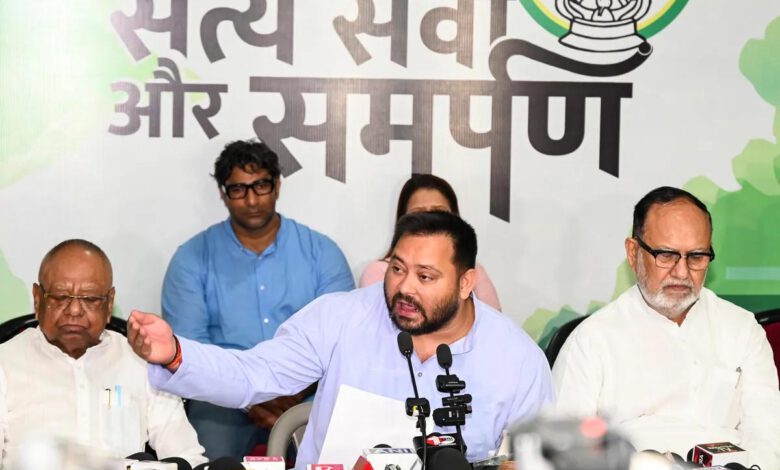
Darbhanga. The election results of Darbhanga graduate constituency of Bihar Legislative Council have sparked a new debate in the politics of the state. Rashtriya Janata Dal (RJD) supported candidate Anil Kumar Jha has registered a big victory by defeating the outgoing Legislative Councilor Sarvesh Kumar of Bharatiya Janata Party. This result is being considered as a sign of changing social and electoral equations in the politics of Mithila. The special thing is that a part of Brahmin voters, who are traditionally considered supporters of BJP, are said to be inclined towards the RJD candidate in this election. However, despite victory in the elections, a new political challenge appears to be facing RJD leader Tejashwi Yadav. Political analysts believe that if RJD has got the support of new social classes, on the other hand, there are signs of disintegration in its traditional Muslim-Yadav i.e. MY equation. In such a situation, this victory has become a shock for BJP and an opportunity for introspection for RJD.
Darbhanga Graduate constituency saw a very exciting contest between RJD supported Anil Kumar Jha and BJP’s Sarvesh Kumar. The election results came out after about 60 hours of counting. According to the final declared figures, Anil Kumar Jha got 25,406 votes, while BJP candidate Sarvesh Kumar got 21,396 votes. Thus, the RJD supported candidate won by a margin of 4,010 votes. During the counting of votes, the contest appeared to be turning several times. In the initial stages, BJP candidates were leading, but the counting of second preference votes changed the outcome of the election.
Most of the discussion in this election is about the attitude of Brahmin voters. Brahmin voters in Mithila region have been playing an important role in the politics of BJP and NDA for a long time. But in this election, there have been reports of support of a section of the Brahmin community in favor of RJD candidate Anil Kumar Jha. Political experts say that there could be many local and social reasons behind this change.
During the election campaign, RJD supporters made the new rules related to the University Grants Commission (UGC) and their possible effects a major issue. This issue was discussed especially among Brahmin voters. It is being told that there was resentment among some sections regarding the proposals and rules related to UGC, which benefited the RJD candidate. However, independent data is not available as to how many voters of each caste voted for which candidate. Therefore, the findings regarding the support of Brahmin voters are being seen only as a political assessment.
The possible support of Brahmin voters is being considered important for RJD. The party’s politics has long centered around the issues of backward classes, the Muslim community and social justice. If RJD succeeds in increasing its acceptance among new social classes, it may benefit from it in future elections. But the Darbhanga result also indicates that it will be important for the party to keep its old supporters united while adding new voters.
RJD’s biggest concern is said to be its traditional Muslim-Yadav equation. The votes received by other candidates in this election have further intensified this debate. Mohammad Imtiaz Noorani received 12,823 votes, while independent candidate Dilip Kumar received 7,143 votes. Based on the votes received by both the candidates, possible voting trends of different social classes are being discussed in political circles. However, it would not be appropriate to decide the voters’ choice only on the basis of caste or religious identity of the candidate.
According to political analysts, the matter of concern for RJD is that if a part of Muslim and Yadav voters are getting attracted towards other options then the party may have to change its strategy in the upcoming elections. Since the era of RJD founder Lalu Prasad Yadav, the Muslim-Yadav equation has been considered the main political strength of the party. The support of these two communities has been important for the party even in adverse circumstances.
Tejashwi Yadav has been trying to increase the social reach of RJD for the last few years. He is working on a strategy to strengthen the party among youth, women, extremely backward classes and other social groups instead of limiting the party to only the traditional vote bank. In such a situation, the results of Darbhanga have brought both opportunities and challenges for them.
Congress candidate Rajnikant Pathak also got 4,514 votes in this election. Despite the political alliance between Congress and RJD, the presence of different candidates in the graduates constituency gave rise to talk of division of opposition votes. This also raises the question as to how much better electoral coordination will be needed between opposition parties in the future.
On the other hand, this result is being considered a serious political message for BJP. Darbhanga area is counted among the areas under the influence of the party. BJP state president Sanjay Saraogi also represents Darbhanga assembly constituency. Despite this, the party could not save the seat of its outgoing MLC in the graduate constituency. NDA also faced defeat in Darbhanga teacher election seat. These results have raised questions about BJP’s election strategy at the local level and its hold among educated voters.
Darbhanga graduate seat election was also in discussion due to preference based voting system. initial opinion