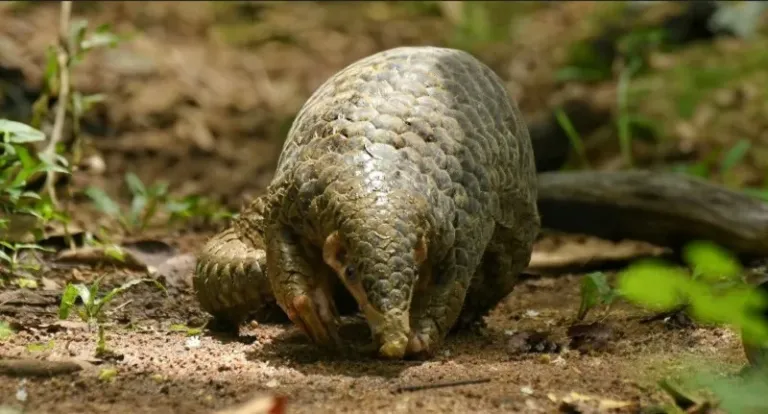
Nagaland: After achieving a major success in the conservation of migratory Amur falcons, Nagaland is once again in the headlines. It has offered community support for the protection of pangolins, considered the world’s most trafficked wild mammal. The Sangtam community of Nagaland has decided to protect pangolins on their traditional lands. The Sangtam—a large ethnic group in the northeastern Indian state of Nagaland—lives in the Kiphire and Tuensang districts bordering Myanmar. These border areas are rich in biodiversity and part of the Indo-Burma Biodiversity Hotspot, yet are vulnerable due to the porous Indo-Myanmar border, which is notorious for wildlife trafficking.
Successful conservation stories around the world are attributed to strong community support. In Nagaland, communities play a key role in managing forests and traditional governance systems, led by village councils and top tribal bodies. Previously, a village council in Wokha district pledged to protect the migratory Amur raptor in Doyang Reservoir – their largest habitat in the country. Now, the United Sangtam Likhum Pumji, the largest organization of the Sangtam community in Nagaland, has passed a resolution to conserve pangolins in collaboration with an ongoing project by the Wildlife Trust of India (WTI). Combating Pangolin Trafficking – A project supported by the Wildlife Conservation Network’s Pangolin Crisis Fund was launched in Manipur in 2023 to combat the illegal trafficking of two pangolin species endemic to the region: the Chinese pangolin and the Indian pangolin.
Prior to the Sangtam resolution, WTI worked closely with the Tangkhul Naga community living in the Ukhrul district of Manipur, bordering Myanmar. In August 2024, the Tangkhul Naga Awunga Long passed a resolution banning the hunting and trade of Chinese pangolins. This was followed by another resolution in June 2025 banning the hunting, poaching, and trade of species such as the hoolock gibbon and hornbill.
India’s northeastern states continue to be a source of wildlife products such as rhinoceros horn, ivory, tiger organs, as well as organs from various cat and civet species, and pangolin scales. Illegal wildlife trade has expanded to include the tokay gecko and monitor lizard, as well as all species of Asian nocturnal lizards. The trade in wildlife organs for use in traditional medicine, laboratories, and the fashion and cosmetic industries, and the smuggling of small animals and reptiles, have led to the extinction of countless species.
Pangolins in a Dire Plight
Despite a worldwide ban on commercial trade, pangolins remain the most trafficked mammals in the world. These slow-moving, nocturnal creatures are found throughout Asia and Africa. Of the eight existing pangolin species, four are found in Asia—the Chinese pangolin (Manis pentadactyla), the Philippine (Manis culionensis), the Sunda or Malayan (Manis javanica), and the endangered Indian pangolin (Manis crassicaudata). Both the Chinese and Indian pangolin species found in India are protected under Schedule I of the Wildlife (Protection) Act, 1972. The Chinese, Philippine, and Sunda pangolins are listed as Critically Endangered on the IUCN Red List, with populations declining by more than 80 percent due to hunting for their scales and meat and habitat loss. In 2016, the seizure of more than 18,000 tons of pangolin scales in 19 countries led to a ban on the trade of all eight pangolin species. The Convention on International Trade in Endangered Species (CITES) lists these eight species in Appendix I and prohibits their international commercial trade.
Often called “scaly anteaters,” pangolins are the only mammals in the world covered in scales. When threatened, they can roll into a nearly perfect ball, covering their face and underside. The animals use these tough, overlapping scales for protection. The pangolin trade is driven primarily by demand for their keratin scales, which are used in traditional medicine. Three or four animals must be killed for every kilogram of scales. Pangolins constitute approximately 20% of all illegally harvested traditional species, making them critically endangered in some parts of the world. Pangolin meat is consumed as bush meat in many parts of Africa and China and has become a luxury food in other parts of the world. This practice has been observed in the northeastern states bordering China and Burma. Cases have revealed organized smuggling networks targeting pangolins.
Last year, large-scale seizures of pangolin scales were reported from various parts of Assam. In one major consignment, over 220 kilograms of pangolin scales were seized at the Barpeta Road railway station in Assam on October 13, 2025. C Ramesh, Field Director of Manas National Park and Tiger Reserve (MNPTR), said that a team of Narcotics Control Bureau (NCB), Sashastra Seema Bal (SSB), Railway Protection Force (RPF) and forest staff of MNPTR was deployed.