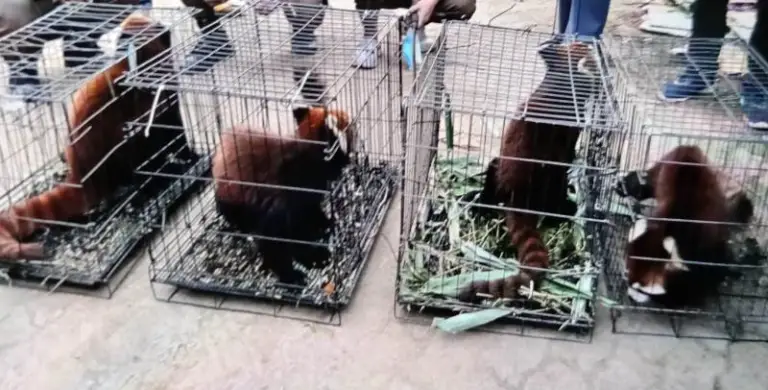
Guwahati: In a major wildlife seizure that has now raised more questions than answers, police on February 10 recovered four endangered red pandas from Panchgram in Algapur area of south Assam’s Hailakandi district.
The animals were allegedly seized from a vehicle. However, police have remained tight-lipped about how the operation was carried out and why the alleged smugglers managed to escape without arrest.
Forest department sources confirmed that the rescued animals were handed over to the department and later shifted to the Assam State Zoo in Guwahati. But shockingly, one of the four red pandas died within two days of arrival.
According to Assam State Zoo DFO Aswini Kumar, the animal succumbed to stress.
“The remaining three are in good condition and are taking food. They are being kept in an air-conditioned facility,” Kumar told Northeast Now.
The red panda (Ailurus fulgens), a small arboreal mammal native to the eastern Himalayas and southwestern China, is listed as Endangered on the IUCN Red List and faces a very high risk of extinction in the wild.
Smuggling Route Under Suspicion
Sources indicated that the animals were brought from Arunachal Pradesh near the Myanmar border and routed through Mizoram before entering Assam — a corridor long flagged by enforcement agencies as vulnerable to wildlife trafficking.
Despite the seriousness of the seizure, police have not clarified how the vehicle was intercepted, who owned it, or how the accused escaped. The silence has only deepened suspicion that a larger trafficking network may be involved.
Transfer to Vantara?
Sources claimed that the three surviving red pandas may eventually be shifted to Vantara, a private wildlife facility in Jamnagar, Gujarat, owned by Reliance Industries.
Two Vantara officials are reportedly camping in Guwahati awaiting clearance from the Central Zoo Authority (CZA) and a court order for transportation. Additional personnel are expected once approvals are secured.
However, DFO Aswini Kumar ruled out any immediate transfer. “Till now no such plan is there. They will be kept here for the time being. If transfer is required, we have to follow legal formalities including court procedures,” he said.
The possibility of relocation has triggered debate among conservationists over whether Guwahati’s climatic conditions are suitable for red pandas, which thrive in cooler Himalayan environments.
Experts argue that if relocation becomes necessary, the animals should ideally be sent to the Padmaja Naidu Himalayan Zoological Park in Darjeeling, widely regarded as India’s premier red panda conservation centre with an established breeding programme.
“Instead of sending them to a private facility, they should be transferred to a specialised conservation centre like Darjeeling Zoo,” a conservationist said.
Allegations of Assam as a Transit Hub
The development has revived earlier allegations that Assam may be functioning as a transit point in a larger wildlife trade network.
Chiriyakhana Suraksha Mancha (CSM), a non-profit monitoring wildlife transfers, had previously alleged that trafficked animals enter India through the porous Myanmar border, move via Mizoram, are temporarily housed at Assam State Zoo, and later relocated to Jamnagar under court orders.
“Animals were transferred at night. Even rescued animals were shifted although rules restrict transfer of animals not born in the zoo,” alleged Rajkumar Baishya, general secretary of CSM.
Assam police and forest officials frequently seize exotic wildlife, including rare and endangered species from Southeast Asia, Africa and Latin America. However, critics argue that several such animals are subsequently transferred to Vantara, raising questions about transparency and procedural scrutiny.
The 2022–23 annual report of Greens Zoological, Rescue and Rehabilitation Centre — Vantara’s former name — shows that in 2022 alone, 64 animals, including two one-horned rhinos, were received from the Assam State Zoo.
With one red panda already dead and the remaining three at the centre of a transfer controversy, the episode has intensified demands for transparency, accountability and strict adherence to wildlife protection norms.