
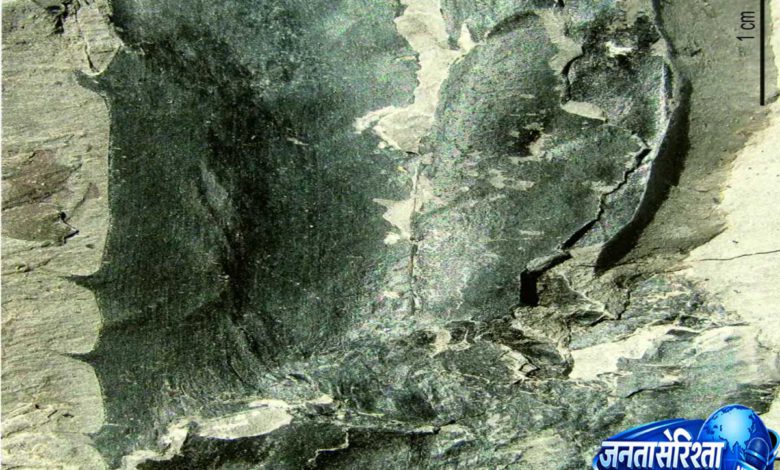
Guwahati: Fossilised leaves unearthed from Assam’s Makum Coalfield have revealed that the kewra (kevda) plant—best known for its fragrant essence used in sweets, perfumes, traditional medicine and temple rituals—has survived on the Indian subcontinent for at least 24 million years, making it far older than human civilisation and even predating the rise of the Himalayas.
The discovery, published in the international journal Geobios, was made by scientists Harshita Bhatia and Gaurav Srivastava of the Birbal Sahni Institute of Palaeosciences (BSIP), Lucknow, an autonomous institute under the Department of Science and Technology (DST).
The researchers analysed four exceptionally well-preserved fossil leaves recovered from the Tikak Parbat Formation in the Makum Coalfield of Tinsukia district. Detailed morphological and microscopic studies showed that the fossils belong to the Pandanaceae, or screw-pine family, to which the modern kewra (Pandanus) belongs.
The fossil leaves display the same distinctive features seen in living kewra plants today—long sword-shaped leaves with parallel veins, an M-shaped cross-section and sharp marginal prickles—confirming that the lineage has remained remarkably unchanged over millions of years.
Scientists say the discovery fills a crucial gap in the evolutionary history of the family. While older fossils of the screw-pine family dating back 85–66 million years have been found in Europe and North America, and younger fossils are known from tropical Asia and Australia, the Assam fossils provide the missing link between these records.
The findings also suggest that the Indian subcontinent served as an important refuge for ancient tropical plant lineages during a period of major global climate change.
Today, Pandanus is largely confined to tropical and subtropical regions across South and Southeast Asia, the Pacific and parts of Africa.
However, fossil evidence indicates that its ancestors once had a much wider distribution across the Northern Hemisphere. As the Earth’s climate cooled around 34 million years ago, the plants disappeared from many regions but survived in tropical areas such as India.
“The Makum fossils suggest Paleogene persistence and ecological continuity of Pandanaceae across the paleotropics,” the researchers noted, adding that the discovery coincides with the evolutionary diversification of modern Pandanus species during the late Eocene-Oligocene.
The study also paints a vivid picture of Assam’s landscape around 24 million years ago. Geological and palaeoclimatic evidence indicates that the region was covered by warm, humid lowland forests, freshwater swamps and riverine ecosystems, closely resembling habitats where screw-pines continue to thrive today.
Scientists believe the discovery strengthens the Makum Coalfield’s reputation as one of India’s richest fossil sites. Over the years, the area has yielded fossil evidence of palms, mangroves, rainforest trees and other ancient tropical plants, helping researchers reconstruct the evolution of Northeast India’s forests and climate.
Highlighting the broader significance of the discovery, lead author Harshita Bhatia said the fossil links a familiar part of everyday Indian life with Earth’s deep past.
“Every time we use kewra essence or encounter the plant in traditional and religious practices, we are witnessing the legacy of a lineage that has survived in India for at least 24 million years. This study demonstrates how fossils connect everyday life with Earth’s deep history, linking India’s cultural heritage with its natural history. It also underscores the exceptional importance of Northeast India as a natural archive of ancient life, where the rich fossil record continues to reveal the evolution of tropical forests, biodiversity, and past climates, strengthening India’s contribution to global palaeontological research,” she said.
Beyond its scientific significance, the study highlights the extraordinary evolutionary journey of a plant that remains deeply woven into Indian culture. Kewra flowers are widely used to produce aromatic kewra water and essence for sweets and biryanis, while different parts of the plant have long been valued in traditional medicine and religious ceremonies.
The researchers said the findings not only improve understanding of tropical plant evolution but also underscore India’s role in preserving ancient biodiversity through periods of dramatic climatic change.