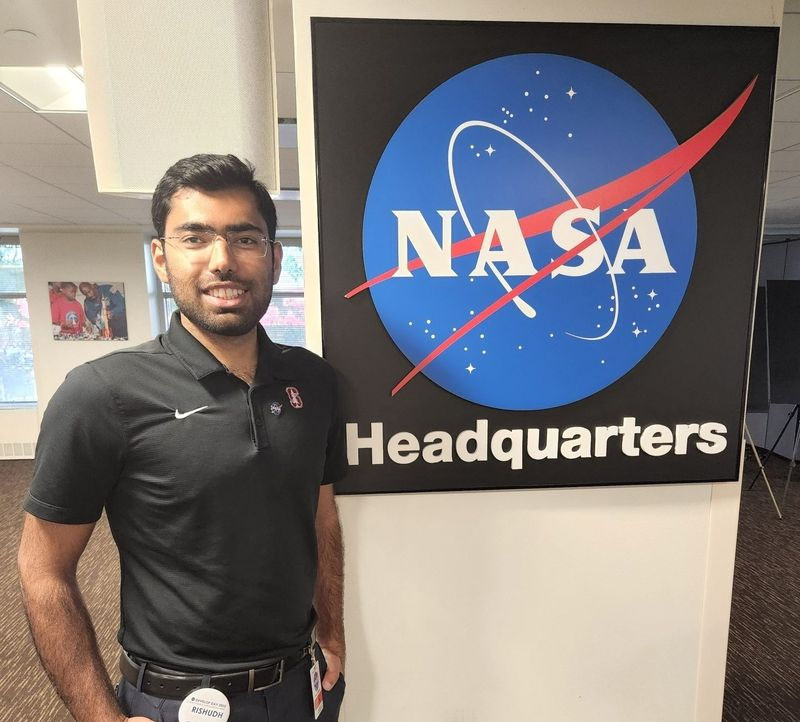
Nahan/Paonta. Hailing from the hills of the Sirmaur district in Himachal Pradesh, a young researcher is carving a niche for himself at a prestigious global university. Rishudh Thakur, a native of Khodri Majri village near Paonta Sahib, is pursuing a PhD in Geophysics at Stanford University in the United States. His research journey is not merely about achieving scientific milestones; it is also about understanding the fragile Himalayan environment and contributing to its conservation through modern technology and scientific inquiry.
Rishudh’s research focuses primarily on understanding climate change and strengthening biodiversity conservation using satellite data. He believes that relying solely on traditional methods is insufficient to protect sensitive ecosystems like the Himalayas. The use of modern scientific techniques is essential to comprehend the impacts of a changing climate, rapidly evolving landscapes, and the pressures facing biodiversity.
Understanding the Environment through Satellite Data
Today, satellite technology has become a vital tool for understanding changes occurring across different parts of the Earth. By analyzing satellite data alongside ground-level conditions, scientists can monitor shifts in climate, vegetation, landforms, and the environment. Rishudh Thakur is leveraging this technology as a cornerstone of his research to address environmental questions concerning the Himalayan region.
His research aims to understand how climate change affects natural systems and biodiversity. Changes in temperature, rainfall, snowfall, glaciers, and vegetation in the Himalayas do not remain confined to the mountainous regions; they can also impact water resources and the ecology of the plains.
An Emotional Bond with the Himalayas
Despite rising from a small village in Sirmaur to a prestigious university in the US, Rishudh remains deeply connected to his roots. His childhood spent in the Himalayan foothills and the natural surroundings he grew up amidst fostered a strong interest in the environment and science. For him, the Himalayas are not merely a geographical region but a vital part of natural and cultural heritage. This is why the long-term goal of his scientific journey is linked to the conservation of the Himalayas. He intends to return to India in the future and contribute to safeguarding the Himalayan ecosystem through scientific research and innovation.
The Goal of Linking Scientific Research with Conservation
Rishudh believes that finding a sustainable solution to any environmental issue requires understanding the underlying scientific causes. Conducting studies based on scientific data regarding topics such as climate change and shifts in biodiversity can make policymaking and conservation plans far more effective.
The Himalayan region boasts immense biodiversity, home to numerous rare plant and animal species. However, this sensitive region faces multiple challenges due to climate change, human activities, increasing construction, and mounting pressure on natural resources. In this context, accurate scientific data can play a crucial role in formulating conservation strategies.
Research Experience at Stanford
Studying and conducting research in geophysics at Stanford University has provided Rishudh with access to state-of-the-art scientific resources and an international research environment. Here, he is working to understand complex questions related to the Earth and the environment through a modern scientific lens.
The field of geophysics involves the scientific study of the Earth’s structure, natural processes, and surface changes. Satellite imagery and other remote sensing technologies make it possible to study changes across vast geographical areas. These technologies are particularly useful for studying inaccessible regions like the Himalayas.
From a Village to the Global Research Stage
Rishudh Thakur’s story is a journey that spans from a rural area in Sirmaur to the global scientific stage. His path—rising from a village like Khodri Majri to Stanford—serves as an inspiration for the youth of his region. His achievement conveys the message that young people from rural and mountainous areas can carve out a place for themselves in the international arena of science and research.
His research holds the potential to bridge the gap between local experience and global science. Having been born and raised in the Himalayas, he possesses firsthand knowledge of the region’s natural conditions and challenges. Meanwhile, conducting research at an international institution like Stanford is providing him with the opportunity to work with modern scientific resources and the global research community.
Plans to Return to India and Work for the Himalayas
Rishudh Thakur’s long-term goal is to return to India after completing his PhD and contribute to the conservation of the Himalayas through scientific research and innovation. He focuses on developing scientific capabilities that can be utilized to understand India’s environmental challenges and devise solutions for them.
He believes that significant change can be brought about in India by aligning scientific research with local needs. Issues related to climate change, water resources, biodiversity, and natural disasters are becoming increasingly critical for the Himalayan states. In this context, scientific research and modern technology are set to become vital components of future conservation strategies.