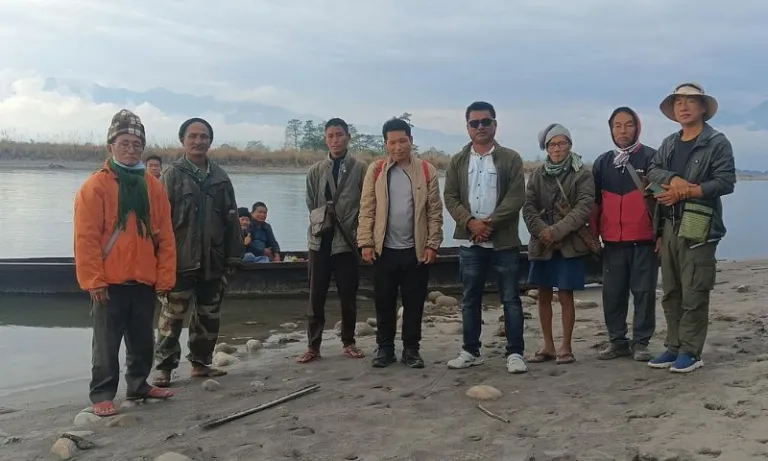
Pasighat: Water Resources Department (WRD) officials, along with village burah and public leaders from Namsing village in Namsing circle of Mebo subdivision in Arunachal Pradesh’s East Siang district, on Monday visited various locations along the Siang River where the river has shifted from its original course to the left bank, causing extensive erosion and flood damage in the Mebo subdivision.
The WRD team was led by Superintending Engineer Er Tanu Tasing, Executive Engineer (Pasighat Division) Er Onit Panyang, Assistant Engineer (Mebo) Er Alat Megu, and Junior Engineer Er Rasiya Tayeng. The group of public members from Namsing was led by former Monggu Banggo-II ZPM Gumin Tayeng, village burah Bohoto Parme, village secretary Banggoi Pertin, and others.
On the instructions of Mebo MLA Oken Tayeng, a ground survey was conducted of various courses of the Siang River on the left bank north of Namsing and Jopong, within the jurisdiction of the D. Ering Memorial Wildlife Sanctuary. The survey was intended to initiate a crash program of flood control works during the winter season to mitigate the impact of flooding on the left bank of the Siang River in Namsing, Gadum, Mer, Seram, and Borguli villages during the monsoon.
Village Burah Bohonto Parme and former ZPM Gumin Tayeng stated that the river needs to be diverted to a large area where it has deviated from its original right bank course to the left bank between Borguli and the Sibiyamukh Wildlife Range, northwest of Namsing village, and at two or three locations northwest of Jopong opposite Borguli and Seram villages to mitigate flooding in the left bank villages.
The villagers also identified specific weak spots where the river’s flow turns to the left bank and showed them to WRD engineers, who will prepare a master plan and detailed engineering designs for the river diversion work.
WRD Superintending Engineer Tanu Tasing and Executive Engineer Onit Panyang said that Mebo MLA Oken Tayeng will initiate flood control work and arrange funding, while the department will do its best to ensure the project remains effective and efficient, and that most of the river’s water is returned to its original course.
Meanwhile, Mebo MLA Oken Tayeng said that if the government does not have the necessary funding, they will voluntarily attempt to divert the Siang River at several locations through donations and crowdfunding.
“We can’t wait for government funding any longer, as the annual floods of the Siang River are destroying agricultural land, roads, power infrastructure, administrative buildings, and village homes every year,” Tayeng said. Seeing these losses and hearing the complaints of my people, I often feel helpless due to lack of funds. He said he would seek support from fellow MLAs, ministers, the deputy chief minister, the chief minister, and other well-wishers in the state through crowdfunding and voluntary donations to implement flood control crash programs in selected areas.
For flood control work, villagers will voluntarily build boulder dams, laborers will use JCBs and Poclains to dig and clear river channels, and organizers will use the funds collected to purchase materials, rent machinery and boats, and purchase galvanized steel wire and other necessary supplies.
“I am confident that like-minded people, including my fellow MLAs from across the state, will support this initiative for the flood-affected areas of the 39th Mebo Assembly Constituency,” Tayeng said.
The Siang River previously flowed on the right bank from Komlighat–Maktumghat–Pillumukh–Kemimukh–Oiramghat, but after the infamous 2000 Chinese floods, the river gradually shifted its course to the left bank over the years. The 2000 floods opened new channels towards the Old Sibiya River (locally known as Ga:ne), which splits off north of Sigar village.
Flood damage on the left bank worsened in 2020 after the closure of a major ₹350 million flood control project northwest of Sigar village.
Critics of flood-affected villages in Lower Mebo have accused the then-leadership of dividing a ₹35 crore flood control project into ₹30 crore for flood protection and ₹5 crore for rebuilding school infrastructure. They argue that officials should have used the entire amount solely for flood control by building boulder dams in erosion-prone areas.
In August 2019, the Ministry of Development of North Eastern Region (DoNER) approved a ₹35 crore project to carry out anti-erosion and flood protection works in 10 villages under the Mebo subdivision, aimed at protecting villages and thousands of acres of agricultural land from the Siang River’s erosion.
WRD officials said that if the proposed community-funded river diversion efforts are successful, the people of Lower Mebo could be relieved of the annual flood-related erosion until the central government approves a larger flood control project.