
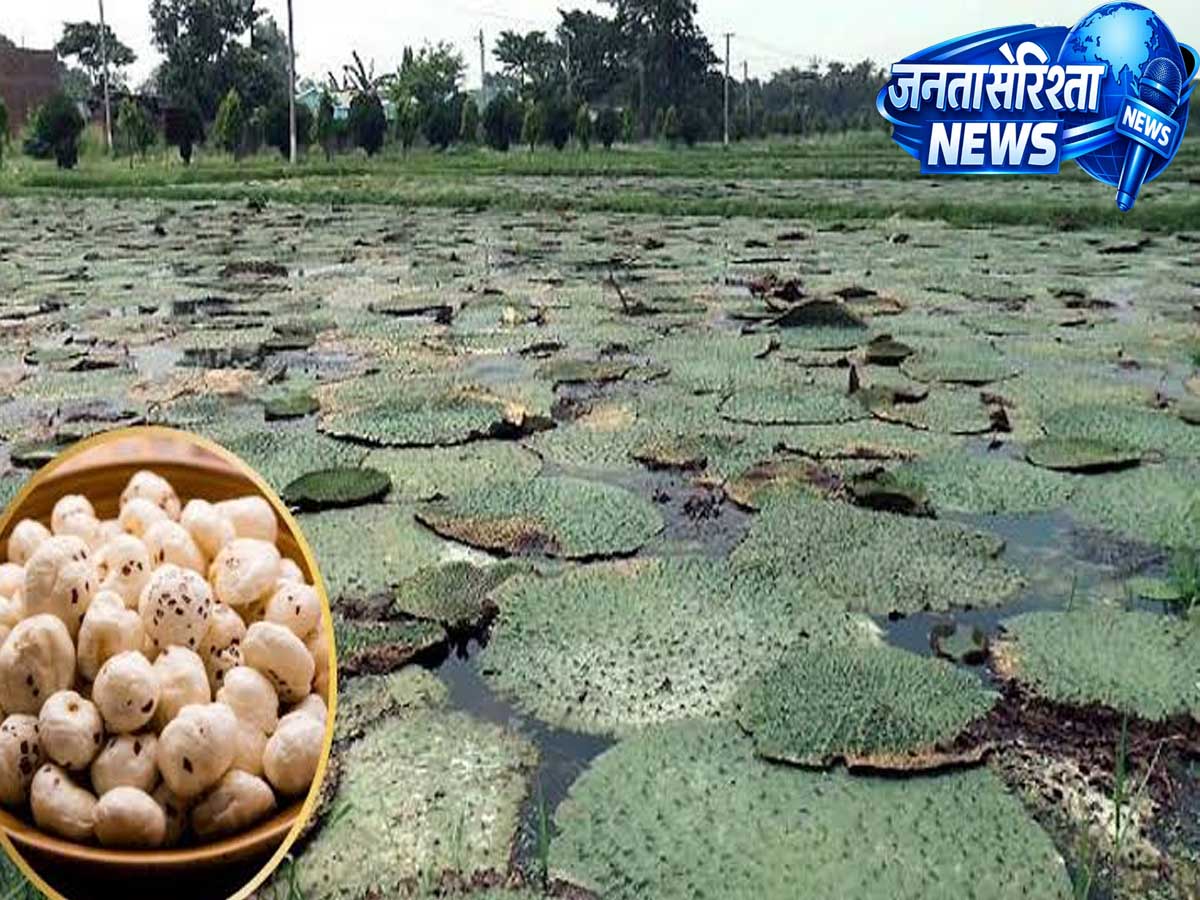
BIHAR: A new ray of hope has emerged for farmers in the Bhojpur district regarding agriculture. Preparations are underway to begin the cultivation of Makhana (Fox Nut)—a crop traditionally associated with the Mithila region—in Bhojpur as well. Farmers will now be able to earn extra income by producing Makhana on land in the district that suffers from waterlogging issues.
Makhana is known as Bihar’s “White Gold” because the demand for it is steadily rising, not just within the country but also abroad. Rich in nutrients and fetching a good market price, Makhana is becoming a profitable crop for farmers. Initiating its cultivation in Bhojpur will also allow for the better utilization of otherwise unproductive, waterlogged land.
Initiative to Cultivate Makhana in Bhojpur Following the Mithila Model
Traditionally, Makhana cultivation has been carried out on a large scale in Bihar’s Mithila region—specifically in Darbhanga, Madhubani, Supaul, Saharsa, and surrounding areas. Farmers there have long been producing Makhana in local ponds and water bodies.
Now, through initiatives by the Agriculture Department and experts, the potential for its production is being explored in districts like Bhojpur. This will provide farmers with a new alternative crop.
Waterlogged Land to Become a Source of Income
In many parts of Bhojpur, water accumulates in fields during the monsoon season, disrupting the cultivation of standard crops. Such land often becomes a problem for farmers.
Since Makhana cultivation requires water, waterlogged fields and ponds can be utilized for its production. This will enable farmers to generate income from land that was previously considered less useful.
What is Makhana and Why is Demand Rising?
Makhana is a food product derived from an aquatic plant. It is considered highly beneficial for health, containing protein, calcium, fiber, and various other nutrients.
Key reasons for the rising demand for Makhana:
Growing health awareness.
Use during religious fasts and rituals.
Popularity as an alternative to dry fruits. A growing market, both domestically and internationally.
For this reason, it is considered a profitable crop for farmers.
New employment and income opportunities for farmers.
Makhana production is not limited to cultivation alone; it involves several stages, such as seed preparation, harvesting, processing, packaging, and distribution to the market.
If production increases in Bhojpur, new local employment opportunities could also be created.
Training required for Makhana cultivation.
According to experts, Makhana cultivation differs from that of conventional crops. It requires farmers to have knowledge of specific techniques, seed selection, water management, and processing methods.
This form of cultivation can be made successful by providing training to farmers. The assistance of the Agriculture Department and specialized institutions can be enlisted for this purpose.
Cultivation can fetch a good market price.
The price of Makhana depends on its quality, size, and processing. High-quality Makhana enjoys strong market demand.
If farmers gain access to better market systems, storage, and processing facilities, they can earn a substantial income from it.
A crop linked to Bihar’s identity.
Makhana is not merely an agricultural product; it is also an integral part of Bihar’s cultural and economic identity. Farmers from the Mithila region have taken it to national and international markets through years of hard work and traditional knowledge.
Now, its introduction in Bhojpur could pave the way for the expansion of Makhana cultivation to other districts of Bihar as well.


