
Villagers join The Himalayan Cleanup
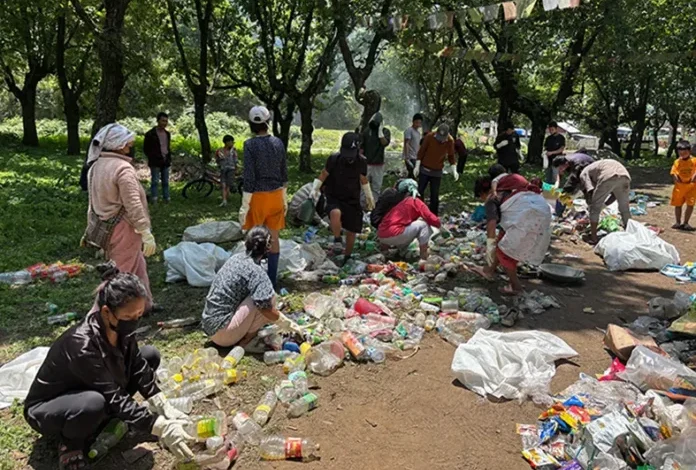
SANGTI VALLEY: More than 100 villagers from Khaso village in Sangti Valley in West Kameng district came together last Saturday to participate in the Himalayan Cleanup (THC) 2026, organised by the Azure Lotus Foundation (ALF).
The ALF, under its waste management vertical, the Northeast Waste Collective (NEWC), based in Sangti Valley, aims to draw attention to the growing plastic waste crisis in the Himalayan region and demand accountability from the companies producing it.
Participants in the drive included village leaders, SHG members, youths, children, and other community members.
The event began with a briefing by ALF director Ittisha Sarah, who explained the purpose and significance of The Himalayan Cleanup. She highlighted how even remote Himalayan villages such as Khaso are increasingly burdened by plastic waste due to changing consumption patterns and the rise in tourism.
“The Himalayan Cleanup is not just about cleaning up waste. It is about understanding where this waste is coming from, documenting it, and collectively raising our voice to demand accountability from the companies that produce it,” she said.
Villagers were divided into several groups, each led by a group leader, and fanned out across the village to collect littered waste from colonies, pathways, public spaces, and riverbanks. The riverbanks received particular attention, as plastic waste carried by wind and water often accumulates in these sensitive ecosystems.
Once the waste was collected, the participants carried out what is considered the most important component of The Himalayan Cleanup – the brand audit. The waste was first segregated according to material type,and then sorted brand-wise. Every piece of branded plastic waste was counted by the villagers to identify the companies whose packaging was most frequently found in the environment.
The findings from Khaso village revealed PepsiCo as the highest polluting brand, primarily through products such as Mountain Dew, followed by Nestlé through Maggi packaging, and The Coca-Cola Company through Coca-Cola (Coke).
Among multi-layered plastic (MLP) waste, other significant contributors included ITC Limited through Bingo!, as well as PepsiCo through Kurkure and Lay’s. In the PET bottle category, commonly recorded products included energy drinks like Sting, Power, and Bisleri packaged water, while in the tetra pack category, Amul emerged as the most frequently recorded brand through its Amul Taaza milk cartons.
Speaking after the audit, Sarah emphasised the need for producer responsibility.
“If companies can make their products reach a remote Himalayan village like Khaso, they should also be held accountable for taking back the resulting waste and ensuring it is recycled. Communities should not be left to bear the burden of managing waste created by products they did not design or package,” she said.
The data collected during the brand audit will contribute to the larger Himalayan Cleanup dataset, which is compiled across multiple Himalayan states and used to advocate stronger implementation of extended producer responsibility (EPR) and corporate accountability.
The organisers stressed also that The Himalayan Cleanup serves as an opportunity for communities to reflect on their consumption habits and reduce dependence on single-use plastic packaged products wherever possible.
As the event concluded, the villagers expressed their commitment to keeping Khaso clean and protecting the fragile Himalayan environment for future generations.