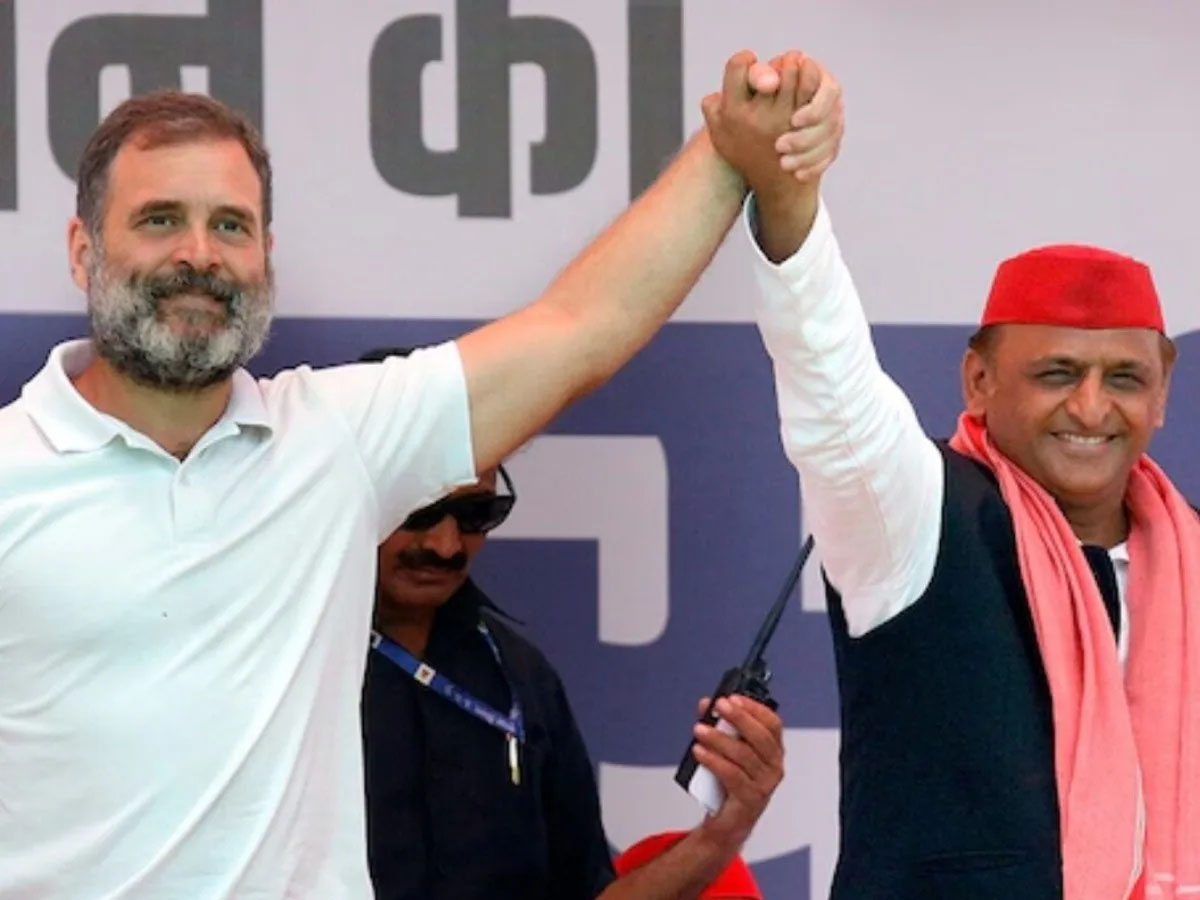
Uttar Pradesh: Although there is still time before the assembly elections, political parties have ramped up their preparations. Indications suggest that talks regarding seat-sharing between the Samajwadi Party and the Congress—key constituents of the opposition alliance—are set to begin soon. Congress strategists believe that the sooner the seat-sharing picture becomes clear, the more effectively both parties can prepare for the election at the grassroots level. It would also facilitate better coordination among party workers and streamline preparations regarding potential candidates.
According to sources, both the Congress and the Samajwadi Party have conducted independent surveys covering all 403 assembly seats in Uttar Pradesh. Through these surveys, both parties have sought to assess seat-specific political equations, potential candidates, organizational strength, and electoral prospects. It is believed that the findings of these surveys could play a crucial role in the seat-sharing negotiations.
Congress strategists hold the view that, within the alliance, the party should secure a respectable number of seats commensurate with its political standing. Consequently, the Congress is likely to reiterate its demand for a “respectable share” of seats during talks with the SP. The prevailing sentiment within the party is that seat allocation should be determined by considering past electoral circumstances and current organizational strength, ensuring that both parties have the opportunity to contest strongly in their respective strongholds.
For the Congress, seat-sharing is not merely a matter of numbers; it is also linked to mobilizing the organization at the grassroots level. Party strategists believe that if it becomes clear well in advance which party will contest which seats, workers will have ample time to prepare accordingly. This could also help foster coordination between the local leaders and cadres of both alliance partners.
Meanwhile, the Samajwadi Party is also conducting its own political assessment of all the state’s assembly seats. Surveys commissioned by the party have examined local political dynamics, potential candidates, and the state of the organization in each constituency. In this context, during seat-sharing negotiations, both parties may present arguments for seats where they hold a strong claim based on their respective internal surveys.
Uttar Pradesh has a total of 403 assembly seats, and alliances have played a crucial role in the state’s politics. Drawing from the experience of previous assembly elections, efforts are being made to reach a timely consensus on seat-sharing among opposition parties. Within the Congress, there is a view that a delay in seat-sharing could create uncertainty among prospective candidates and local party workers. Therefore, the party wants the dialogue to begin early and a clear roadmap regarding the seats to be prepared.
The impact of an alliance between the Congress and the Samajwadi Party will not be limited to seat allocation alone; both parties will also face the challenge of mobilizing their respective organizational machinery for the election campaign. In constituencies where one party does not contest, it will be necessary to mobilize the local organization and workers in support of the other party’s candidate. Consequently, an early decision on seat-sharing is considered essential.
According to sources, the Congress strategy involves staking a claim to seats where it is strong, based on its internal surveys and ground-level feedback. The party leadership believes that merely increasing the number of seats is not enough; it is crucial to secure seats where the Congress organization and its candidate have a genuine chance of winning.
On the other hand, seat-sharing is also strategically important for the Samajwadi Party. The party would want to retain its hold over its strongholds and constituencies where social equations favor it. Given this, reaching a consensus on several seats during negotiations could take time. However, the priority for both parties is likely to be formulating a joint electoral strategy against the BJP while maintaining the alliance.
Congress strategists believe that while seat-sharing is vital for the alliance’s success, coordination between the two parties at the grassroots level is equally important. If differences persist among party workers at the local level after the candidates are announced, the alliance could suffer. Therefore, the party seeks an early decision on seat allocation, followed by the joint execution of organizational activities. As of now, neither party has formally announced a timeline or formula for seat-sharing negotiations. However, the fact that both sides have conducted surveys across all 403 assembly constituencies makes it clear that behind-the-scenes electoral preparations are already underway. Should talks regarding seat allocation commence between the SP and the Congress, the parties’ respective surveys, local political dynamics, and winnability prospects are likely to serve as the key determinants.
In this context, the next major test for the SP-Congress alliance ahead of the Uttar Pradesh assembly elections will be the seat-sharing arrangement. While the Congress is preparing to press for a respectable share of seats, the SP will aim to maintain a firm grip on its strongholds. It remains to be seen how quickly the two parties can reach a consensus on seat allocation through negotiations and in what form they will take the alliance into the electoral arena.