Kolkata : As the Indo-Pacific becomes a key region for global cooperation and competition, India’s Northeast is increasingly seen as a strategic bridge to regional and global markets.
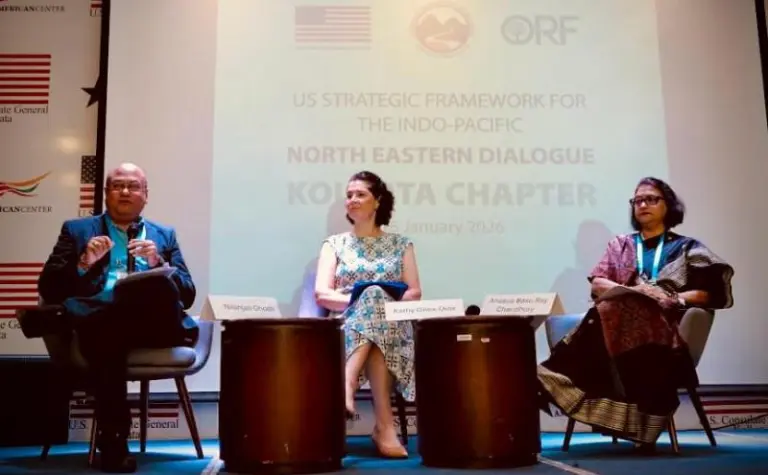
Reflecting this growing importance, the U.S. Consulate General, Kolkata, in partnership with the Observer Research Foundation (ORF), hosted the “U.S. Strategic Framework for the Indo-Pacific: Northeastern Dialogue – Kolkata Chapter” at the American Center, Kolkata, on Thursday.
The dialogue highlighted the deepening U.S.-India partnership, which aims to advance the Quad vision of a free, open, and prosperous Indo-Pacific.
The discussion, attended by approximately 30 participants from various states in the Northeastern region, served as a national-level pre-dissemination dialogue ahead of a larger policy engagement scheduled for New Delhi in March.
Discussions focused on how improved connectivity through ports, railways, inland waterways, roads, and digital corridors can better integrate Eastern and Northeastern India into global trade networks. Speakers emphasized that stronger connectivity will not only boost economic growth in the region but also help reduce dependence on weak or complex supply chains.
Addressing the gathering, U.S. Consul General Kathy Giles-Diaz said that Kolkata is a natural location for the conversation, given its historical role as India’s gateway to the Bay of Bengal and Southeast Asia.
She added that as India expands its engagement in the Indo-Pacific, the Eastern and Northeastern regions are once again becoming central to global trade, supply chains, and economic growth.
Giles-Diaz reiterated the United States’ commitment to a free and open Indo-Pacific, emphasizing that such a regional order ensures free trade, respect for sovereignty, secure movement of goods and data, and shared prosperity. He described the Quad – comprising India, the United States, Japan, and Australia – as a practical partnership that delivers real results in areas such as disaster response, infrastructure development, clean energy, supply-chain resilience, and critical technology.
Emphasizing the strength of the U.S.-India relationship, he said this partnership, anchored at the highest political level, will foster cooperation in trade, technology, and security.
He emphasized that improved infrastructure in eastern and northeastern India will not only facilitate the flow of goods but also connect the region to global markets, creating jobs, investment, and long-term economic strength.
The Consul General also emphasized the strategic importance of maritime security and highlighted the role of ports like Kolkata and Haldia in regional trade and stability.
He stated that secure sea lanes are essential for reliable energy supplies, stable exports, and uninterrupted commerce, and added that the U.S., through the Quad and other partnerships, is committed to maritime domain awareness, port security, disaster response, and combating illicit activities at sea.
Gilles-Diaz further stated that insights from discussions focused on the Northeast will directly inform national-level policy discussions in New Delhi, ensuring that U.S.-India cooperation remains grounded in the region’s economic realities.
The sessions were moderated by Nilanjan Ghosh, Vice President and Project Director for Development Studies at ORF, and Anasua Basu Ray Chaudhuri, Senior Fellow, Neighborhood Studies Initiative at ORF, served as Project In-Charge, along with their respective teams.
The opening session featured discussions by U.S. State Department officials Abigail Bard, Quad Team Coordinator, and Jeffrey Wang, Quad Team Lead and Political Officer, also delivered virtual presentations.
Their presentations provided insight into the United States’ strategic vision for the Indo-Pacific and emphasized the essential role of maritime security in ensuring regional economic stability.