
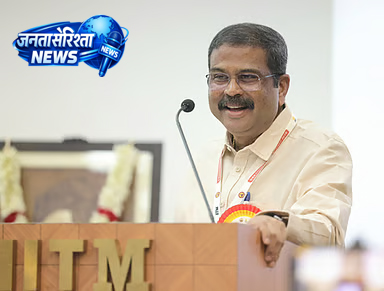
Tamil Nadu: Union Education Minister Dharmendra Pradhan on Saturday accused the ruling DMK government in Tamil Nadu of denying Tamil students the opportunity to learn foreign languages in the name of “imposing Hindi.” This statement was made in response to Chief Minister M.K. Stalin’s criticism of the CBSE’s three-language curriculum.
Some media reports suggested that the CBSE was preparing to implement a three-language program from the sixth grade. In response, Chief Minister M.K. Stalin stated in a post on his “X” page that the central government’s attempt to impose a language was a deliberate and worrying initiative.
In response, Union Minister Dharmendra Pradhan said that the Chief Minister’s argument of “imposition” was merely an attempt to hide political failures. Citing the National Education Policy (NEP) 2020, he said that this policy is a blueprint for language freedom and prioritizing the mother tongue. Its aim is to ensure that Tamil children excel in their mother tongue while also learning other languages to become globally competent.
Pradhan stated that the NEP 2020 promotes all languages equally and addresses the shortcomings of the current dual-language system, in accordance with constitutional principles. Efforts are underway to strengthen the education and training system at the district level, focus on holistic education, and implement the National Professional Standards for Teacher Training and Teachers (NPST) and the Teacher Mentoring Movement (MMM).
The Union Minister accused the DMK government of refusing to sign the MoU despite the Prime Minister’s promise to build schools in Tamil Nadu. Despite the Supreme Court’s order to establish Navodaya schools in Tamil Nadu, the DMK government has obstructed its implementation.
Dharmendra Pradhan stated that the central government is fully committed to funding educational projects and providing high-quality training to teachers. However, the DMK government’s political activities are hindering students’ academic progress.
Pradhan also clarified that by “imposing” Hindi, the state government is hindering children’s linguistic and academic prospects. He stated that by implementing the education policy in the right direction, Tamil Nadu’s children can become globally knowledgeable and competent citizens.
This controversy has highlighted differences between the state and central governments regarding education policy. The Union Minister’s statement indicated that the central government is actively working to improve education in Tamil Nadu and expand opportunities for students, while the state government’s policies remain a hindrance in this direction.


