
Supreme Court’s big decision on creamy layer, Centre’s petition rejected
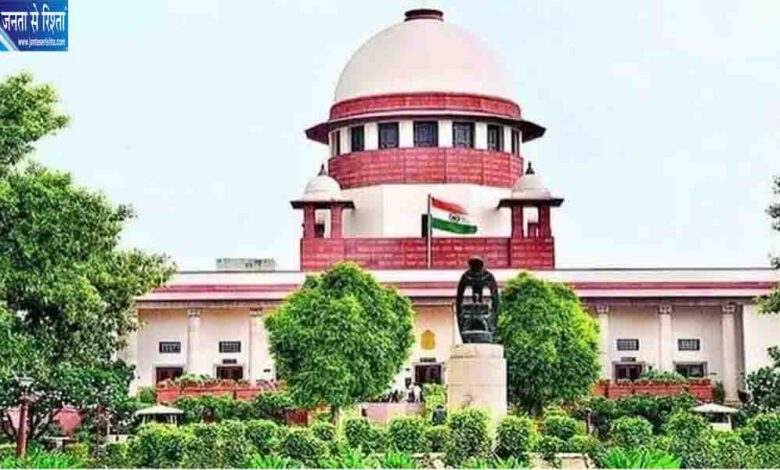
New Delhi. The Supreme Court delivered a significant verdict on Friday regarding the determination of the ‘creamy layer’ within the Other Backward Classes (OBC) reservation category. The apex court rejected the Central Government’s request for an additional two-year period to implement a ruling dated March 11, 2026. The Court reiterated that the ‘creamy layer’ status of an OBC candidate cannot be determined solely based on the salary income of their parents. Instead, established criteria—such as the parents’ official position, category of service, and social status—must also be taken into account.
This Supreme Court decision will particularly impact OBC candidates whose parents are employed in public sector undertakings (PSUs), banks, or private companies. Previously, many such candidates were classified under the ‘creamy layer’—based solely on their parents’ salary income—and were consequently denied the benefits of reservation. The Court clarified that the government cannot exclude a candidate from the ‘non-creamy layer’ category merely because their parents’ salary exceeds a specified income threshold; rather, the original rules governing reservations and service-related criteria must be adhered to.
The dispute stems from a 1993 Office Memorandum issued by the Central Government and a subsequent clarification issued in 2004. In 1993, various categories were established to identify the OBC ‘creamy layer,’ with particular emphasis placed on the parents’ official position and service status within government employment. Additionally, a separate test concerning income and assets was introduced, which included provisions to distinguish salary and agricultural income from other forms of income. However, a dispute arose following the 2004 clarification regarding how the salary income of employees in public sector undertakings and private institutions should be treated. The matter reached the courts when some OBC candidates, who had succeeded in the Civil Services Examination, were denied the benefits of reservation on the grounds that they fell under the ‘creamy layer’. The parents of these candidates were employed in public sector undertakings (PSUs), banks, and other institutions. The candidates argued that there could not be differential treatment between government employees and those working in the public or private sectors for the purpose of identifying the ‘creamy layer’. They contended that if the rank and service status are examined in the case of government employees, the same principle should be applied to employees in other sectors as well.
The Supreme Court delivered its verdict on this dispute on March 11, 2026. The Court stated that it is not appropriate to categorize a candidate as belonging to the ‘creamy layer’ based solely on an income threshold; the service category and the rank or position held by the employee are also significant factors. The apex court further held that a clarification issued in 2004 could not alter the provisions of the original Office Memorandum of 1993. It would not be legally permissible to modify the framework of the original policy based on an administrative clarification.
Subsequently, the Central Government sought a clarification from the Supreme Court regarding the implementation of the judgment. The government stated that time would be required to establish the equivalence between various positions in public sector undertakings and private institutions, and those in government service. The Centre requested a two-year period for this process. The government also argued that applying the judgment to past cases could lead to administrative difficulties concerning recruitment and appointments that had already been concluded.
During the hearing on Friday, the Supreme Court declined to grant the Central Government an additional two-year extension for the implementation of the judgment. However, the Court provided an important clarification: the judgment of March 11, 2026, would not apply retrospectively to appointments that had already been finalized. In this manner, the court clarified the distinction between past cases and ongoing recruitment processes. The court also made significant observations regarding candidates for the Civil Services Examination 2025. The Supreme Court noted that while the results for this examination were declared on March 6, 2026, the final allocation of services to the candidates has yet to be completed. Given this, the court clarified that the principles established in the March 11 judgment would apply to the service allocation of OBC candidates selected through the Civil Services Examination 2025. The court reasoned that since the service allocation process is still pending, there is no valid justification for delaying the application of the new legal principles.
The significance of this order is further underscored by the fact that candidates selected through the Union Public Service Commission’s Civil Services Examination are appointed to the Indian Administrative Service, Indian Police Service, Indian Foreign Service, and other central services. Changes in the ‘creamy layer’ status can impact both the reservation benefits and the service allocation of eligible candidates. According to experts, this Supreme Court decision is likely to bring greater clarity to the determination of ‘OBC non-creamy layer’ status and eligibility for reservations. However, this does not imply that the ‘OBC creamy layer’ framework has been abolished, nor does it mean that all forms of income have been excluded from the calculation.
The court’s primary conclusion is that the salary income of parents cannot serve as the sole criterion for determination. The ‘creamy layer’ status must be assessed in accordance with the specific positions, service status, and other applicable criteria defined under the relevant rules. It now falls upon the central government and the concerned departments to resolve pending cases in alignment with the court’s directives.