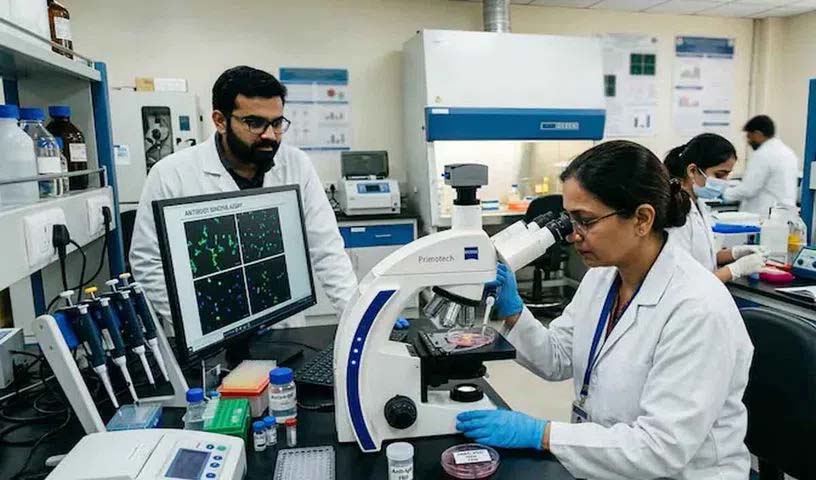
Dengue is one of the diseases spread by mosquitoes. Millions of people are affected by this disease every year. According to the World Health Organization, dengue cases have increased significantly in recent decades. Many people are suffering from this disease. In this context, scientists are continuing intensive research to develop better treatments and vaccines for dengue prevention. At such a time, researchers at the Indian Institute of Science Education and Research Mohali have found a new ray of hope in the prevention of dengue disease. Their study suggests that special antibodies produced in the body of camels, i.e. nanobodies, are capable of blocking the dengue virus. In the future, these nanobodies are likely to play a key role in the development of treatments and vaccines. Camel antibodies are structurally different from human antibodies. They are very small in size and have high stability. Due to this, they can also target parts of the virus that normal antibodies cannot reach. This research has once again proven that studying unusual systems in biology opens new avenues in the field of medicine.
The ability to block infection pathways.
Nanobodies derived from camels have been found to be effective against four main types of dengue virus. This has been a major challenge in the development of dengue vaccines, which is why this research has gained importance. Since there are four different types of dengue virus, immunity to one type does not work against another. This has made it difficult to develop a vaccine with comprehensive protection so far. However, camel nanobodies are expected to show promise in that they bind strongly to virus proteins and block infection pathways. Unlike normal antibodies, camels produce heavy-chain antibodies. The part of these that recognizes antigens is called a nanobody. These are considered very valuable in medical research due to their small size, high stability, and properties that work even under harsh conditions. Dengue disease is mainly spread by Aedes aegypti mosquitoes. It starts as a common fever and can lead to severe conditions such as dengue hemorrhagic fever and dengue shock syndrome. Approximately 390 million cases are reported worldwide each year, of which approximately 100 million cases are symptomatic.
Potential to play a key role in antiviral treatments.
Currently, dengue treatment is mainly based on symptom control. Efforts are made to save the patient by controlling problems such as fever, dehydration, and bleeding. Since vaccines cannot provide comprehensive protection against all types of viruses, research is ongoing to find new solutions. There are already examples of nanobodies that have been effective against other viruses as well. In particular, past research has shown that camel nanobodies have been useful in blocking the SARS-CoV-2 virus, the cause of COVID-19. They bind tightly to virus proteins and prevent the virus from infecting human cells. Nanobodies are likely to play a key role in future antiviral treatments due to their properties such as being easy to manufacture in labs and being customizable as needed. Scientists believe that they can also be used to inhibit the growth and spread of the virus in the case of dengue.
The possibility of creating effective vaccines.
This research is also likely to have an impact on the development of dengue vaccines in the future. Experts say that it is possible to design more effective vaccines based on the virus targets identified by the nanobodies. However, experts caution that this research is still in its early stages. Before being used on humans, stages such as lab tests, animal experiments, and clinical trials must be completed. This process is likely to take several years. Research on unusual biological systems is increasing in the field of modern immunology. From snake venom to llama antibodies, special molecules in nature are contributing to the development of new drugs. Camel nanobodies are also considered another key step in this direction. Scientists believe that they have the potential to become a key weapon in the fight against dengue and other viral diseases in the future.