
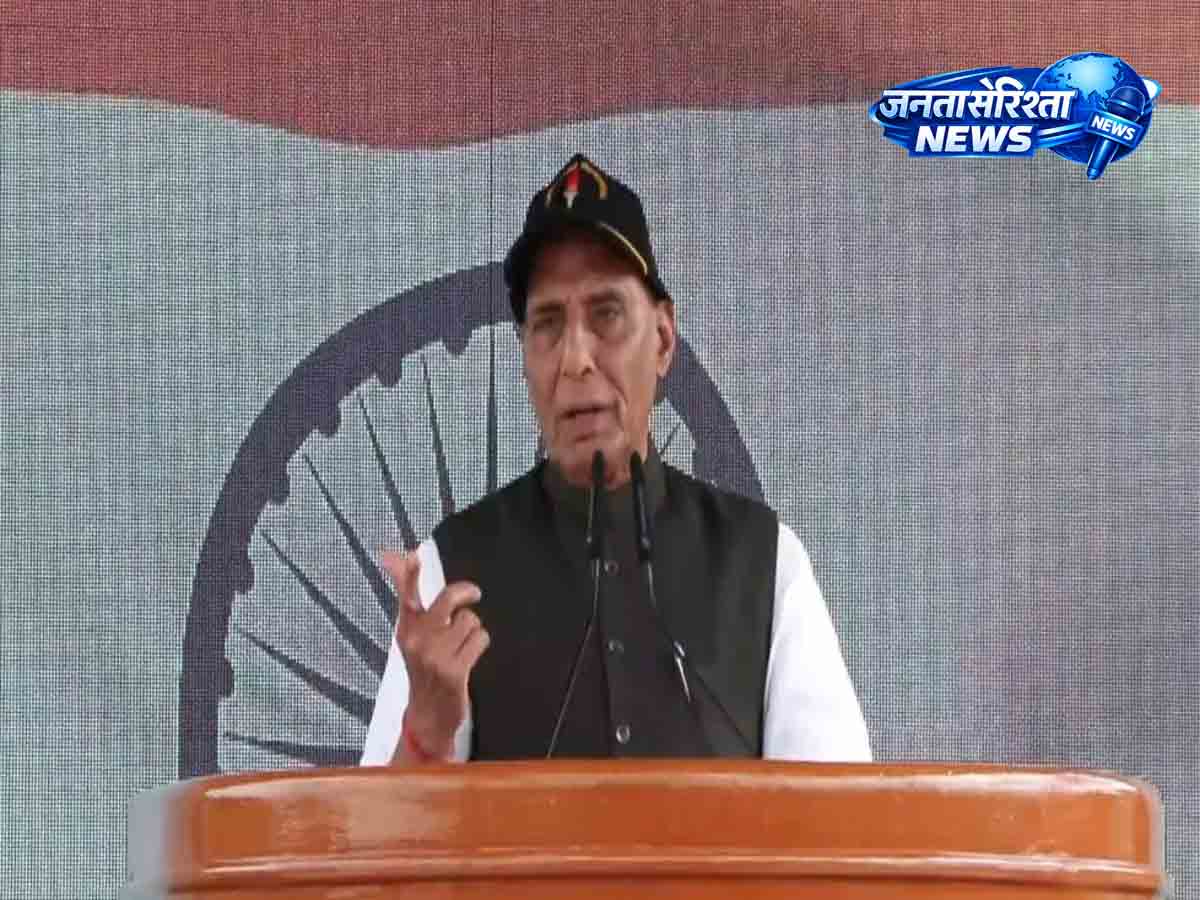
Drass: Defence Minister Rajnath Singh highlighted the stark contrast between the paths taken by India and Pakistan on Sunday. He noted that while India is rapidly advancing towards progress and development through innovation and technology, Pakistan has made terrorism a key component of its state policy.
Speaking at an event commemorating the Kargil War at the Kargil War Memorial in Drass, Singh observed that nearly 27 years after the conflict, the two neighboring nations have adopted vastly different trajectories. He stated that Pakistan’s system continues to foster terrorism, whereas India focuses on growth and development.
Addressing the gathering, Singh said, “Pakistan has now made terrorism a part of its state policy. The distinction between the army and terrorists has vanished there; the army not only provides protection to terrorist organizations but also collaborates with them. That is why, back during ‘Operation Sindhur,’ we made it clear that India would no longer view terrorists and the governments that nurture them as separate entities.”
The Defence Minister remarked that the divergence in priorities between the two countries has become even more pronounced in recent years; India is investing in innovation and development, while Pakistan is engaged in cross-border terrorism.
Singh said, “Today, while India explores new avenues for innovation, Pakistan seeks new routes for infiltration. India is designing chips, whereas Pakistan is busy designing terror. India is building a start-up ecosystem, while Pakistan is creating an ecosystem of terror. India is manufacturing semiconductors, while Pakistan is grooming suicide bombers. India is making a mark with space missions, while Pakistan is running proxy missions. India is sending satellites into space, while Pakistan is busy sending terrorists across the border.”
Continuing the comparison, he noted that India has emerged as a global leader in technology and the digital sphere, whereas Pakistan relies on networks that promote radicalism and terrorist activities. He further stated, “India is providing software to the world, while Pakistan is exporting sleeper cells. India is building data centers, whereas Pakistan is establishing centers that spread radicalism. India is connecting the world through UPI, while Pakistan is linking terrorism with ‘Hawala’ networks. In short, our paths are vastly different. Given this, if Pakistan attempts to obstruct our path of progress with malicious intent, our brave armed forces are fully prepared to deliver a befitting reply.” Referring to ‘Operation Sindoor’, Singh said that the Indian armed forces have dealt a severe blow to terrorists and their sympathizers. This has sent a clear message that terrorist activities against India will be met with a stern response.
Speaking about the military operation, he remarked that the armed forces have taught terrorists and their supporters “a lesson they will never forget.”
He added, “‘Operation Sindoor’ has made it clear what fate awaits those who dream of intimidating India through terrorism. India possesses the capability to respond to any of Pakistan’s nefarious acts in a manner beyond their imagination; from this platform, I wish to convey a clear message: this is the fate that awaits any malicious act against India’s sovereignty.”
Reiterating the government’s stance on talks with Pakistan, the Defence Minister ruled out the possibility of any comprehensive dialogue with the neighboring country. He stated that if talks were to take place at all, they would be confined solely to the issue of Pakistan-occupied Kashmir (PoK).
Singh said, “There will be no talks with Pakistan. Even if talks do occur, they will focus exclusively on PoK—an integral part of India that is under Pakistan’s illegal occupation.”


