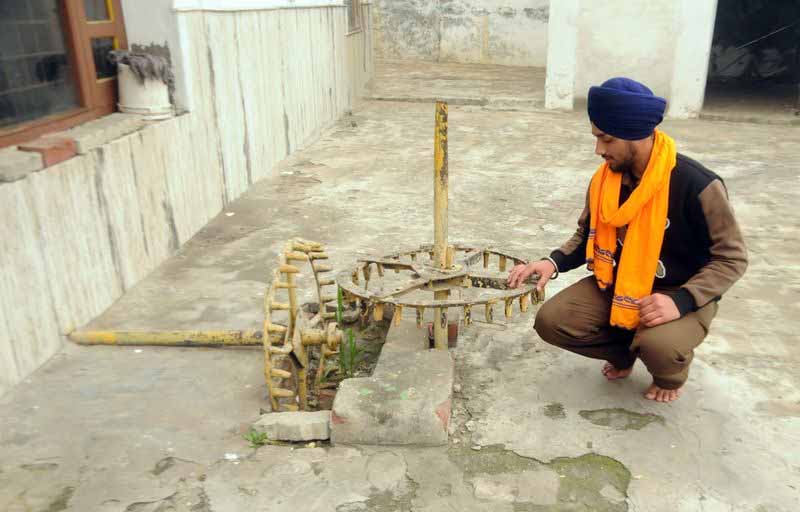
Punjab: The village is home to the historic Gurdwara Mithasar, built on the site where the sixth Guru, Hargobind Singh, stayed. Legend has it that at the time of the Guru’s visit, the mansion belonged to a king whose two wives were constantly quarreling. To end their constant fighting, the king decided to have two separate wells dug. One believed in the existence of God, and the other was an atheist. The believer’s well yielded salty water, while the atheist’s well yielded sweet water. When the Guru was returning from Bhujanga Da Dera in Lahore, he stopped at the mansion and asked for water from the believer’s well, describing it as “meetha” (sweet). Jashandeep Singh, a resident of the village, said the villagers were astonished to see that the well yielded sweet water instead of salty water. Two wells from the Guru’s time still remain intact: one beneath the building and the other next to it. A large fair is held here every June, attracting devotees from far and wide. The people here associate this village with King Nal and say that he founded it centuries ago. The more than five-century-old Shesh Nag and Shesh Mata temples, which also house idols of Radha and Krishna, give the temple a heritage look. Its current head, Mahant Ram Narayan Das, stated that the temple was spread over two acres of land. He added that the site was formerly known as the land of the nine Siddhas. The temple also has an old well with some Urdu writings inside its walls, which will need to be studied by experts using technology, as the writing is more than 10 feet below the surface. He stated that the temple was built by Para Brahma Parmeshwar Khanduchary Ji Maharaj. Its second head was Para Brahma Parmeshwar Yogiraj Brahmadas, followed by Para Brahma Parmeshwar Puran Giri, Para Brahma Parmeshwar Tirath Ram, Para Brahma Parmeshwar Bishan Das, who lived during the time of Maharaja Ranjit Singh, Ram Das, Para Brahma Parmeshwar Tulsi Dal, and Para Brahma Parmeshwar Kaushal Das. Another temple, known locally as Baba Tapiyana, is located outside the village, facing the barbed wire fence along the Indo-Pak border. Its name suggests that the site was used for meditation, as a beautiful natural pond further enhances the beauty of the area. People gather here during the annual fair.
Punjab: A village full of religious sites of historical importance