
Major political upheaval in Meghalaya; 11 out of 12 UDP MLAs break away
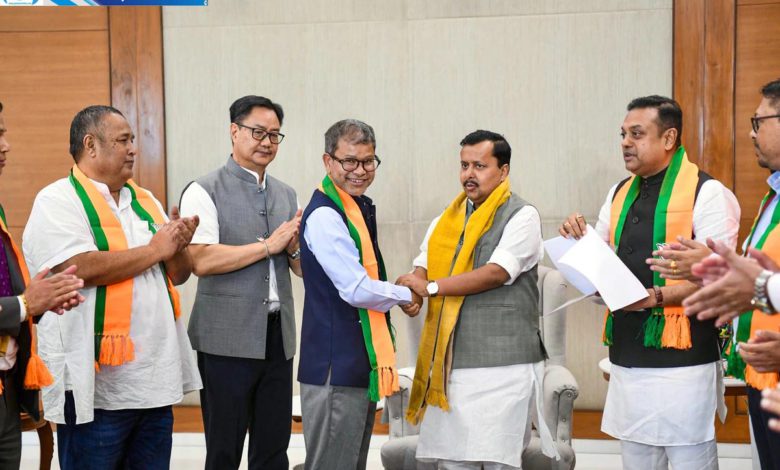
Shillong. A big change is being seen in the politics of the north-eastern state of Meghalaya. Chief Minister Conrad K. The United Democratic Party (UDP), which is part of the Sangma-led Meghalaya Democratic Alliance (MDA) government, is facing continuous political setbacks. Eight MLAs of UDP, which was till some time the second largest party in the ruling coalition with 12 MLAs, have joined the Bharatiya Janata Party. After this, three other MLAs have applied for merger with Chief Minister Sangma’s National People’s Party (NPP). Due to this development, UDP is left with only one MLA. On the other hand, BJP has increased its strength in the Assembly from two to ten. This change within the MDA alliance, which has the support of 51 MLAs in the 60-member assembly, has given a new direction to the political equations of the state.
How did the entire political picture change in a month?
Political change in Meghalaya began in September 2026. At that time 12 MLAs of the United Democratic Party were present in the assembly.
On September 23, eight party MLAs joined the Bharatiya Janata Party at the BJP headquarters in New Delhi.
These MLAs were inducted into the party in the presence of Union Minister Kiren Rijiju and senior BJP leaders.
After this political change, BJP’s strength in the assembly increased from two to ten, while UDP was left with only four MLAs.
With this change, BJP became the second largest party in the assembly after NPP.
Assembly Speaker approved the merger of eight MLAs
After eight UDP MLAs joined BJP, questions were also raised regarding anti-defection law.
However, Meghalaya Assembly Speaker Thomas A. On October 16, Sangma approved the merger of these eight MLAs with BJP.
According to the notification of the Assembly Secretariat, eight of the total 12 UDP MLAs had decided to merge with the BJP.
This number was equal to two-thirds of the party’s legislative party members. Therefore, the Speaker of the Assembly accepted this decision under the merger provision of the Tenth Schedule of the Constitution.
After this, ten BJP MLAs and four UDP MLAs were officially registered in the Assembly.
Now three more MLAs joined NPP
After the departure of eight MLAs to BJP, another crisis arose in front of UDP.
On October 19, its three other MLAs Paul Lyngdoh, Renikton Lyngdoh Tongkhar and Nujorki Sungoh submitted applications to the Assembly Speaker to merge with Chief Minister Conrad Sangma’s National People’s Party.
After the separation of these three leaders, only party president Metbah Lyngdoh is left in UDP.
UDP has also expelled all three MLAs from primary membership.
However, Assembly Speaker Thomas A. Sangma has clarified that the decision on the merger application with NPP will be taken after taking legal opinion. So there is a difference between leaving only one MLA within the party and the merger being valid in the official records of the assembly.
Why did UDP MLAs leave their party?
The MLAs who joined BJP have cited development-related issues as the main reason behind their decision.
Khliehariyat MLA Kirmen Shyalla said that due to the presence of BJP government at the Centre, it can help in fulfilling the pending demands of Meghalaya.
These demands include solution to the problem of coal mining, inclusion of Khasi language in the Eighth Schedule of the Constitution and issues related to the Meghalaya Residents Safety and Security Act.
On the other hand, Renikton Lyngdoh Tongkhar, who joined the NPP, cited the failure of earlier efforts to unite regional parties as the reason for his decision.
However, the UDP leadership has considered the separation of MLAs as a serious blow to the party.
Status of Chief Minister Conrad Sangma
NPP President and Chief Minister Conrad Sangma is at the center of this political development.
If the merger of three more MLAs with NPP is approved, the party’s strength will increase from 33 to 36. With this, NPP will get majority in the Assembly on its own.
At the same time, with BJP having ten MLAs, it has become the second largest party in the alliance.
After this change, new questions may arise regarding representation in the cabinet, decision making process within the coalition and the role of different parties.
However, at present there has been no official announcement of any change in the leadership of the government.
Questions on the future of regional parties also
Regional parties have played an important role in the politics of Meghalaya. UDP has also been counted among the major political forces in the state for a long time.
But the situation of the organization has been affected with the separation of 11 out of 12 MLAs from the party within a month.
This development has raised the question of how the UDP will re-establish its political and organizational strength in the coming elections.
Party President Metbah Lyngdoh faces the challenge of keeping the workers united and reorganizing the organization.
Eye on 2028 assembly elections
The next assembly elections in Meghalaya are scheduled for early 2028. This major political change that took place before that is being considered important.
The BJP has increased its numbers in the Assembly, while the NPP has also moved towards strengthening its position.
On the other hand, UDP faces the challenge of maintaining its political base.
At present, the final decision of the Assembly Speaker on the merger of three MLAs in NPP will be important.