
Investigation into missing idols at Thanjavur’s Brihadeeswarar Temple intensified.
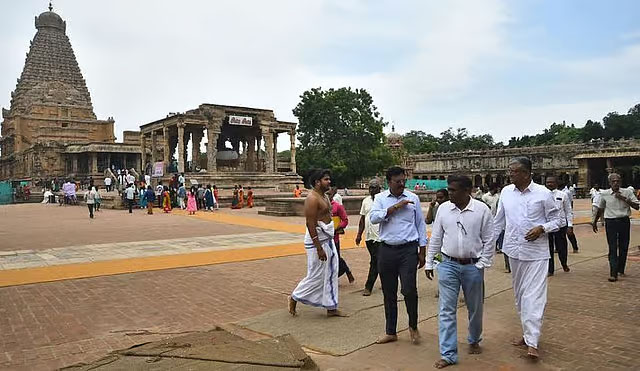
Thanjavur: The issue of missing and damaged idols of the Ashta-Dikpalas (deities guarding the eight cardinal directions) at the world-famous Brihadisvara (Big) Temple has once again raised serious questions regarding temple conservation and heritage protection. Following directives from the Madurai Bench of the Madras High Court, officials from the Archaeological Survey of India (ASI) and the Hindu Religious and Charitable Endowments (HR&CE) Department conducted a joint inspection of the temple complex on Thursday to assess the situation. A report, prepared in compliance with the court’s order, is scheduled to be submitted to the court on July 28.
Thanjavur’s Brihadisvara Temple, a UNESCO World Heritage Site, is considered an exquisite example of Chola architecture. In addition to the worship of Lord Shiva, this historic temple complex houses separate shrines for the Ashta-Dikpalas—the deities guarding the eight directions (Indra, Agni, Yama, Nairuti, Varuna, Vayu, Kubera, and Ishana)—in accordance with Agama scriptures. These deities hold special religious and spiritual significance.
However, the sanctums of four of these eight shrines—dedicated to Indra, Yama, Nairuti, and Kubera—currently lie empty; the original idols are missing, and the shrines themselves have been closed. Meanwhile, the idols in the remaining four shrines have suffered damage over time due to a lack of proper conservation and maintenance. The dilapidated state of the idols has disrupted regular worship rituals, leaving devotees unable to offer prayers or seek blessings from these deities.
Religious scholars state that, according to Agama traditions, the presence and regular worship of the Ashta-Dikpalas hold immense significance in any Shiva temple. The neglect of these shrines not only contravenes religious traditions but also raises serious concerns regarding the preservation of cultural heritage.
It was regarding this issue that Kaliyamurthy, a resident of Thanjavur, filed a Public Interest Litigation (PIL) in the Madurai Bench of the Madras High Court in 2019. The petition sought permission from the Archaeological Survey of India (ASI) to install new idols in temples where the original ones have been damaged, thereby enabling the ritualistic worship of the Ashta-Dikpalas (Guardians of the Eight Directions) to resume. The petitioner also demanded an investigation into temples where idols are missing, action against those responsible, and the immediate commencement of necessary conservation work.
The matter was heard by a division bench comprising Justice C.V. Karthikeyan and Justice R. Sakthivel. Acknowledging the gravity of the issue, the court directed a joint team—comprising the Joint Commissioner of the Hindu Religious and Charitable Endowments Department (Thanjavur), ASI officials, and the temple’s hereditary trustee—to inspect the temple. The court specified that the inspection report must provide detailed information regarding the current condition of the idols, their conservation status, the missing idols, and proposed remedial measures.
In compliance with the High Court’s order, a joint team of officials conducted a thorough inspection of the temple complex on Thursday. During the inspection, they closely assessed the condition of the Ashta-Dikpala shrines, the vacant sanctums, the damaged idols, and existing conservation arrangements. The officials also gathered necessary information from available records and the temple administration to clarify when and under what circumstances the idols went missing and what steps have been taken so far to locate them.
According to sources, the joint team is also examining historical documents, epigraphic records, and past conservation efforts associated with the temple complex. The report will further outline the legal and technical procedures required for conserving the damaged idols or installing new ones.
Experts in heritage conservation believe it is essential to strike a balance between religious traditions and archaeological preservation in historical monuments like the Brihadeeswarar Temple. While it is crucial to safeguard the temple’s original structure and historical significance, it is equally important to ensure the continuity of the devotees’ religious faith and worship practices. Local devotees and social organizations have reiterated their demand to resume the regular worship of the Ashta-Dikpals (deities of the eight cardinal directions) at the temple. They urge the government and relevant departments to prioritize reopening temples that have remained closed for years and restoring the necessary religious arrangements.
All eyes are now fixed on the joint report to be submitted to the High Court on July 28. It is expected that the court will issue further directives based on this report, paving the way for concrete steps regarding the investigation into missing idols, the preservation of damaged statues, and the restoration of religious traditions. This matter is not merely about the security of a historic temple; it also underscores the importance of preserving India’s rich cultural and religious heritage.