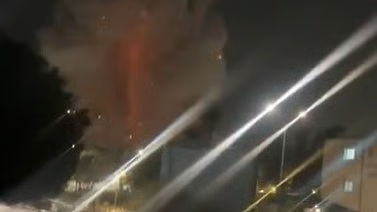
The Iranian missile strikes on the southern cities of Dimona and Arad on Saturday, March 21, 2026, have marked a watershed moment in the month-long conflict between Israel and Iran. For decades, the area surrounding the Shimon Peres Negev Nuclear Research Center was considered one of the most impenetrable airspaces on the planet. However, the successful penetration of these defences by Iranian ballistic missiles has shattered public confidence and forced a painful reassessment of Israel’s military capabilities.
Why the Dimona and Arad strikes caught Israel off guard
The primary shock stems from the location and the failure of a multilayered defence system that was specifically designed for this scenario.
According to reports from the New York Times, the strikes occurred just eight miles from Israel’s main nuclear reactor. While the International Atomic Energy Agency (IAEA) confirmed that no damage was sustained by the nuclear facility itself, the fact that two missiles struck residential areas in Dimona and Arad—occurring roughly three hours apart—exposed significant gaps.
Military officials, including reserve brigadier general Ran Kochav, admitted to the New York Times that despite being protected by both Israeli and American systems, the incident was a clear “operational failure.”
Strategic pressure on air defence stockpiles
A deeper layer of the surprise involves the potential exhaustion of Israel’s most advanced interceptors. The New York Times suggests that concerns are mounting over whether Israel is limiting the use of its expensive Arrow 3 interceptors to preserve a dwindling stockpile.
These worries are exacerbated by the length of the current campaign. Lt Gen Eyal Zamir, Israel’s military chief, recently noted that the war is only “midway.” During a visit to Washington, Amir Baram, the director general of Israel’s Ministry of Defence, reportedly requested more munitions, highlighting that the supply is not, as General Kochav put it, a “bottomless barrel.”
Technical challenges of interception and fragmentation
Technical hurdles also played a role in the failure to protect these southern cities. Experts interviewed by Al Jazeera explain that even when systems like the Arrow 2 or 3 are engaged, the margin for error is razor-thin. Arrow 3 requires a direct “kinetic” hit—described by researcher Yehoshua Kalisky as “two bullets meeting in mid-air”—which can be thwarted by minor atmospheric changes or the manoeuvering capabilities of Iranian missiles. Furthermore, even successful interceptions at lower altitudes can result in “cluster” fragmentation, where smaller warheads or massive fuel tanks—some the size of a bus—fall onto civilian populations, causing significant secondary damage.
Human toll and the Iranian motivation
The strikes were not just military failures but humanitarian crises, resulting in approximately 175 to 200 injuries across both cities. The Times of Israel reported that at least 11 people were seriously hurt, including a 12-year-old boy in Dimona and a 5-year-old girl in Arad.
Iranian state media framed the attack as a direct retaliation for a strike on Iran’s Natanz nuclear enrichment complex earlier that day. This tit-for-tat targeting of nuclear-adjacent sites signals a dangerous new phase of the war, as noted by Mohammad Bagher Ghalibaf, the Speaker of Iran’s Parliament, who claimed the strikes proved “Israel’s skies are defenceless.”
Aftermath and future risks
As Israel investigates these failures, the government has urged citizens to abandon complacency.
Prime Minister Benjamin Netanyahu described the lack of fatalities as a “miracle” during his visit to the impact sites, yet he offered no technical explanation for why the systems failed.
Analysts now warn that if the conflict continues to drain interceptor resources, Israel may be forced to prioritise the defence of only its most critical strategic infrastructure, potentially leaving more residential areas vulnerable to future barrages.