
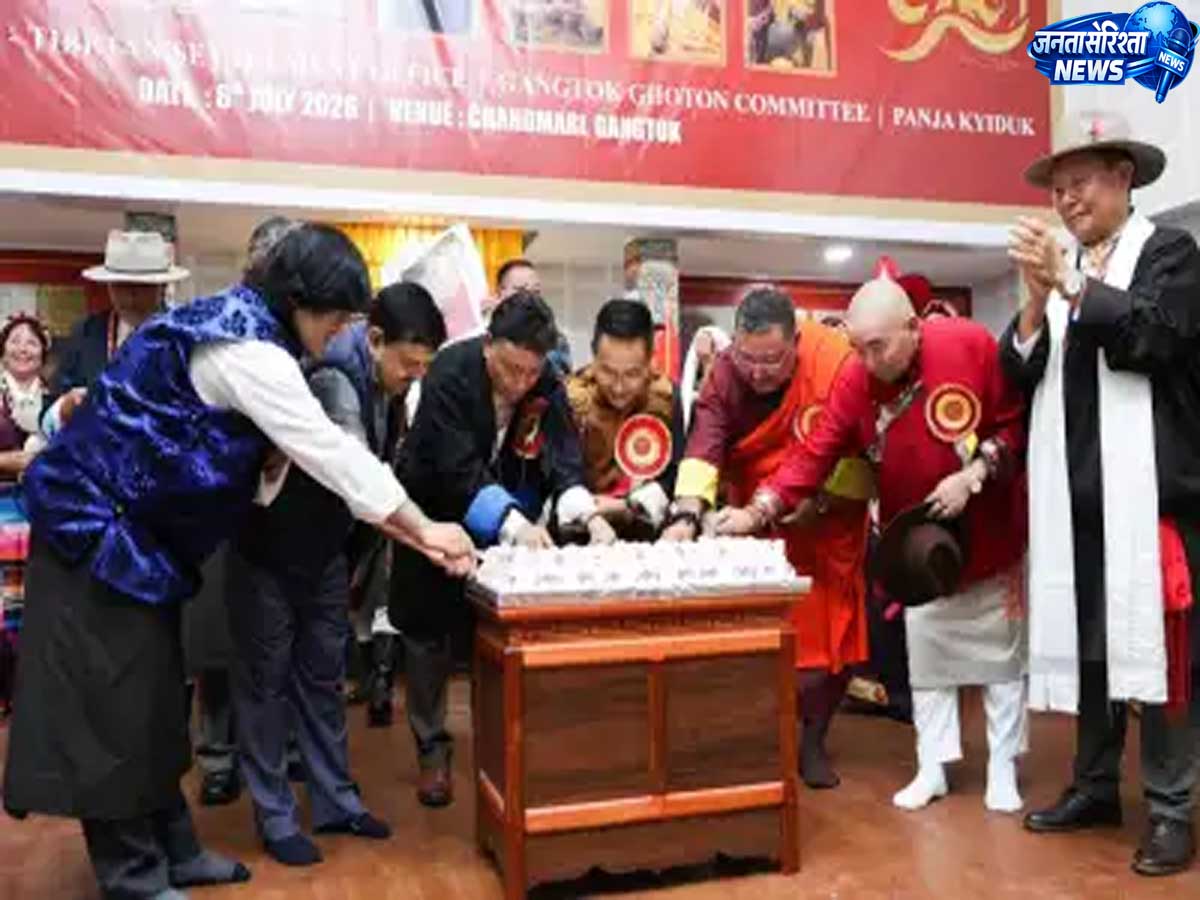
Gangtok: While Tibetans across the world marked the 91st birthday of His Holiness the Dalai Lama with celebrations, Tibetan leaders and youth representatives in Gangtok used the occasion to highlight what they described as growing threats to Tibetan identity, religion and culture under Chinese rule, while renewing calls for greater international support for the Tibetan cause.
The 91st birthday celebration was attended by Chief Minister Prem Singh Golay along with Palden Dhondup, Home Minister of the Central Tibetan Administration (CTA), State Ministers and MLAs. On the occasion CM Golay inaugurated a community center for Tibetans in Gangtok which will is also for the residents of Chandmari in Gangtok.
Speaking at the celebrations, Palden Dhondup, Home Minister of the Central Tibetan Administration (CTA), said he had attended the birthday celebrations in Dharamshala before travelling to Gangtok on behalf of the CTA President, who was unable to attend due to an official visit to Ladakh.
“What makes me very happy is that representatives from different communities and all religions have gathered here to celebrate together. This reflects the spirit of compassion. Compassion means living together with harmony, respecting different cultures and religions. We all have to live together peacefully,” he said.
However, Dhondup said the celebrations also came at a difficult time for Tibetans because of what he described as continued policies by China aimed at assimilating minority communities.
“Regarding the ethnic law passed by China, what they call a new law is, in reality, a continuation of policies they have been implementing for the last 10 to 20 years. This so-called ethnic law is aimed at assimilating the cultures, languages and identities of minority communities,” he said, adding that the policies affected not only Tibetans but also other minority groups, including the Uyghurs.
Referring to the recent self-immolation of Tibetan activist Lobga Rangzen outside the United Nations headquarters in the United States, Dhondup described the incident as “deeply saddening.”
“The most valuable thing anyone has is life, yet he was prepared to sacrifice his life for the Tibetan cause. Since China’s occupation of Tibet, around 150 Tibetans have self-immolated inside Tibet. There have also been self-immolations outside Tibet,” he said.
At the same time, he reiterated the Dalai Lama’s commitment to non-violence.
“When we speak about compassion, it means not harming others. His Holiness the Dalai Lama has always advocated non-violence, and we do not support violence. These individuals sacrificed their lives to draw the attention of the international community, including the United Nations, to the plight of the Tibetan people,” he said.
Tenzing Tsephel, Coordinator of the North East Tibetan Youth Congress (TYC), said Tibetan youth living in exile considered themselves the voice of Tibetans inside Tibet, who, he alleged, were unable to speak freely.
“We believe this ethnic policy will have serious consequences not only for the people of Tibet but also for other minority communities under China’s rule,” he said.
According to Tsephel, the policy requires Tibetan children to attend boarding schools where Mandarin is the compulsory language, resulting in children becoming disconnected from their language, culture and traditions.
He also alleged that the policy interferes with Tibetan Buddhism by affecting monasteries and attempting to control the recognition of reincarnated Tibetan Buddhist leaders.
“China claims it has the authority to choose reincarnations, but we do not accept that. We strongly oppose these policies and will continue to resist and fight against them in the future,” he said.
Speaking about Lobga Rangzen, Tsephel said the activist had spent years campaigning for Tibet and believed self-immolation was his final option to draw international attention.
“As an individual and as a human being, I do not believe sacrificing one’s life is the solution. But there are situations where people become so desperate that they take such an extreme step to draw the world’s attention. By sacrificing his life outside the United Nations headquarters, his intention was to send a message to the international community. I believe that message has reached the world,” he said.
Tshering Wangchuk, Chairman of the Local Tibetan Assembly, Gangtok, said the recent self-immolation reflected the frustration felt by many Tibetans over what he described as China’s continued policies towards Tibet.


