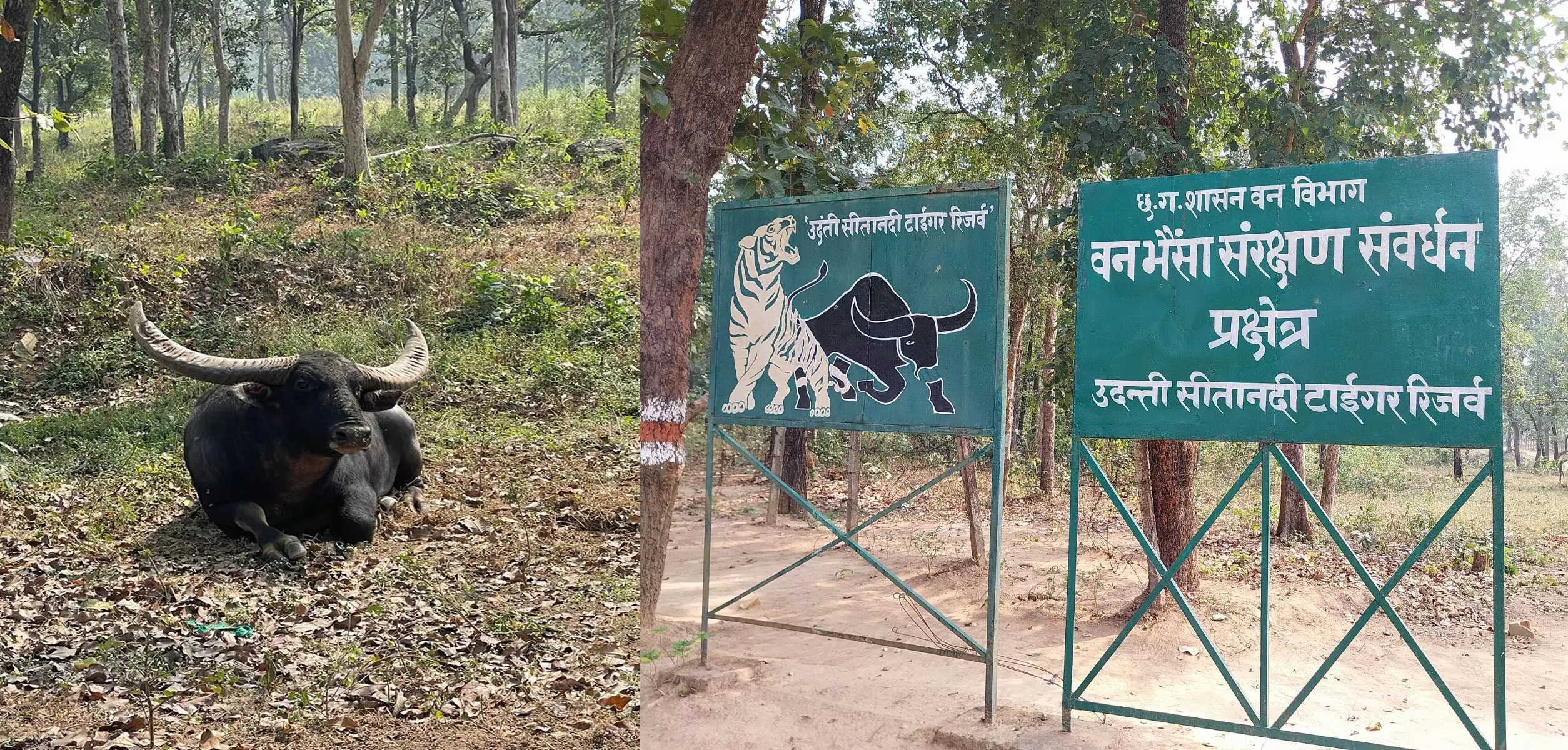
Raipur. For twenty years, the Chhattisgarh Forest Department has spent crores of rupees on the conservation and development of wild buffaloes. Wild buffalo calves were born by keeping them in enclosures in the Udanti-Sita River Tiger Reserve. Throughout, they were told that their numbers were increasing. Now it has come to light that ten days ago, the Forest Department, calling them hybrid wild buffaloes, drove them out 100 kilometers away from the Udanti-Sita River Tiger Reserve. Some insiders say they were taken to Odisha and released there, preventing their return. Raipur wildlife enthusiast Nitin Singhvi has demanded an investigation into the entire matter and has questioned the Principal Chief Conservator of Forests (Wildlife).
How were they fooled? How was the truth revealed? What is the history of hybrid wild buffaloes?
In 2007, the Forest Department forcibly took a female named Asha from a villager, claiming she was purebred. Asha gave birth to Raja, Prince, Mohan, Veera, Somu, Khushi, and Hira. Later, Rs. For twenty-seven thousand rupees, the department purchased two crossbred females named Rambha and Menaka from villagers. Rambha and Menaka gave birth to Malti and Bhanumati. The four gave birth to Parvati, Vishnu, Durga, Kiran, Kanha, Prahlad, Ravi, Somvati, Janaki, Urvashi, and Surya (more than 15).
The Forest Department knew from day one that all these, including Asha, were hybrid wild buffaloes. The purchase documents for Rambha and Menaka stated that both were crossbreds. The Forest Department’s secret was exposed when the Central Zoo Authority, calling these wild buffaloes hybrid, refused to grant permission for breeding them with purebred wild buffaloes from Assam. Then, the Forest Department suddenly came to its senses and remembered the Constitution of India. Citing the provisions of Articles 48(a) and 51(a)(g), the Deputy Director USTR proposed to release all the hybrid wild buffaloes. Later, in October 2023, they were reportedly driven from the enclosure—it was reported that they escaped by breaking the fence.
After escaping, these hybrid wild buffaloes caused some crop damage due to the large number of villages in the USTR. Villagers demanded compensation, but the Forest Department refused, citing a lack of provisions to compensate for crop damage caused by hybrid wild animals. As a result, in August 2024, using sticks and rods, the villagers herded the hybrid wild buffaloes into the old boma. Later, they lived in the enclosure during the harvest season, and in the forest the rest of the time. According to reports, ten days ago, they were released 100 kilometers outside the Udanti-Sita River Tiger Reserve.
Why hate them now?
From 2013-14 to 2024-25, the Forest Department spent ₹24,638,831 on food and supplements, enclosure maintenance, and other expenses. Now, the Forest Department is preparing to bring three female wild buffaloes, which have been kept in an enclosure in Barnawapara for the past six years, to the Udanti-Sita River Tiger Reserve to cross them with the only remaining 26-year-old wild buffalo, “Chhotu,” whose vision is very weak due to old age. Forty-five days after being brought from Barnawapara, they will be released into the wild with Chhotu. If hybrid wild buffaloes also lived in the Udanti-Sita River forest, these hybrid male wild buffaloes would have been more likely to mate with purebred females from Assam. Therefore, the Forest Department has released them outside the Udanti-Sita River Tiger Reserve. Singhvi demanded that the entire matter be handed over to a high-powered committee for investigation.
Raipur wildlife enthusiast Nitin Singhvi demanded that the expenditure of crores of rupees on hybrid wild buffaloes be handed over to a high-powered committee, saying that the entire expenditure should be recovered from the guilty officials after investigation.
The Principal Chief Conservator of Forests (Wildlife) should explain what he was doing in 2020.
The Principal Chief Conservator of Forests (Wildlife) should explain why the wild buffaloes from Assam were brought to the Udanti-Sita River and kept confined in a pen in Barnawapara in 2020. He was the Additional Principal Chief Conservator of Forests (Wildlife) in 2020. If a female from Assam had been brought to Chhotu in 2020, when Chhotu was 20-21 years old, there might have been a possibility of breeding. Now that Chhotu is old enough to be unable to reproduce—why is this experiment being conducted? The three females being brought in have young children. They will remain in Barnawapara, even though they are old enough to learn from their mothers.