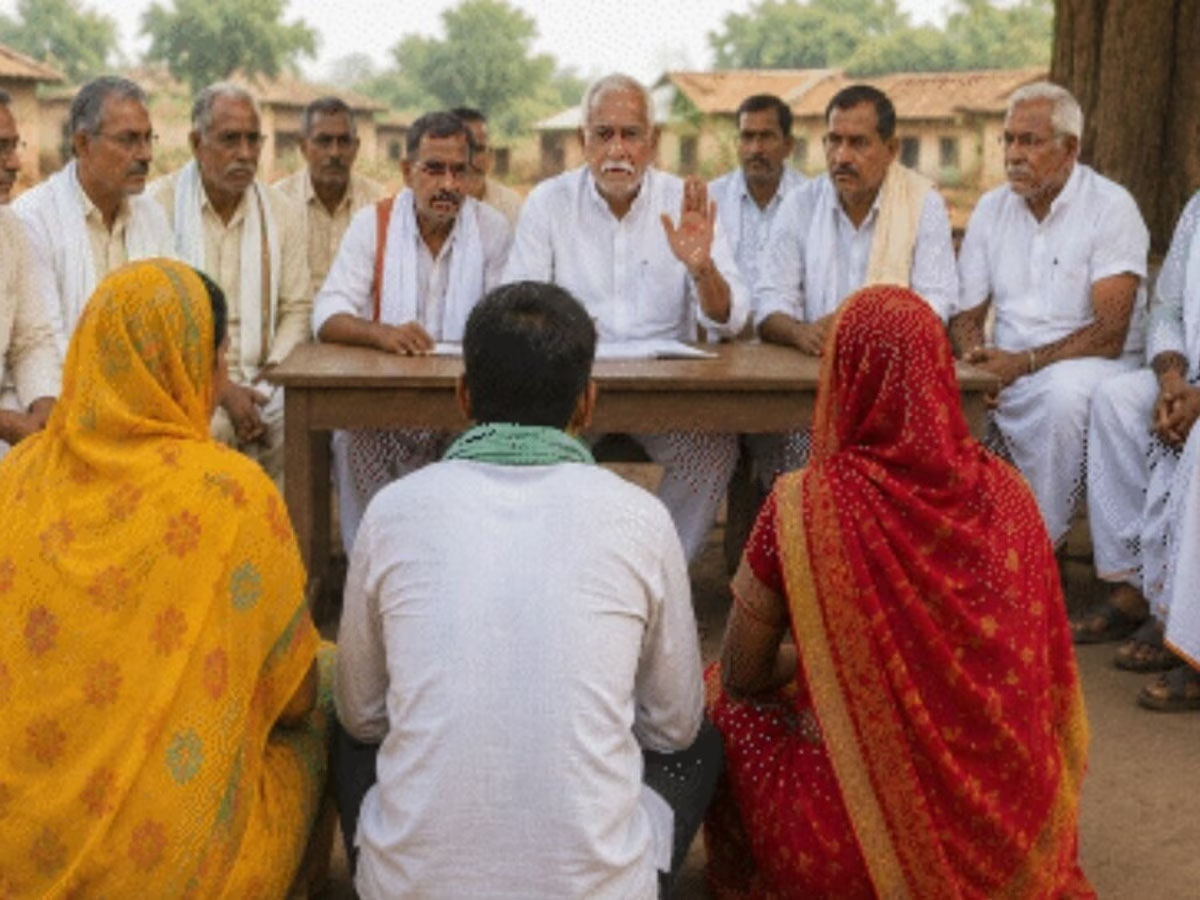
Rampur. A decision delivered by a village council (panchayat) to resolve a family dispute involving a man and his two wives in Uttar Pradesh’s Rampur district did not last even a week. Last week, the council had devised a unique arrangement—agreed upon by both parties—for the husband to live with both wives, but this system has now completely collapsed. Reports indicate that the younger wife has left home, taking her younger daughter with her but leaving the elder daughter behind. So far, the police have not been informed of the matter, nor has any written complaint been filed by either party.
According to reports, this issue had been a topic of discussion in the area for some time. Constant disputes plagued the family because the man had two wives; frequent arguments and tension arose between the two women regarding who would live with the husband. As the conflict escalated, the matter reached the village council, where both parties were summoned in an attempt to reach a settlement.
After lengthy deliberations, the council announced a decision that drew widespread attention. It was decided that the husband would live with his first wife for three days a week and spend the next three days with the second wife. The remaining day of the week was left to the husband’s discretion, allowing him to choose which wife to stay with. The council hoped this arrangement would resolve the dispute and restore peace within the family.
Initially, both parties accepted the council’s decision, and the arrangement was implemented accordingly. However, the agreement was short-lived. Barely a week after the decision, the younger wife left the house. She took her younger daughter along but left the elder daughter behind. Her sudden departure has once again created a tense atmosphere within the family.
Those close to the family state that despite the council’s ruling, the differences between the husband and wives had not been fully resolved. Domestic disputes and mutual disagreements persisted, and it was under these circumstances that the younger wife decided to leave home. However, details regarding where she has sought refuge or what steps she might take next have not yet emerged.
Meanwhile, the first wife and other family members are present at the home. The eldest daughter is also currently living with the family. Following the incident, the matter has become a subject of much discussion in the village; people are expressing their views on the Panchayat’s decision and its subsequent failure.
The police state that no formal complaint or report has been filed by any party involved so far. Officials have indicated that if a written complaint is received, the matter will be investigated, and action will be taken in accordance with the law. At present, the situation is being viewed as a family dispute, and there has been no police intervention.
Legal experts maintain that matrimonial and family disputes should be resolved through mutual consent and within the framework of the law. While settlements reached at the Panchayat level may offer immediate relief, they often fail to remain effective in the long run if the root causes remain unaddressed. In such cases, it is crucial to consider the consent of all parties, legal rights, and the best interests of the children.
Social experts also believe that family disputes cannot be resolved merely by dividing time. When relationships lack trust, communication, and mutual respect, it becomes difficult for any settlement to endure. Family counseling and legal advice can play a significant role in such situations.
For now, this case from Rampur is once again in the spotlight. What happens next—following the failure of the Panchayat’s unusual decision—will depend on the family’s subsequent actions and, if necessary, any legal proceedings involving the police or the courts. As no formal complaint has been lodged by any party yet, the police are keeping a close watch on the situation and have stated that they will take appropriate action should a complaint be filed.