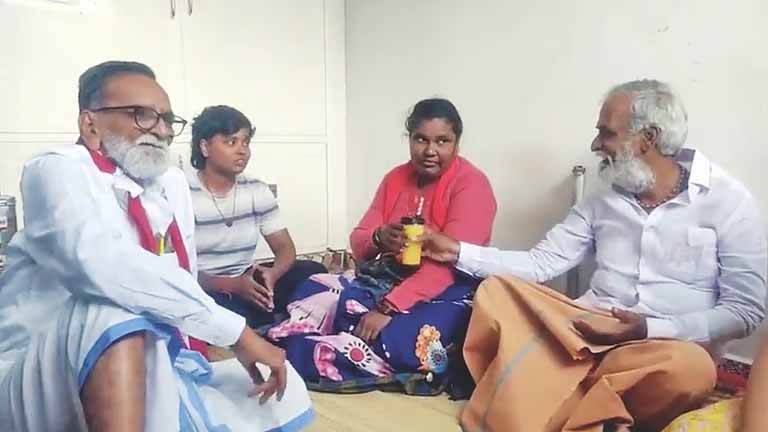
Chennai: In major news, a 165-day protest by hundreds of Greater Chennai Corporation (GCC) sanitation workers against the privatization of Solid Waste Management (SWM) in the Royapuram and Thiru Vika Nagar zones, which included a 57-day hunger strike, ended on Monday after Hindu Religious and Charitable Endowments (HR&CE) Minister PK Sekhar Babu and Chennai Mayor R Priya assured them of resumption of work by the end of January. The minister and mayor met the protesters at the Uzhaipur Urimai Iyakkam (UUI) head office in Ambattur. In a symbolic gesture, Sekhar Babu gave juice to S Lakshmi, one of the four workers involved in the final phase of the hunger strike, officially ending her fast. He promised to meet their main demands, including reinstatement to their old positions under GCC and a resolution regarding their salary scales. The workers had asked for a deadline of January 20th, but Sekhar Babu stated that the administration would work to complete the process by January 30th. He also assured them that their demand for permanent status would be addressed and praised their dedication, comparing it to a mother’s selfless care. The agitation began on August 1st last year, sparked by the corporation’s move to hand over SWM operations to Chennai Enviro Solutions Private Limited (CESPL). The workers’ unions, UUI and the Left Trade Union Congress (LTUC), claimed that 1,952 workers were illegally dismissed. Workers, struggling without income for six months, participated in the protest, and four sanitation workers died during the protest. Over the months, their demonstrations took various forms. It began with a camp outside the GCC headquarters, which attracted widespread attention and attracted visits from politicians and celebrities. After negotiations failed, the police detained them on August 13th, prompting a series of creative and vigorous protests by the workers. These included clearing roads, blocking roads, marching to the Secretariat and the Cooum River, sleeping in cemeteries, and picketing prominent memorials and political party offices.
The hunger strike, which began on November 17th, was conducted in phases with legal permission from the Madras High Court. The third and final phase involved four women, three of whom had to resign due to serious health problems before the minister’s intervention. Confident of this, UUI President K. Bharathi called it “the first round of victory,” emphasizing that final victory would only be achieved when the workers actually returned to their duties and appealed to the corporation to make the Self-Help Group (SHG) workers permanent in other zones. J. Geetha, a sanitation worker and single mother, felt relieved as she recalled the hardships of the past six months. He said, “I worked hard for 15 years and earned ₹23,000 per month. I had to borrow money from loan sharks to support my family.” Speaking to the press, Minister Sekhar Babu credited Chief Minister MK Stalin for bringing the proposal and various leaders for their efforts to facilitate negotiations. Expressing hope that the upcoming Pongal festival will now be a happy one for sanitation workers, he said a decision to restore their previous salary rates would be taken soon.
Chennai: The 165-day-long protest by sanitation workers ended after they were promised reinstatement.