
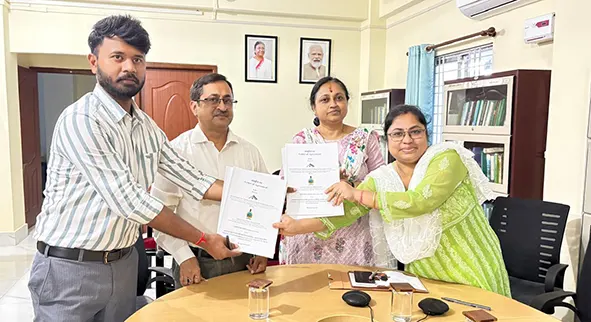
ITANAGAR: The Central Ground Water Board, North Eastern Region (CGWB-NER) and Govind Ballabh Pant National Institute of Himalayan Environment, North-East Regional Centre (GBPNIHE-NERC) have signed a letter of agreement (LoA) to undertake a collaborative scientific study titled ‘Mapping, Assessment, and Rejuvenation of Vulnerable Springs in Arunachal Pradesh’.
The agreement was signed on behalf of the CGWB-NER by its Regional Director Tapan Chakraborty and on behalf of the GBPNIHE-NERC by its Head Paromita Ghosh, in the presence of scientists, hydrogeologists, and technical experts from both institutions.
The collaboration is expected to create a scientific framework for spring conservation and rejuvenation in ecologically fragile Himalayan landscapes, where springs serve as a lifeline for rural communities.
Speaking on the occasion, Chakraborty described the partnership as an important milestone in strengthening scientific groundwater management in the Northeastern Himalayan region. He emphasised the urgent need for integrated hydrogeological investigations and long-term monitoring to ensure sustainable water availability amid changing climatic conditions.
Paromita Ghosh said that the collaboration would promote interdisciplinary research. She noted that scientific spring rejuvenation, combined with ecosystem-based management approaches, is essential for enhancing climate resilience and livelihood security in Arunachal.
A key role in conceptualising and facilitating the collaboration was played by Tridipa Biswas, Scientist-C, GBPNIHE-NERC, who helped develop the institutional framework for the partnership.
Biswas stated that the study would combine advanced geospatial technologies, hydrogeological assessments, and traditional ecological knowledge to design sustainable and replicable spring rejuvenation models for the Indian Himalayan Region.
She further stressed that community participation would remain central to the study to ensure long-term conservation outcomes and local ownership of water resources and policy interventions in mountain regions.
Hydrogeologist Rajat Gupta from the CGWB contributed to the coordination and implementation framework associated with the initiative. Gupta noted that the study would generate baseline scientific data and decision-support tools that could guide future spring management programmes.


