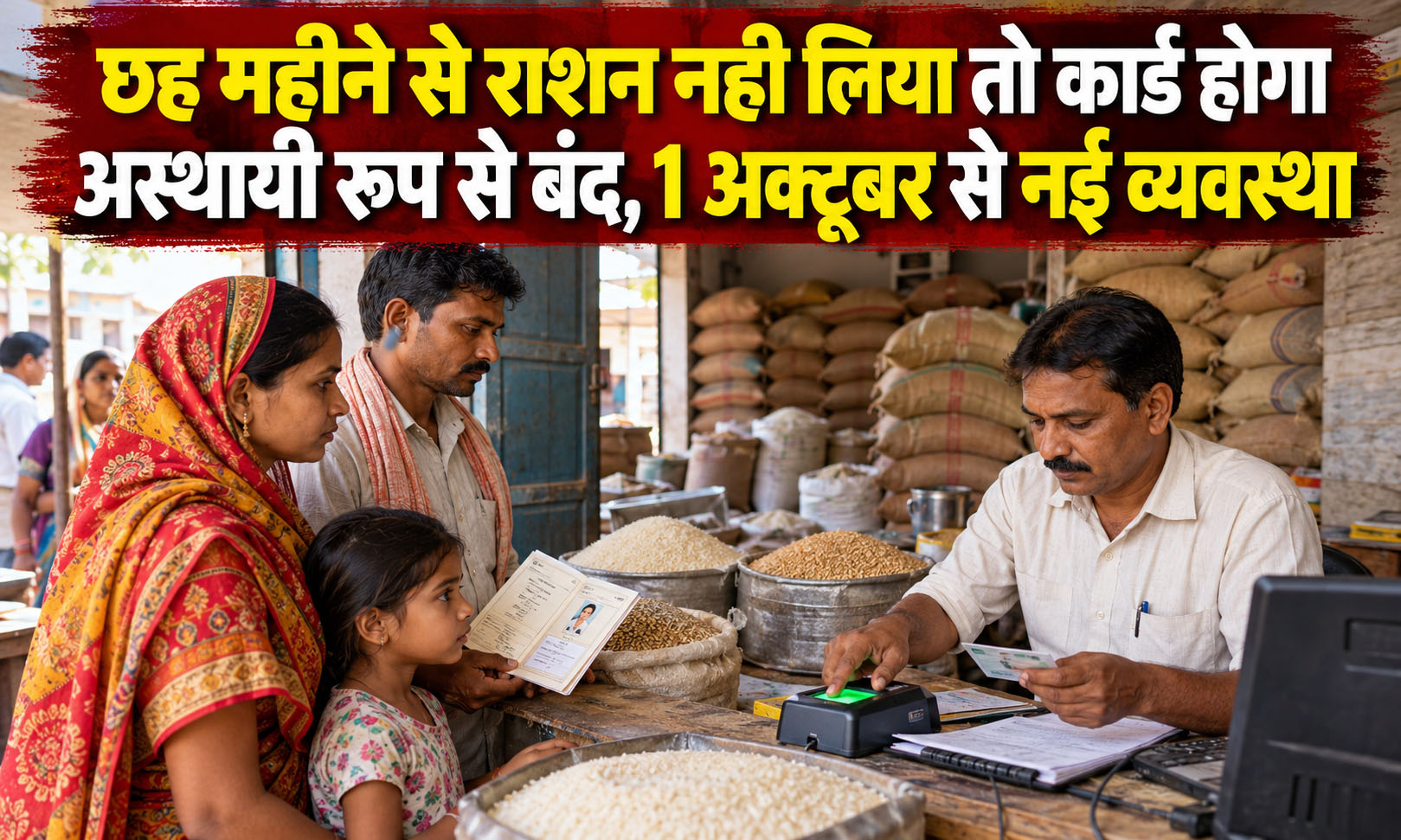
New Delhi. Important changes in the Public Distribution System (PDS) are going to be implemented for ration card holders from October. Such ration cards, from which grains have not been taken for six consecutive months, can be temporarily closed by considering them as ‘silent’ or inactive cards. The Central Government has prepared a new system for identifying such inactive ration cards and duplicate beneficiaries in the SMART-PDS system, which will be implemented from October 1, 2026.
The objective of the new system is to make the database related to ration distribution more accurate and to identify such beneficiaries in whose name ration is not being taken for a long time. Along with this, duplicate, doubtful and ineligible beneficiaries will also be investigated. The government says that this will help in delivering food grains to the genuinely needy families and removing incorrect or duplicate records present in the PDS.
However, not taking ration for six months does not mean that the ration card will be immediately canceled forever. According to the Centre’s new Standard Operating Procedure i.e. SOP, such cards will first be temporarily deactivated. After this, the concerned beneficiary will be given three months time, in which he will be able to reactivate his ration card by completing e-KYC and necessary verification.
Under this system, the beneficiary will have to prove that he is still eligible for the government ration scheme. For this, Aadhaar based e-KYC, information related to mobile number and other necessary records can be verified. After the verification is found correct, the ration card can be reactivated and the beneficiary will be able to get food grains again.
Therefore, the most important thing for ration card holders is to check the status of their records if their card has not been used for a long time. Especially those families, who due to some reason have not been able to get ration for six months or more, may need to update e-KYC and other details timely.
The government is also emphasizing on identification of duplicate beneficiaries in the PDS database. In many cases, situations like the name of the same person being recorded in different records, name persisting after the death of a family member or benefits continuing even after the eligibility has ended. Such records will be identified through the new digital system.
This process will also work automatically in the SMART-PDS system. If no ration transaction is recorded from a card for a specified period, the system can identify it as an inactive card. After this, the state government and the concerned food department can proceed with the verification process.
The central government has also asked the states and union territories to play an active role in this process. Verification of beneficiaries will be done at the local level, as the responsibility of issuing ration cards and checking eligibility rests primarily with the states and union territories.
In Jharkhand too, preparations have been made to suspend ration cards which have not been used for six months from October 1. The state food department has said that a campaign will be launched to identify and verify inactive cards. Action has already been taken to remove lakhs of ineligible ration cards in the state.
The scope of digital verification in the ration system has continuously increased in the recent past. According to the central government, by the end of July 2026, the e-KYC coverage of ration beneficiaries had reached more than 90 percent. The government has also implemented a new process for linking mobile numbers and updating e-KYC based records through ePOS machines.
The objective of this entire exercise is to ensure that only eligible beneficiaries receive free or subsidized ration under the National Food Security Act. Due to the records remaining inactive for a long time, there is a possibility of irregularities in the quota and beneficiary list of the states. After removing such names, it can also help in giving place to the people who are eligible but are still out of the list.
Ration card holders should also keep in mind that there is no need to panic if the card becomes inactive. If the beneficiary is indeed eligible, he will have the opportunity to reactivate his card through verification and e-KYC. In the new SOP, a re-verification period of three months has been kept for this.
At present, there is no mention of direct and permanent termination of all cards inactive for six months in the information available officially. The system is first of temporary deactivation and then verification. Therefore, the most important step for cardholders who have not taken ration for a long time will be to check their ration card status, e-KYC and Aadhaar related information.
Identification of inactive, duplicate and suspicious records is expected to speed up after the new system is introduced in SMART-PDS from October 1. In such a situation, it will be necessary for the cardholders to complete the verification on time, so that despite being eligible, their ration benefits are not disrupted.