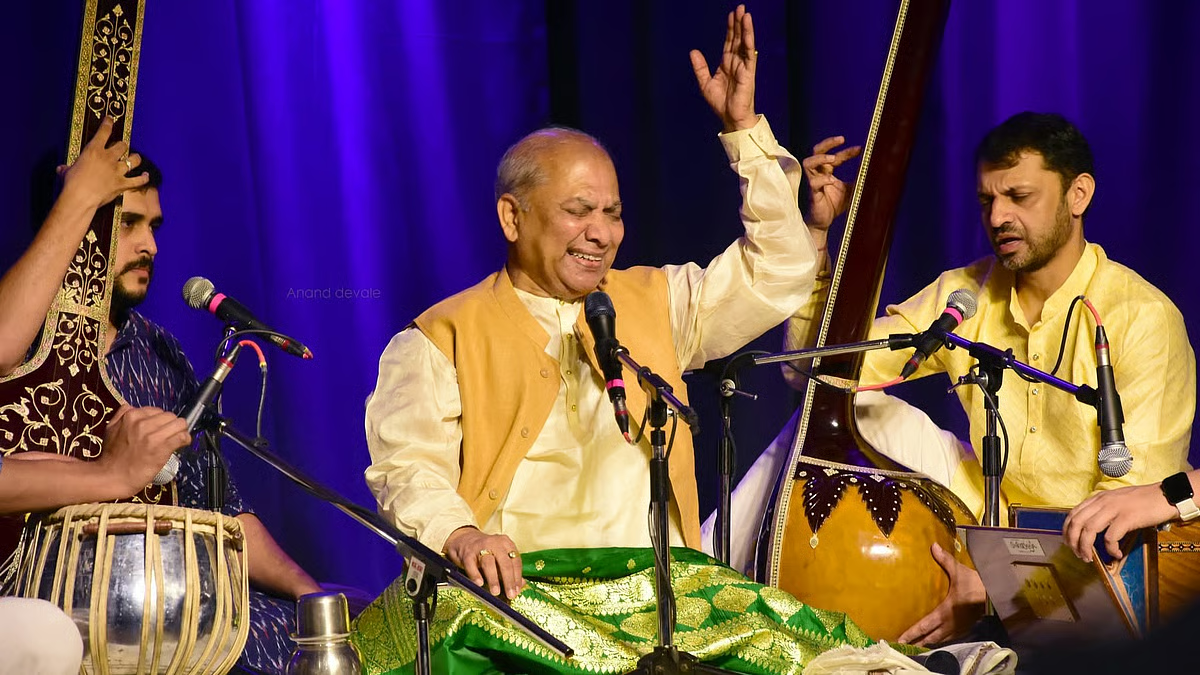
Indian classical music has that otherworldly quality to it, especially when morning ragas are concerned. But few know about that. Pt Suhas Vyas, a big torch-bearer of Indian classical music, will be presenting such morning ragas in Mumbai at the Morning Ragas – Unique Experiences of Rare Ragas. The concert series conceptualised and organised by Pancham Nishad and presented by Grace Foundation is on July 12 at Ravindra Natya Mandir from 10 AM onwards.
The son of the doyen of Indian classical music, Pt. CR Vyas, he carries his legacy with aplomb. Among the awards bestowed upon him are the Pandit Basavraj Guru Puraskar by the Govt of Karnataka and the Pandit Jitendra Abhisheki award in 2024. He also performed at the inauguration of Kartavya Path in front of the honourable PM and other Indian ministers, at the BRICS summit in China in 2017 and all across the globe. He is a top-grade artist of All India Radio. Hear Pt. Vyas speaks about the concert series and more.
Excerpts from the interview:
What is the concert series ‘Morning Ragas’ about? Is this about rare bandishes?
In Indian music, there are eight prahars or segments. Early morning starts at 4.45. Today, there are more evening concerts. Earlier, concerts ran throughout the night, where you heard all the ragas. Now, you don’t get to. Shashi (Vyas, founder and MD of Pancham Nishad) had the idea that some ragas don’t get sung often. Because concerts are in the evening, many of the same ragas get repeated. There are 4,484 ragas in Indian music. Around 150 ragas can be sung. Usually, 50 ragas are sung. People can get bored hearing the same ones. The idea came that there are such morning ragas that the singer can present to the audience.
What will the listeners hear in the concert?
There is a soothing raga called Ahiri Lalat of Maihar Gharana belonging to Ustad Allauddin Khan. But it is used more on instruments. Vocally, it was introduced and composed by my father. The second raga is my father’s, Dugam Hindol. Among the six basic ragas, Hindol raga was sung in shuddha madhyam years back. It is now sung in teevra madhyam. My father wondered about the effects of combining these two madhyams and created this raga.
After the interval, there is Baradi Todi. This traditional raga is usually sung after 10 AM. I am not sure but it was first sung by my father. It combines three ragas. Then, I will sing Dev Gandhar, a traditional raga. It is sung in two ways. You will not find the knowledge of prevailing raga anywhere in the scriptures. After that, there is a raag called ‘Salang’ found only in the books of Ramakrishnanhau Vaze. These two pieces are sung very rarely. I will end with Jogiya Asavari. It is a blend of Jogiya and Asavari.
There are many morning ragas that are sung. Sadly, not many are there to tell all this. Shashi thought these ragas should be sung in front of people. But it is a challenge for the singer, too. You have to sing one raga after the other. The first thing is to create the ambience of the raga. There are 4,400 types of ragas. It is important to know which ones can be sung.
Also, the raga has a personality. It has to be shown while singing. And that is a difficult task. So, when people get a chance to present a raga, they don’t present a complex raga. In our musical language, we call them ‘Aam raga’ and ‘Anuvat raga’. ‘Aam’ means ‘prevalent’. ‘Anuvat’ means infrequent. So, singing the Anuvat raga needs command and is difficult.
What impact does the morning raga have on people?
Firstly, nature and music always go hand in hand. When you wake up in the morning, how is your mental state? How is it in the afternoon, in the evening, or at night? These four mental states are different.
In the morning, a person is full of energy. If you sing Marwa in the evening, the feeling of listening to it is similar to twilight. Similarly, in the morning, Bhairava raga or Lalat raga says something different. Bilaval is sung in the morning, and Yamak in the evening. These are bigger ragas. You can sing Bilaval, Todi, Bhairava and Ahir Bhairava for as many hours.
The second technical thing is Rishabh (second swara) and Dhaivat (sixth swara). Re and Dha are heard differently in the morning raga. Similarly, evening ragas feel different in the evening. The reason is the treatment.
The important point is your mental state. In the morning, the singer sings around Brahma Murta. There are different ragas for this time based on two madhyams of music – shuddha and teevra madhyam. As they increase and decrease, the ragas change. In Brahma Muhurta, the teevra madhyam decreases, and Bhairava starts. When the shuddha madhyam of Bhairava decreases, Todi comes into the picture.
After 12-12.30 pm, the two madhyams meet again. The pure Sarang raga is performed. In the afternoon, the teevra madhyam is more powerful. There are morning ragas and afternoon ragas. So, all these are formed in these two madhyams.