
Budget 2026–27 Repositions Make in India 2.0 as a Jobs Engine, Shifts Focus to Manufacturing-Led Employment
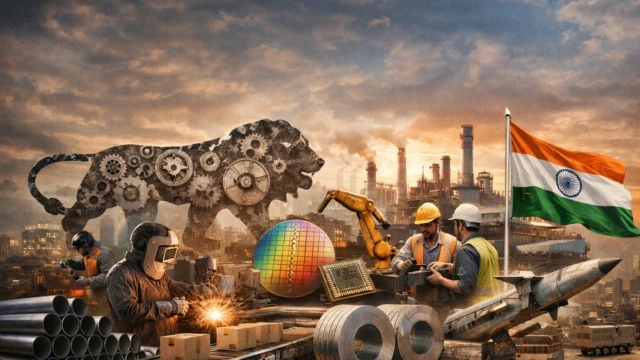
The Union Budget 2026–27 has given a decisive push to Make in India 2.0, signalling a clear policy shift towards manufacturing-led job creation as the government looks to address employment challenges while strengthening domestic industrial capacity.
Rather than headline-grabbing giveaways, the Budget has quietly aligned multiple policy levers capital expenditure, sector-specific manufacturing incentives, customs rationalisation and skill-linked employment support towards reviving labour-intensive and high-value manufacturing. Officials and industry observers view this as a recalibration of the original Make in India programme, with sharper emphasis on employment outcomes.
Manufacturing-linked job creation has emerged as a central theme, with the Budget reinforcing sectors such as electronics, semiconductors, defence production, renewable energy equipment and MSME-driven manufacturing ecosystems. Continued support for Production-Linked Incentive (PLI) schemes, combined with targeted import-duty corrections, is expected to improve domestic value addition while reducing reliance on critical imports.
The Budget’s capital expenditure push is also seen as indirectly supporting Make in India 2.0 by creating demand for domestically manufactured steel, cement, capital goods and engineering products sectors that are employment-intensive across supply chains. Industry estimates suggest that sustained capex-led demand has a multiplier effect on both direct and indirect job creation.
Policy clarity on customs duties and input costs has been another key signal for manufacturers. By reducing tariff inversions and simplifying compliance, the government aims to improve cost competitiveness for Indian manufacturers at a time when global supply chains are diversifying away from single-country dependence.
Importantly, the renewed Make in India thrust is positioned not as a protectionist move, but as a strategic response to global geopolitical shifts, supply-chain disruptions and slowing external demand. Officials indicate that the second phase of the programme will prioritise scale, technology adoption and workforce skilling alongside employment generation.
While industry bodies have largely welcomed the direction, they have underlined that execution will determine outcomes. Faster project approvals, smoother credit access for MSMEs and timely implementation of incentive schemes will be critical to translating policy intent into jobs on the ground.
With Budget 2026–27, Make in India 2.0 appears less about slogans and more about outcomes marking a shift towards using manufacturing as a sustained engine for employment, resilience and long-term growth.