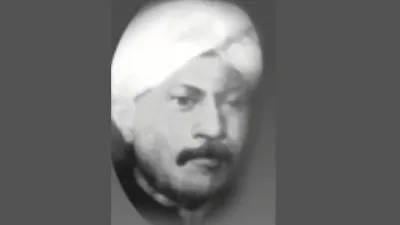
Assam: On his 125th death anniversary we would like to commemorate the life and legacy of Dutiram Hazarika, one of Assam’s prolific historians, who belonged to the Baniya community of Assam. Dutiram Hazarika was born on September 22, 1806 and died on July 1, 1901. The history of Assam in the 19th century cannot be written without engaging with Dutiram Hazarika’s profound historical work.
Dutiram Hazarika received his early education from Bhayaram Barpujari’s tol at Jorhat. As a disciple of Dihing Satradhikar, Dutiram learned the arts that were essential to become a skilled Bhakat. Dutiram was also well read in the Assamese scriptures and the ecclesiastical history of the region. He composed music and took part in Bhawans, and acted in Vaisnava dramas.
Dutiram was a well-trained goldsmith. From a very early age, Dutriam was skilled at the intricate process of making various kinds of gold jewellery and he also mastered the art of Minakara, a process of setting delicate jewels on green surfaces. As an expert goldsmith, he gained entry into the inner circle of King Purandar Singha’s household.
Dutram had a comprehensive understanding and knowledge of the history of Assam. Ahom King Purandar Singha would invite Dutiram to his palace without any hesitation to hear the stories of Assam history from Dutiram. Moreover, the King Purandar Singha asked his son Kameswar Singha Juvaraj to share with Dutiram all traditions preserved in Ahom royal families which immensely enriched Dutiram’s knowledge on Assamese factlore. Dutiram Hazarika was commissioned to compile a history of Assam by Kameswar Singha and as a result Dutiram Hazarika produced the Kali Bharat Chronicle. He worked rigorously on the Kali Bharat chronicle even after the death of Purandar Singha in 1846 and his son, Kameswar Singha in 1852. Although the exact date of composition of Kali Bharat cannot be ascertained, yet it can be assumed that author Dutiram Khazarika was working till 1862 when the last incident was recorded in the book. He was revising the book even after 1862 and the final copy of the Kali Bharat was produced after 1873 (Bhuyan, 2008).
Dutiram titled his book as Kali Bharat, which literally means epic of Bharat in the Kali Age. Dutiram’s book, Kali Bharat Buranji can be regarded as a complete history of Assam from 1679 to 1858 as it incorporates events from the accession of the Sulikpha Ratnadhwaj Singha Lora Raja in 1679 to the transfer of territories of the Honourable East India Company to the Crown in 1858 (Bhuyan, 2008).
In his Kali Bharat Buranji, Dutiram Hazarika had himself narrated about his auto-biography in the chapter, “গ্রন্থকাৰৰ আত্মপৰিচয়।” (Author’s Autobiography) from pages 183-186. The author, Dutiram Hazarika, regrets that he was not born within the pale of four castes. For which he was discriminated against or stigmatised as Akulin or a casteless one. In his words:
The author also stated that his name is Dutiram and he is Banik (or Baniya ) by caste and his gram, his place of residence, is Jorhat and his father was Sonbar Hazarika. Dutiram also says that his grandfather was also a Hazari, who were bestowed with the immunities enjoyed by non-paik subjects under the reign of King Lakshmi Singha. Dutiram says,