Assam: How BJP Has Weaponised Turncoats To Create An Epic Ex-Congress Versus Congress Battle
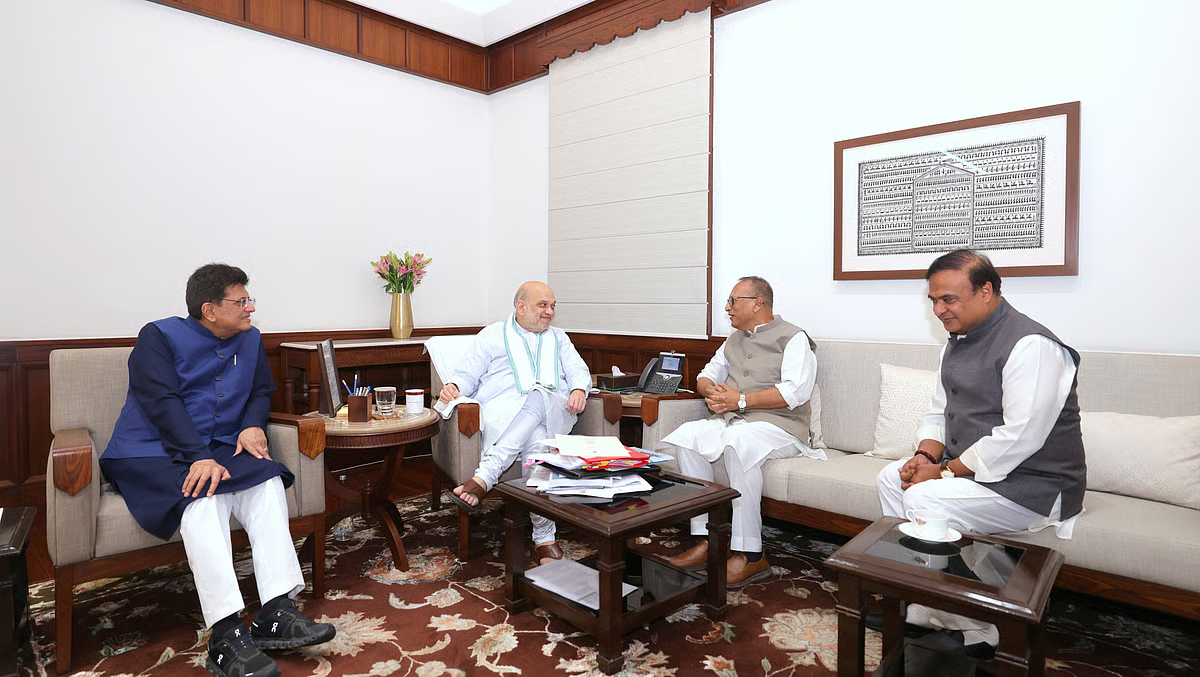
Assam: The 2026 Assam Assembly elections have evolved into an unprecedented ‘civil war’ of political identity, where the Bharatiya Janata Party (BJP) is effectively deploying a sophisticated ex-Congress vanguard to dismantle the remaining fortress of the Grand Old Party.
This strategy is not merely about gaining seats but about a total organisational absorption that has turned the electoral map into a mirror image of the state’s former political order.
From high-profile ingress to immediate nomination
The most dramatic shifts in this election cycle occurred just days before the nomination deadlines, signalled by the arrival of two of the Congress party’s most influential pillars. Pradyut Bordoloi, the incumbent Nagaon MP and former three-time minister under the then chief minister Tarun Gogoi in the state, formally donned the saffron scarf on March 18, 2026, citing a sense of “humiliation and sidelining” within his former party.
His immediate nomination for the Dispur seat marks his first-ever contest under the BJP banner, symbolising a total bridge-burning with his three-decade-long legacy. This was preceded by the defection of Bhupen Kumar Borah, who resigned as the Assam Pradesh Congress Committee (APCC) president to join the BJP on February 22, 2026. Borah, who represented Bihpuria from 2006 to 2016 but lost the last two elections to the BJP, has returned to his home turf as a BJP candidate, completing a “homecoming” transition after 32 years in the Congress.
Legislative defection block
Beyond the state-level leadership, the BJP has successfully integrated a block of sitting legislators who have been supporting the government from within the Assembly for over two years. On March 5, 2026, Kamalakhya Dey Purkayastha, the sitting MLA for Karimganj North, and Sashi Kanta Das, the MLA for Raha, formally joined the party after long periods of suspension from the Congress.
For both leaders, this 2026 election will be their first time contesting as official BJP candidates, though they have functioned as “soldiers of the party” in legislative spirit since 2021.
Established turncoats and 2021 success model
The 2026 list also rewards the “Class of 2021,” a group of defectors who have already proven their loyalty and electoral worth. This cohort is led by Ajanta Neog, who joined the BJP in December 2020 after terming the Congress “visionless.” Having already won the Golaghat seat in 2021 as a BJP candidate, she enters the 2026 fray as a seasoned incumbent within the saffron fold.
Similarly, Rupjyoti Kurmi and Sushanta Borgohain, who resigned from Congress in 2021 citing a lack of leadership in the Gandhi family, have already successfully contested by-polls under the BJP banner. For these leaders, the 2026 election is their second major poll for the BJP, solidifying their transition from opposition firebrands to core components of the ruling establishment.
Marginalising the ‘old guard’
The influx of high-profile turncoats has created a palpable identity crisis within the BJP’s grassroots, as the party’s original ideological guardians find themselves increasingly marginalised by the same Congress leaders they once spent decades opposing.
This displacement is most visible in the 2026 candidate selection, where 18 sitting MLAs—many of them long-term party loyalists like former state president Siddhartha Bhattacharya and minister Nandita Garlosa—were dropped to accommodate new entrants. For the original BJP cadre, the displacement is not just political but existential.
They feel that the party’s decision-making apparatus has been hijacked by a Congress-style functional culture that prioritises immediate electoral optics over long-term ideological purity. This top-down imposition of candidates has effectively silenced the internal feedback loops that veteran activists once relied on, leading to rare public displays of dissent, such as the resignation of Nihar Ranjan Das in Dholai.
As the party’s core DNA shifts toward this hybrid model, many veteran workers fear they are becoming “outsiders in their own home,” relegated to the role of mobilising votes for the very leaders they once sought to defeat.
Architects of transition: The 2015 legacy
At the apex of this ex-Congress phenomenon stands the chief minister himself, Himanta Biswa Sarma, who fundamentally altered Assam’s political trajectory when he left the Congress in August 2015.
Sarma’s defection, rooted in a famous rift with the then-leadership over the party’s future, has seen him lead the BJP through two successful general election cycles in 2016 and 2021.
His inner circle—including Pijush Hazarika and Jayanta Malla Baruah—all share this 2015 pedigree and are now veterans of multiple BJP campaigns. Together, they represent the foundational layer of the ‘Saffron Congress,’ a group that has moved from being turncoats to becoming the very architects