
AquaEx Northeast in Sikkim: A Major Platform Created for the Fisheries Industry
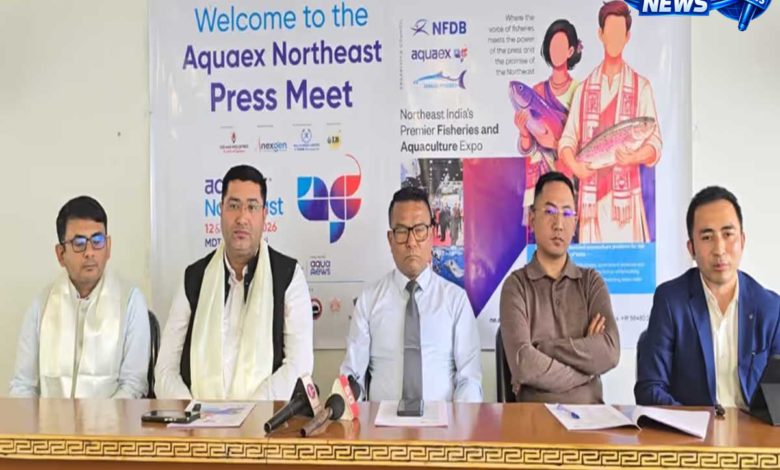
Sikkim: The National Fisheries Development Board (NFDB) will organise AquaEx Northeast, a two-day fisheries and aquaculture expo, on June 12 and 13, 2026, with the aim of creating a common platform for fish farmers, technology providers, experts, government agencies and investors from across the Northeast region.
The event, described as Northeast India’s premier fisheries and aquaculture expo, is expected to focus on aquaculture business networking, technology exchange, training and investment opportunities in the fisheries sector.
Speaking about the event, Rajnish Kumar, Governing Board Member of the National Fisheries Development Board under the Ministry of Fisheries, Government of India, and partner of AquaEx, said the programme was aimed at creating awareness in society about fisheries and aquaculture opportunities.
“This event works to create awareness in society. This is our tenth edition, which we are going to organise in Assam and the Northeast,” Kumar said.
He said India was currently not facing a food shortage but a protein shortage, and fisheries could play a major role in addressing the issue.
“Fish is one such food item that provides the highest quality protein, the cheapest source of protein, and has an excellent amino acid profile,” he said.
Kumar said AquaEx was designed especially for freshwater and inland water states and had been structured around three major focus areas. The first area, he said, was farmer interaction with exhibitors and companies connected to fisheries and aquaculture.
According to him, farmers continue to face several challenges during the pre-harvest stage, including difficulty in getting quality fish seed, proper feed, technical support and modern farming technology. He added that post-harvest challenges also remain serious for many fish farmers.
“A farmer may complete harvesting, but if he does not get a good marketplace, then despite working the hardest in the entire supply chain, he receives the least profit,” Kumar said.
He said companies participating in the expo would help farmers understand market opportunities and entrepreneurship possibilities in the fisheries sector.
“This is truly the era of entrepreneurship and we need to promote them,” he added.
Kumar said the second vertical of the expo would include seminars and technical sessions involving industry experts, professional farmers, ICAR scientists and specialists from different sectors including fish seed, feed, ornamental fisheries and banking.
“These discussions will focus on how modern technologies and systems can be implemented effectively at the grassroots level,” he said.
The third vertical, he said, would focus on investment opportunities in the Northeast fisheries sector. According to Kumar, several sectors in the region, including aerators, IoT-based fisheries systems and fish processing infrastructure, still remain underdeveloped despite having large potential.
“In Assam and the Northeast, there are huge opportunities in areas like aerators, IoT-based fisheries and processing, but these sectors are still underdeveloped here,” he said.
He urged farmers to make full use of the two-day event through direct interaction with experts and companies.
“If you have knowledge, practical exposure and a good mentor, success becomes possible,” Kumar said, while also requesting media organisations to spread awareness about the programme.
He added that official communication regarding the event had already been sent to officials of the Fisheries Department and the Government of Sikkim.
Assistant Director of the Fisheries Department, Surendra Bhandari, said the fisheries sector in Sikkim had witnessed significant progress after the launch of government-supported schemes in 2021.
“Through this scheme, there are now around 2,000 fish farmers in Sikkim who are active farmers,” Bhandari said.
He said total fish production in the state had increased sharply over the past few years. According to him, fish production, including rainbow trout, carp farming and fish capture from streams and rivers, stood at around 453 metric tonnes during 2021-22. It has now increased to nearly 1,070 metric tonnes.
Bhandari attributed the increase mainly to schemes such as the Pradhan Mantri Matsya Sampada Yojana, which is being jointly implemented by the Central and State Governments.
He said fish seed and feed continue to remain among the biggest challenges for fish farmers in the state. Earlier, most trout farmers depended on fish seed brought from outside Sikkim.
“Now our farmers have started producing fish seed themselves, and we even have excess seed production,” he said.
According to Bhandari, Sikkim currently has enough rainbow trout seed production capacity to supply other states as well.