
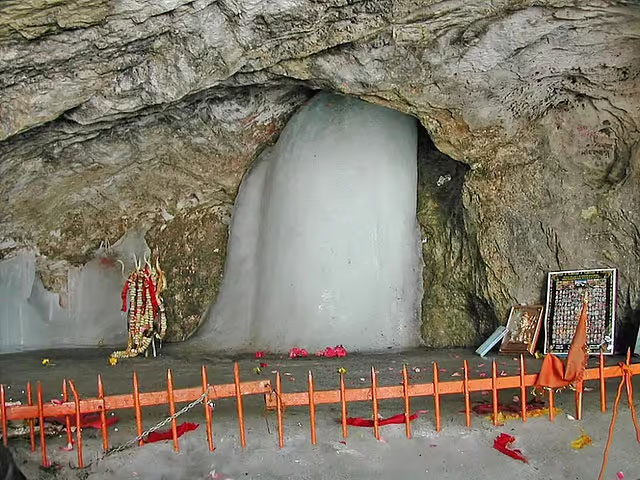
Jammu: The annual Amarnath Yatra to the sacred Amarnath cave shrine in the South Kashmir Himalayas began on Friday (July 3). The cave, located at an altitude of approximately 3,880 meters above sea level, houses a naturally formed Shivalinga of ice, which devotees worship as a symbol of Lord Shiva. An atmosphere of devotion and enthusiasm prevailed throughout the route as the yatra began.
According to officials, the first batch of pilgrims departed from two major base camps: Nunwan-Pahalgam in Anantnag district and Baltal in Ganderbal district of central Kashmir. These two routes are considered the main routes for the Amarnath Yatra, leading pilgrims to the holy cave.
This year, the yatra is being conducted via two traditional routes. The first route is the Nunwan-Pahalgam route, which is approximately 48 kilometers long and is considered longer but more traditional. The second route is the Baltal-Paldal route, which is approximately 14 kilometers long and is considered shorter but more difficult.
Despite intermittent rain, the yatra commenced on time. The administration stated that weather conditions are being continuously monitored and all necessary arrangements have been made for the safety of the pilgrims. The yatra commenced early in the morning from both routes, generating enthusiasm among the pilgrims.
A large number of pilgrims, including men, women, and sadhus, participated in this annual religious event. People from various parts of the country participate in this religious event. As the yatra commenced, chants of “Bam Bam Bhole” echoed at both base camps, filling the atmosphere with devotion.
Local administration officials, including the Deputy Commissioners and Superintendents of Police of the respective districts, formally inaugurated the yatra by hoisting the flag at the base camps. After this, pilgrims were allowed to proceed in a phased manner.
Earlier on Thursday, Lieutenant Governor Manoj Sinha flagged off the first batch from the yatri base camp in Bhagwati Nagar, Jammu. This first batch, comprising over 4,809 pilgrims, departed for Kashmir amid tight security.
The administration has made stringent security arrangements for the pilgrimage. Security forces have been deployed along the entire route, and surveillance has been strengthened. Health facilities, relief camps, and emergency services have also been activated to provide assistance to pilgrims in case of any emergency.
Weather poses a significant challenge during the pilgrimage, as sudden weather changes are common in the high Himalayan region. Keeping this in mind, the administration has advised pilgrims to exercise caution and follow the instructions.
Every year, millions of pilgrims participate in this pilgrimage to visit the naturally formed ice Shivalinga in the Amarnath cave. This pilgrimage is not only a symbol of religious faith but also an example of discipline and order in difficult geographical conditions.
The administration has already made extensive preparations for this year’s pilgrimage. Infrastructure, medical aid stations, and security arrangements have been strengthened along both routes. Disaster management teams have also been deployed.
With the start of the Amarnath Yatra, a wave of religious and cultural activities has intensified in the Kashmir Valley. Anticipating the large number of pilgrims, the administration has decided to continuously monitor all arrangements during the pilgrimage period.


