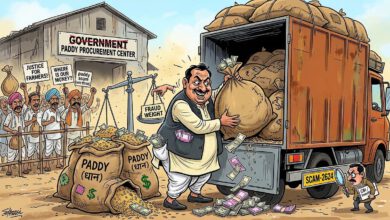
Maharashtra. An alleged case of irregularities in the distribution of sugar under the ‘Antyodaya Anna Yojana’—a scheme designed to provide food security to economically weaker families—has come to light. A complaint alleges that approximately 400 to 500 kilograms of sugar, intended for the scheme’s beneficiaries, was diverted to a different location instead of being delivered to its designated destination. It is alleged that this sugar was sold at a ‘fair price shop’ (ration shop) located on the Pimpalgaon (Najik)-Waki Road. The incident has sparked resentment among local residents, who assert that rations allocated for the poor should reach the intended, eligible beneficiaries.
Under the Antyodaya Anna Yojana, food grains are provided at subsidized rates to the most economically vulnerable families, with the primary objective of ensuring food security for those in need. However, this alleged irregularity in sugar distribution has raised questions regarding the transparency and oversight mechanisms of the Public Distribution System (PDS).
The complaint claims that about four to five quintals of sugar, meant for the beneficiaries, were diverted elsewhere and sold. The fair price shop where the sugar was allegedly sold is situated on the Pimpalgaon (Najik)-Waki Road. It should be noted, however, that the allegations made in the complaint have not yet been independently verified.
Local residents point out that the government provides food supplies through various schemes to offer relief to poor and needy families. If rations intended for the beneficiaries are sold elsewhere instead of reaching them, the core purpose of the scheme is undermined. The community has expressed strong dissatisfaction regarding these alleged irregularities in the distribution of rations.
The Antyodaya Anna Yojana is a significant initiative aimed at providing food security to the poorest families in the country. For economically weaker households, government-provided rations help alleviate the burden of domestic expenses. Consequently, any irregularity in the distribution of food supplies directly impacts the families who need this support the most. In this case, verifying the entire process—from the allocation of sugar to its final distribution—will be crucial. Comparing the quantity of sugar allocated to the specific shop, the amount actually distributed to beneficiaries, and the remaining stock could clarify the validity of the complaint. Transport-related documents and stock registers may also prove significant in the investigation.
Under the Public Distribution System (PDS), essential food items are provided to eligible ration cardholders through ‘fair price shops.’ This system requires maintaining records of the allocation, storage, and distribution of these food items. Any discrepancy between the recorded figures and the actual stock can serve as a basis for investigating potential irregularities.
Ensuring regular inspections and accountability is essential for the effective functioning of government schemes. Transparency can be enhanced by making information—such as the details of available food items, prescribed rates, and distribution procedures—accessible to the beneficiaries. Furthermore, an effective grievance redressal mechanism would allow families in need to bring their concerns to the attention of the relevant authorities.
This complaint, which emerged in Maharashtra, once again highlights the importance of monitoring government-run ration distribution. For economically vulnerable families, the regular supply of food items is of critical importance; purchasing these goods from the open market can impose an additional financial burden. Consequently, the timely distribution of supplies under government schemes is vital.
According to the complaint, approximately 400 to 500 kilograms of sugar were diverted elsewhere instead of being distributed to the intended beneficiaries. However, detailed information—such as the number of individuals involved in the alleged misappropriation, the origin of the sugar, and the price at which it was sold—is not yet available. The perspective of the ration shop operator in question has also not yet been presented.
If the investigation confirms the complaint, it could form the basis for fixing responsibility and taking action against the individuals involved, in accordance with the rules. Additionally, it will be essential to identify the affected beneficiaries and ensure they receive the food supplies to which they are entitled. Currently, there is resentment among local residents regarding alleged irregularities in the distribution of sugar under the Antyodaya Anna Yojana. Accusations that sugar allocated for poor families was sold elsewhere have raised questions about the ration distribution system. All eyes are now on the relevant Department of Food and Civil Supplies for an official response and the action taken in light of the complaint.