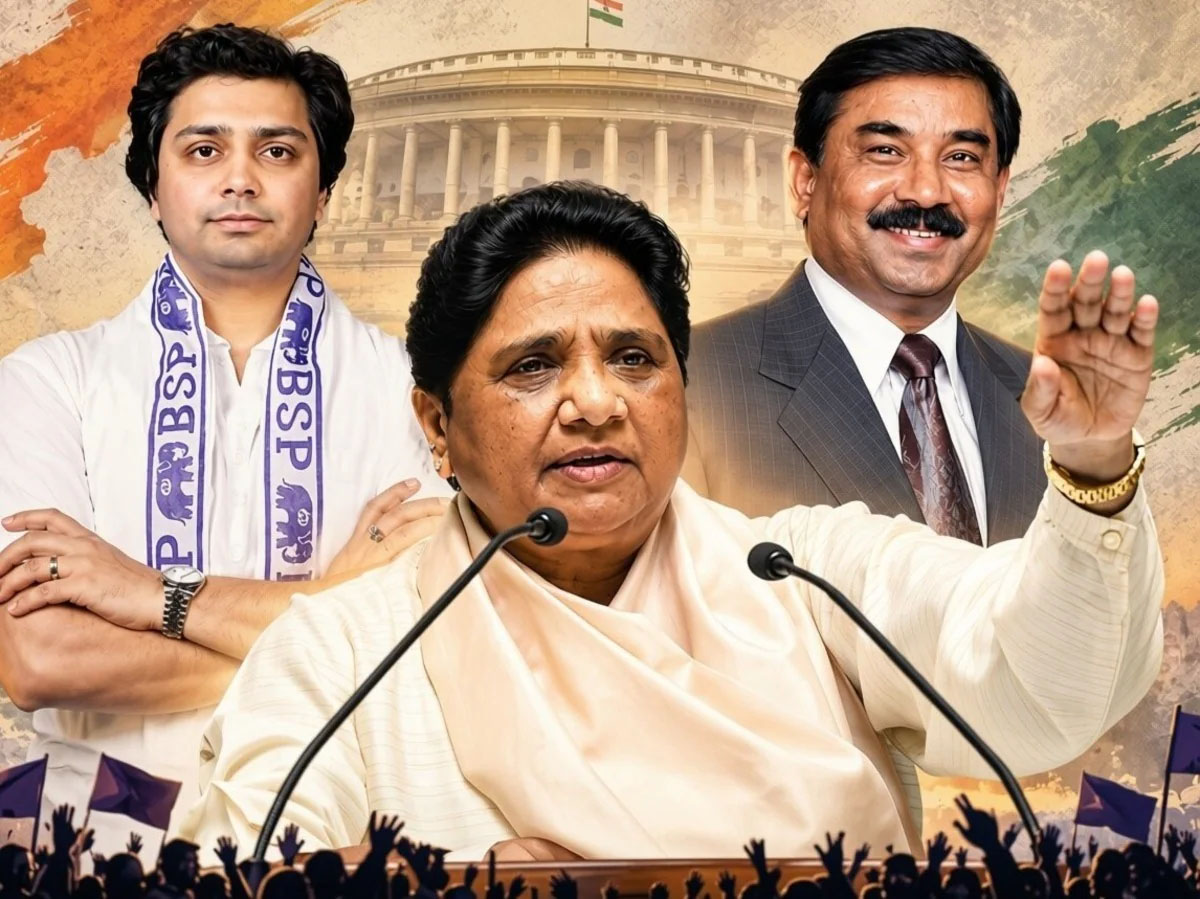
Lucknow. The issue of family and succession has once again taken center stage in the politics of the Bahujan Samaj Party (BSP). BSP supremo Mayawati is continuously taking new decisions to quell internal turmoil and maintain a firm grip on the organization. These moves are being viewed as efforts to safeguard the party’s legacy and identify future leadership. After decisions involving her elder nephew Akash Anand—such as assigning him responsibilities, subsequently removing him from his post, and eventually expelling him from the party—speculation about bringing her younger nephew, Ishan Anand, to the forefront has added a new layer of intrigue to BSP’s internal politics.
Mayawati took over the reins of the party after its founder, Kanshiram, and played a decisive role in Uttar Pradesh politics for a long period. Serving as the state’s Chief Minister four times, she steered the BSP to the pinnacle of power. Throughout this political journey spanning nearly 23 years, Mayawati personally made almost all critical decisions regarding the organization and electoral strategy; her word within the party has always been final. Consequently, any development concerning the BSP’s future or its political successor is invariably linked directly to Mayawati.
In recent years, Akash Anand had emerged as Mayawati’s likely political successor. He was entrusted with significant responsibilities within the party and tasked with strengthening the organization at the national level. His active participation in election rallies and organizational events conveyed a message to BSP supporters that Mayawati had initiated the process of handing over leadership to the next generation. Akash sought to carve out a distinct identity for himself through his engagement with the youth and an aggressive style of speech.
However, Mayawati’s decisions regarding Akash Anand fluctuated frequently. After being assigned responsibilities, he was removed from his post, only to later regain a significant position within the organization. Subsequently, a decision was made to relieve him of his duties and expel him from the party once again. These repeated shifts have created uncertainty regarding the BSP’s succession plan. According to political observers, this signals that Mayawati wishes to assess a leader’s political maturity and loyalty to the organization before granting them complete, independent control.
Amid the turmoil surrounding Akash Anand, there is growing speculation about bringing her younger nephew, Ishan Anand, to the forefront of public and political activities. Ishan’s presence is being viewed as part of the BSP’s future strategy. Although the party has not officially declared him her successor, his increased activity has sparked various speculations in political circles. Questions are arising as to whether Mayawati is preparing to entrust Ishan with a major organizational responsibility or if his role will remain limited for now.
Mayawati faces a challenge that goes beyond merely choosing a successor. She must cultivate a leadership capable of keeping the BSP’s core social base united, commanding acceptance within the party organization, and confronting opponents in electoral politics. The BSP’s electoral performance in Uttar Pradesh has weakened over the past few years; the party’s vote share and its representation in both the Legislative Assembly and the Lok Sabha have declined compared to the past. Consequently, the new leadership will bear the significant responsibility of revitalizing the organization and bringing back former supporters.
For a long time, BSP politics has revolved around Mayawati’s persona. No other figure with comparable influence and mass appeal has emerged within the organization. Several veteran and influential leaders have parted ways with the BSP over the years, leading to a perceived lack of second-tier leadership. In this context, the choice of a successor becomes even more critical; a wrong decision could breed internal dissent, whereas the right leadership could infuse the BSP with fresh political energy.
The decision to promote a family member is not easy for Mayawati either. The BSP has consistently positioned itself as a party dedicated to social change and the interests of the Bahujan community. Consequently, the opposition could target the party with accusations of dynastic politics. Furthermore, the issue of trust is paramount for Mayawati; she would need to entrust the party and her political legacy to someone in whom she has absolute confidence—both organizationally and personally. The frequent changes regarding Akash Anand have made this test of trust the most critical factor.
Mayawati’s recent decisions also make it clear that she is not yet ready to fully hand over the party’s reins to another leader. She keeps a close watch on every significant organizational development and does not hesitate to alter decisions when necessary. Her supporters view this as a strategy to maintain discipline, whereas political opponents portray it as uncertainty regarding her successor.
Despite speculation about bringing Akash Anand to the forefront, the BSP’s future currently appears tied to Mayawati’s leadership. All eyes will be on whether Akash receives a formal party role in the future or if the path opens for Akash Anand’s return. It is also possible that Mayawati might entrust significant responsibility to an experienced and trusted leader from outside the family. For now, it is evident that the search for a political legacy and a successor within the BSP remains incomplete. Mayawati’s next move could determine not only the internal dynamics within the family but also the party’s future direction.