Water conservation is being strengthened by collective labour
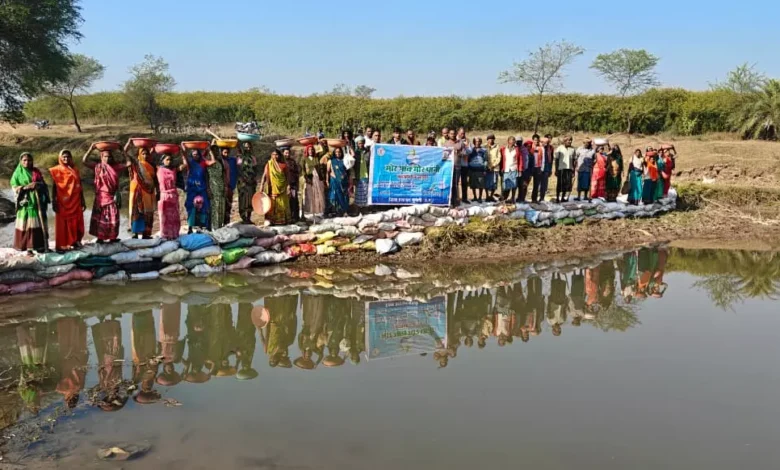
Mungeli. Under the guidance of Collector Kundan Kumar, significant work is being done in the district towards water conservation and improving groundwater levels under the “More Village-More Water” campaign. With public participation at the core, sack bunds are being constructed through collective labor in rural areas, preventing rainwater from flowing into drains and conserving it locally. Before the monsoon season, sack bunds were constructed through voluntary labor at a total of 121 identified sites in the district’s three district panchayats: Lormi, Mungeli, and Patharia. These structures have not only increased rainwater harvesting but are also helping with groundwater recharge, soil conservation, and maintaining moisture in fields. The administration is identifying other suitable sites and encouraging villagers to come forward and contribute their labor.
Extensive efforts to address falling groundwater levels
Groundwater levels have dropped by up to 200 feet in 168 villages of the district, creating a drinking water crisis. Keeping this in mind, in accordance with the vision of Chief Minister Vishnudev Sai, the “More Village, More Water” campaign has been launched under the guidance of Collector Kundan Kumar and District CEO Prabhakar Pandey to maximize rainwater conservation in villages.
Under the Mahatma Gandhi National Rural Employment Guarantee Scheme, activities such as sand filters, livelihood ponds, soak pits, vermicompost, Nadep pits, water harvesting structures, and rainwater harvesting in buildings are being specifically encouraged. A publicity campaign has also been launched to raise awareness among villagers about these initiatives.
Active role of the Water Panchayat Committee and villagers
The active participation of the Water Panchayat Committee, women’s self-help groups, villagers, and public representatives has been ensured in each Gram Panchayat. Through seminars, the causes of falling water levels—overexploitation, lack of drainage, lack of rainwater harvesting, and deforestation—were discussed.
Villagers were encouraged to construct farm ponds, revive traditional water sources, and build rainwater harvesting structures in their homes. They were also introduced to the concept of water budgeting by providing information on groundwater status through GIS tools. Beneficiaries of the Pradhan Mantri Awas Yojana (PMAY) are also being encouraged to construct rainwater harvesting systems.
Livelihood Ponds Will Increase Rural Income:
Under the campaign, 600 willing beneficiaries have been selected for the construction of livelihood ponds. These ponds are expected to generate additional income of approximately 1 lakh rupees per family through vegetable production, fish farming, poultry farming, and pulses and oilseeds farming, enabling rural families to become self-reliant. The Collector stated, “Water conservation is a paramount need today. Through the ‘More Village, More Water’ campaign, continuous efforts are being made to strengthen groundwater levels with public participation.” The District Panchayat CEO stated, “When the community itself takes responsibility for water conservation, the results are long-term and effective.” Overall, the “More Village-More Water” campaign is emerging as an exemplary model of water conservation through coordination of administration, community and modern technologies, which will strengthen the district towards water security in the future.