The High Court dismissed Punjab MP Amritpal’s plea to attend the Parliament session.
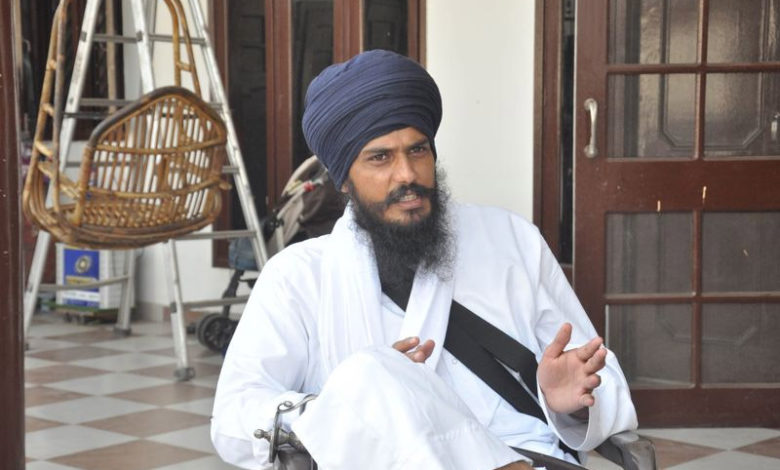
Punjab: The Punjab and Haryana High Court on Friday dismissed Khadoor Sahib MP Amritpal Singh’s plea seeking temporary release to attend the ongoing budget session of Parliament. Among other things, a division bench of the High Court held that a sitting MP held in preventive detention has no constitutional privileges over ordinary citizens and that concerns for public order and state security should trump personal liberty. Amritpal Singh had filed the petition seeking the quashing of the Punjab government’s February 2 order rejecting his plea for temporary release under Section 15 of the National Security Act (NSA), 1980. He had requested release to attend the budget session, convened in two phases from January 28 to February 13 and March 9 to April 2. The bench initially clarified that Article 105 of the Constitution, which deals with the powers and privileges of parliamentarians, does not grant any special or special rights to a detained MP.
Referring to previous precedents, the court said, “All these authoritative decisions clearly state that a sitting MP, who is already in detention, does not have any special or special rights over an ordinary citizen. Therefore, a sitting MP, as well as an ordinary citizen, will enjoy the same special rights and responsibilities as Section 15 of the NSA.” Placing the issue within a broader constitutional framework, the court noted the importance given to preventive detention cases. It noted that while the Constitution was federal in nature, it gave greater importance to the Union in several matters, including legal capacity under the Seventh Schedule. It said, “Matters relating to preventive detention are listed in Item No. 9 of List I—Union List, which reflects the importance given to matters of preventive detention.” The court also cited Article 22, which allows preventive detention under specific conditions, which led to the imposition of the NSA. It stated that under Section 15, the concerned government has the power to grant or refuse temporary release with or without conditions. Examining the impugned order, the bench held that there was “no constitutional or legal infirmity” in refusing temporary release. It relied on the reports of the District Magistrate, Amritsar, and the SSP (Rural), which indicated a continuing threat to public order and the security of the state. Elaborating on the legal principle governing such cases, the Court stated: “Whenever the right to liberty of a person subject to a preventive detention order is at odds with the maintenance of public order and the security of the State, the first and foremost consideration is whether granting liberty would in any way adversely affect the concept of public order and the security of the State.” It further stated that the curtailment of a person’s liberty is considered intrusive and unnecessary even if the concerned authority has the slightest doubt about the possibility of a breach of public order or the security of the State. The bench further clarified that it could not examine the “truth of the material” based on the apprehension of a breach of public order, as it observed that such satisfaction was “subjective” and based on the material available to the competent authority. Concluding that “national interest is paramount over private interests,” the court upheld the state’s decision, saying: “We have no option but to uphold the impugned order.” Punjab was represented by senior advocate Anupam Gupta and others, while the petitioner was represented by senior advocate RS Bains, along with advocates Iman S Khara and Anmol Singh. Additional Solicitor General of India Satya Pal Jain and advocate Dheeraj Jain argued the case for the Centre.