
Madras High Court praised Thalapathy Vijay, despite being a Christian, he respected the faith of the Hindu temple.
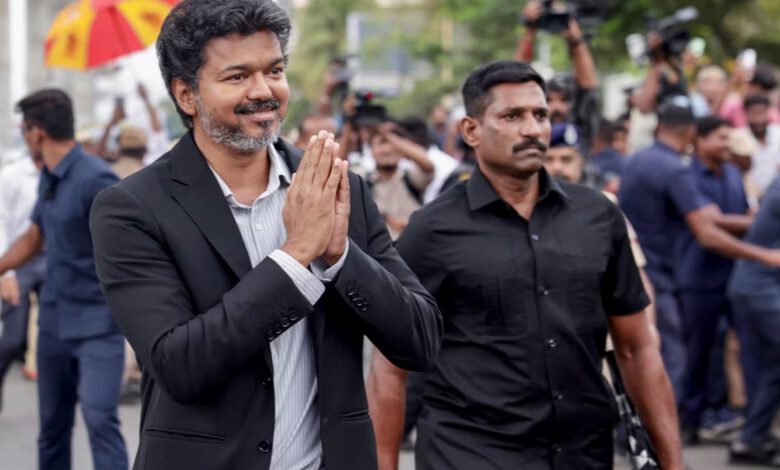
Chennai. Tamil Nadu Chief Minister and famous actor Thalapathy Vijay is once again in the news. This time the reason is not a film or a political statement, but an important comment of the Madras High Court. The High Court praised the conduct of Chief Minister C. Joseph Vijay during the hearing of the case related to entry of non-Hindus in Hindu temples. The court said that despite belonging to Christianity, Vijay followed the rules laid down before entering the famous Meenakshi Amman temple in Madurai and expressed his reverence for the goddess. The court called it a good example of religious inclusivity. A bench of Justices GR Swaminathan and P Murugan clarified that it is not necessary for a person of another religion to change his religion to enter the temple, but it is necessary to show respect for the temple traditions and the worshipable deity. This comment of the court has come at a time when there is a debate going on in Tamil Nadu regarding temple entry and religious traditions.
Chief Minister Vijay had given the manifesto before entering the temple.
During the hearing, the Madras High Court mentioned Chief Minister Vijay’s visit to Madurai in September.
The Chief Minister had visited the famous Meenakshi Sundareshwar Temple on 28 September 2026. On reaching the temple the priests welcomed him with traditional Purna Kumbh honours.
After this, Vijay signed a written declaration following the prescribed procedure of the temple administration.
In this manifesto, he agreed to pay reverence to the deity of the temple and respect religious traditions.
After completion of the formalities, he had darshan of Goddess Meenakshi and Lord Sundareshwar and offered prayers.
The court described this conduct as an example of respect for religious traditions.
High Court said – no need to change religion, respect for faith is necessary
A bench of Justice GR Swaminathan and Justice P Murugan made important observations while referring to the example of Chief Minister Vijay.
The court said that the Chief Minister belonged to the Christian religion, but he was not asked to convert to Hinduism to enter the temple.
They were only asked to consent to express their reverence for the respective goddess and follow the temple traditions.
Calling it an inclusive approach, the court said that harmony can be created between people of different religions with respect for religious faith and traditions.
The bench clarified that the condition of respecting the religious dignity of the temple should not be considered as a compulsion for religious conversion.
Important decision of High Court on temple entry of non-Hindus
The Madurai bench of the Madras High Court has given important guidelines regarding the entry of non-Hindus into the Agamic tradition temples of Tamil Nadu.
The court said that non-Hindu persons entering such temples will have to give a written declaration that they have reverence for the respective deities.
Along with this, they will also have to agree to follow the religious traditions and customs of the temple.
If any non-Hindu refuses to give the prescribed declaration, he cannot be allowed to enter the Agamic temple premises.
The court clarified that the format of the declaration will be decided by the concerned temple administration.
This decision does not apply equally to all religious places, but specifically pertains to Hindu temples in the Agamic tradition.
After all, what are Agamic temples?
Agamic temples are Hindu temples whose construction, worship and religious rituals are conducted according to the traditions described in the Agama scriptures.
In these temples, there are special rules for worship, entry into the sanctum sanctorum and religious rituals.
A large number of ancient temples in Tamil Nadu follow Agamic traditions.
The court clarified that its order pertains to the specific religious system of these temples.
Citing the example of the places of worship of Lord Ayyappa and Shirdi Sai Baba, the bench said that devotees of different religions come there and the nature of their religious traditions is different.
Therefore, the order given in respect of Agamic temples should not be considered as a general restriction applicable to all temples.
Public interest litigation was filed regarding entry into the temple
This case is of Madurai resident. Thangam is related to the PIL filed by Venkatesh.
The petitioner had demanded that the already existing rules regarding entry of non-Hindus in Hindu temples should be strictly followed.
The petition specifically mentioned the rules related to entry beyond the temple mandapam and Kodimaram i.e. the flag pillar.
The petitioner alleged that some political leaders and other persons were entering the temples without following the prescribed religious procedures.
Due to this, the traditions and religious system of the temples are being violated.
The court gave its decision considering these complaints and earlier judicial decisions.
Court’s displeasure over political posturing and flattery
During the hearing, Madras High Court also made strict remarks regarding the behavior of political leaders and their supporters in temples.
The court said that many times political leaders enter temples and their supporters also follow them without caring about the rules.
Linking it to the tendency of political flattery and show-off, the bench said that the religious traditions of the temples are being ignored for political display.