
How did the Tridev originate in Hinduism? Find out what the scriptures say about it.
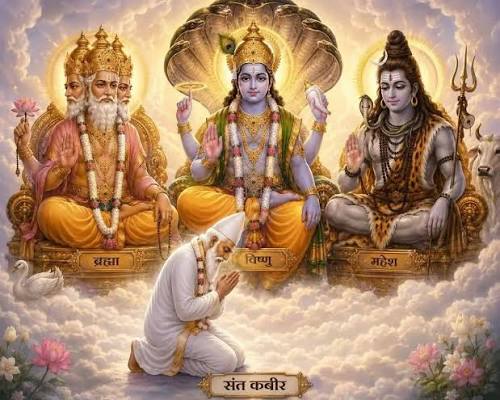
In Hinduism, Brahma, Vishnu, and Mahesh are known as the Tridev (the Trinity). But do you know how they originated? Discover the origins of the Tridev as described in the Puranas, their roles, and the greatest mystery of creation.
Do you know how the Tridev originated? Uncover the profound mystery behind the birth of Brahma, Vishnu, and Mahesh.
In Sanatan Dharma, Brahma, Vishnu, and Mahesh are referred to as the ‘Tridev‘. These three deities are considered the foundation for the functioning of the universe. Brahma is regarded as the Creator, Lord Vishnu as the Preserver, and Lord Shiva (Mahesh) as the Destroyer. However, the question often arises: if Brahma, Vishnu, and Mahesh are the supreme deities of the universe, how did they come into existence?
Answers to this question are found in various forms across different Puranas and religious texts. The purpose of these narratives is to convey spiritual and philosophical truths; they are viewed and understood within the context of religious traditions.
Who are the Tridev?
In Hinduism, the term Tridev signifies three principal divine powers—
Brahma – The Creator of the universe.
Lord Vishnu – The Preserver of the universe.
Lord Shiva (Mahesh) – The presiding deity of destruction and regeneration.
Although their roles differ, these three are considered complementary to one another. The creation, preservation, and transformation of the universe occur through these three powers.
The Mystery of the Tridev’s Origin
Hinduism encompasses multiple traditions and Puranic tales regarding the origin of the universe. According to the most widely accepted belief, only the Param Brahma (Supreme Absolute) or Supreme Consciousness existed at the beginning of creation. From that supreme divine power, three principal forces emerged to govern the universe; these came to be known as the Tridev.
From this perspective, Brahma, Vishnu, and Mahesh are not deities born in the ordinary sense; rather, they are three distinct functional manifestations of the Supreme Truth.
The Narrative in the Vishnu Purana
According to the Vishnu Purana, at the beginning of creation, there was nothing but water all around. Amidst these infinite waters, Lord Vishnu rested upon the serpent Sheshnag in a state of Yoganidra (divine slumber).
After some time, a divine lotus emerged from Lord Vishnu’s navel. Brahma appeared upon that lotus. Following meditation and penance, Brahma commenced the task of creating the universe.
According to this legend, Brahma is believed to have manifested from the lotus that sprang from Lord Vishnu’s navel.
Beliefs from the Shiva Purana
In the Shiva Purana, Lord Shiva is described as Anadi (beginningless) and Ananta (endless). According to this text, Shiva has neither birth nor end; He is considered Svayambhu (self-manifested) and Kalatita (beyond time).
A famous legend recounts a dispute between Brahma and Vishnu regarding supremacy. Suddenly, an infinite Jyotirlinga (pillar of light) appeared, with neither a discernible beginning nor an end. Ultimately, both deities acknowledged that this infinite light was the very form of Lord Shiva.
This story symbolizes the truth that the Ultimate Reality transcends limited forms.
Perspective of the Devi Bhagavata Purana
In the Devi Bhagavata Purana, Adi Shakti (Primal Energy) is regarded as the Supreme Being. According to this tradition, Brahma, Vishnu, and Mahesh (Shiva) manifested from Mahashakti or Adi Parashakti.
This belief holds special significance in the Shakti tradition, asserting that the entire universe and the powers of the deities are manifestations of Adi Shakti.
The Legend of the Linga Purana
The Linga Purana also speaks of Lord Shiva’s formless and infinite nature. It describes how the various forms of the universe expanded from Shiva’s infinite Linga form.
This narrative seeks to explain the spiritual and philosophical dimensions of creation, rather than merely the concept of physical birth.
Roles of the Trideva (The Trinity)
- Brahma – The Creator of the Universe
Brahma is regarded as the knower of the Vedas and the source of origin for all living beings. The four-faced Brahma symbolizes the four Vedas.
- Lord Vishnu – The Preserver
Lord Vishnu maintains the balance of the world and upholds Dharma (righteousness). Whenever unrighteousness prevails, He restores Dharma through various Avatars (incarnations). Sri Rama, Sri Krishna, Narasimha, and Vamana are considered His principal incarnations. 3. Lord Shiva – Destruction and Transformation
Lord Shiva is not merely the deity of destruction; he also symbolizes transformation and reconstruction. His act of destruction paves the way for new creation.
Are the Trideva distinct entities?
Many traditions within Hindu philosophy hold that while Brahma, Vishnu, and Mahesh (Shiva) appear as three distinct divine forms, they are ultimately different manifestations of the same Ultimate Reality or Brahman.
Traditions such as Advaita Vedanta, Vishishtadvaita, Shaivism, Vaishnavism, and Shaktism interpret this concept from varying perspectives. Consequently, there is no single universal narrative regarding the origin of the Trideva; instead, a multitude of religious traditions and interpretations exist.
What is the religious message conveyed?
The stories of the Trideva are not merely tales of origin; they convey the message that creation, preservation, and transformation are all essential to the cosmos. Life itself operates on these very principles—new beginnings occur, sustenance follows, and, in time, transformation takes place.