
Gadag: Rare idol of the three-faced Sun God found in Betageri; sparks curiosity among researchers.
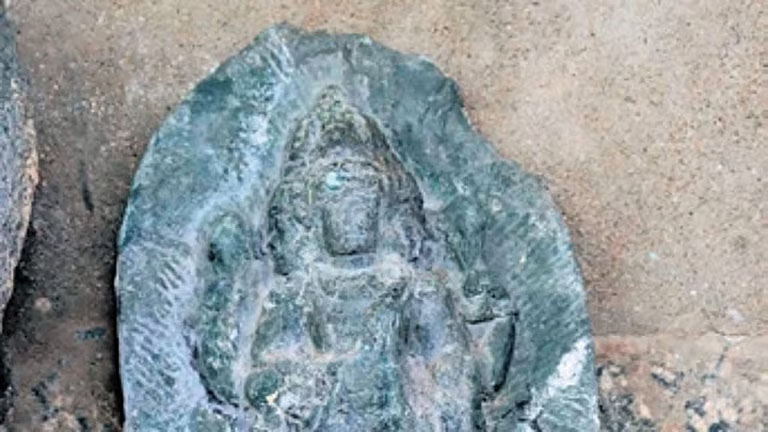
Karnataka: The discovery of an ancient and rare idol in the Betageri area of Gadag district has sparked keen interest among historians and researchers. While locals had long worshipped the idol believing it to be Lord Brahma, a recent study has revealed new facts about its true identity.
According to reports, the idol—located in the Gargipet area of Betageri—had been worshipped for years as Lord Brahma. However, a team of experts specializing in the iconography of Lord Brahma and the Sun God (Surya Dev) recently conducted a detailed study of the statue. Their examination confirmed that it is, in fact, an extremely rare idol of the Sun God depicted with three faces.
Researchers believe the idol symbolizes the three distinct forms of the Sun God: morning, noon, and evening. This discovery is considered highly significant from both religious and historical perspectives, as such idols are rarely found elsewhere.
Carved from black-blue stone, the idol depicts the Sun God in a standing posture. It features four arms, with the deity shown holding lotus buds. The figure wears a tall crown and ornaments around the neck and shoulders. Signs of age and wear are clearly visible around the waist, indicating the idol’s antiquity.
Experts believe the idol holds not only religious importance but also serves as a remarkable example of the art and craftsmanship of its era. The three-faced depiction of the Sun God—representing the different phases of the day—is considered a rare concept in ancient Indian sculpture.
The research team stated that further studies will be conducted to gather more information regarding the idol’s historical period, style of craftsmanship, and cultural significance. Scientific analysis of the idol’s structure and the quality of the stone will also be undertaken.
For the local community, this discovery has come as a surprise, given that they had previously worshipped the statue as Lord Brahma. The emergence of this new information has sparked both curiosity and reverence among the people.
Archaeological experts state that such discoveries play a crucial role in understanding the history of the region. The statue was likely part of an ancient temple or religious site that was either forgotten or relocated over time.
Currently, studies and research regarding this rare statue are underway, and it is expected that further significant facts about it will come to light in the future.