
DiWAS: Taking urban waste handling to the household
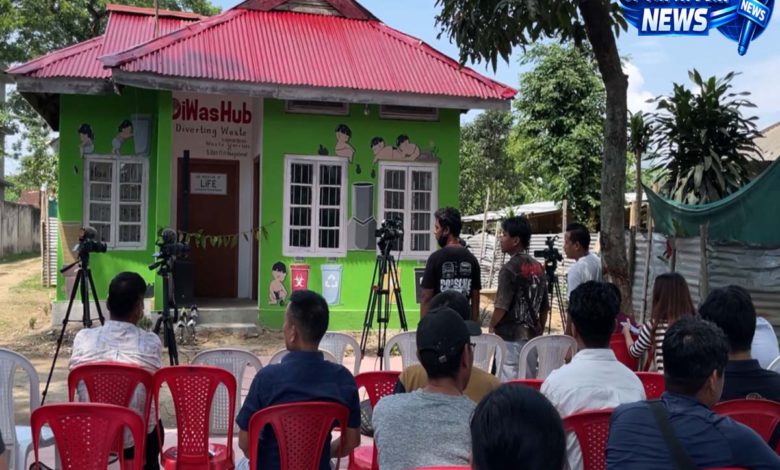
Nagaland: Nagaland’s first community-based waste sorting unit has taken shape in Dimapur. A first of its kind for the state, the Material Recovery Facility (MRF), located in Forest colony, was the result of a collaborative effort initiated by the Dimapur-based NGO– Living For Environment (LiFE). Decentralising the current model of waste disposal is at the heart of the project.
The facility was inaugurated by Supongnukshi, Additional Principal Chief Conservator of Forests (Territorial), at a programme held in Dimapur, on May 7.
Also called the DiWAS Hub, short for Diverting Waste, hands-on community involvement is at the heart of the initiative. It aims to take waste management to the household by taking the community into confidence, and in the process, serving as a model for sustainable waste management. According to Niksungla, Founder-Chairperson of LiFE, the project envisions residents taking the initiative to segregate waste at home, and delivering the pre-sorted waste to the MRF. She said, “Without the community support, any waste intervention will fail.”
An abandoned Assam-type government building of the Department of Environment, Forest and Climate Change, was repurposed to serve as the waste sorting hub for the locality with seed money from the Dehradun-based Waste Warriors Society, funding from Swachh Bharat Mission-Urban (SBM-U) 2.0, and contributions from an anonymous donor, the Wandering Minds College of Fine Arts, and local artists.
The idea is to incentivise waste management, turning it into wealth. “The recyclables will go to the storeroom and the inerts or the rejects will go to the landfill,” Niksungla said. She said that any revenue generated will go to a community welfare fund.
While stating that that the DiWas Hub was developed under LiFE’s ‘Sustainable Environment Action for Green Forest Colony’ initiated in April 2025, she added that the system also aims to integrate informal waste workers, including ragpickers.
Speaking at the event, APCCF Supongnukshi termed the launch a historic day for the state. He stressed the necessity of viewing waste as a resource and combining civic responsibility with government action. He observed that while voluntary waste management by citizens and NGOs typically accounts for 20 to 30 percent of the overall effort, the rest is affected only through “enforcement of the law” by municipal agencies.
Commissioner and Secretary for Urban Development and Municipal Affairs, Kekhrievor Kevichusa, highlighted the mounting legal pressure regarding state waste management from bodies like the Supreme Court and the National Green Tribunal (NGT). He disclosed that the NGT recently directed Nagaland to demonstrate visible on-ground improvements by March 2026. Acknowledging that the government cannot take the situation for granted, Kevichusa challenged organisations to replicate the DiWas model, encouraging them to adopt other towns or villages to build capacity. He maintained that without the community taking ownership of the waste they generate, “nothing will change.”
SBM-U 2.0 State Mission Director Kezhochole Rhetso outlined Dimapur’s waste management challenges, further aggravated by a growing population. She said that the Dimapur municipal area alone generates over 85 tonnes of waste daily. According to her, SBM-U 2.0 supported LiFE’s proposal to create a practical material recovery facility that could serve as an example for the rest of the state.
“Waste is only a waste when we mismanage it and dump,” Rhetso said.
Forest Colony Council Chairperson Shilumayang Ao expressed what he said was the community’s commitment to the project. Recalling the initial proposal from LiFE and SBM-U, he said that the council readily agreed to collaborate. “After all, who wouldn’t agree to make their colony the cleanest colony in Dimapur?” he said.