
Ancient stone idol of Lord Vishnu found on the banks of the Palatarangrai River.
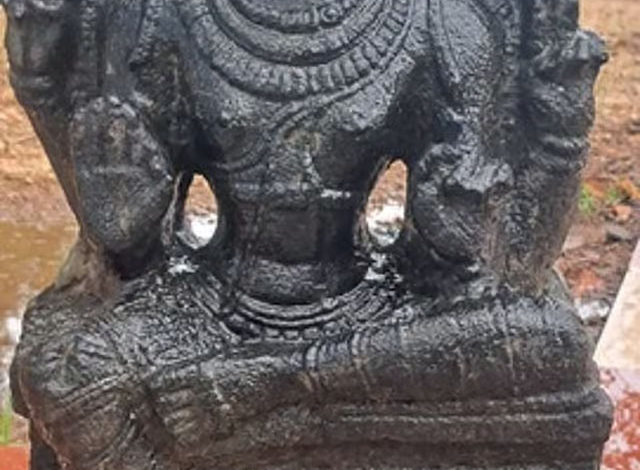
Ranipet. The discovery of an ancient stone idol of Lord Vishnu along the banks of the Palatarangrai River in the Puliyankannun Panchayat area has become a topic of discussion in the locality. Believing the approximately two-foot-tall idol to be a representation of Lord Vishnu, locals reverently retrieved it, installed it in the village’s Ponniyamman Temple, and performed special prayers. Once news of the discovery spread, a large number of villagers visited the temple to pay their respects.
According to locals, some people spotted the stone idol while near the Palatarangrai River. It looked distinct from ordinary stones, bearing the distinct form of Lord Vishnu. They informed other villagers, and the news quickly spread throughout the area. Subsequently, the villagers moved the idol to the nearby Ponniyamman Temple and installed it there.
After the installation, villagers began worshipping the idol in accordance with religious traditions. Recognizing it as an ancient image of Lord Vishnu, they performed special rituals, and people from surrounding areas began visiting the temple for a glimpse of the deity. Villagers remain curious about the idol’s antiquity and the circumstances of its discovery by the river. Many consider it an artifact of historical significance, although there is no official confirmation yet regarding its actual age or the period of its creation.
News of the discovery and installation reached the police and the Revenue Department. Following this, a team comprising the Sibcut police and Revenue Department officials—led by Walaja Talukdar Natarajan—arrived at the site. Officials inspected the idol at the temple and gathered preliminary information. Subsequently, administrative officials took the idol into their custody.
The Revenue Department team transported the idol to the Walaja Talukdar’s office, where it is currently being kept safely. Following this administrative action, the focus has now shifted to awaiting an examination by archaeological experts to determine the idol’s identity and historical significance.
The stone idol is reported to be approximately two feet tall. Part of the idol’s head is broken, making its full form difficult to discern clearly. Despite this, based on the figures visible on the idol, locals have identified it as a statue of Lord Vishnu. However, questions regarding the idol’s actual era, the type of stone used, and its historical significance can only be answered after an examination by experts.
Revenue Department officials stated that the Archaeological Research Institute has been informed about the discovery. Detailed information is expected to emerge only after archaeological experts study the idol. Experts can determine its probable era and historical background by analyzing its structure, craftsmanship, the nature of the stone, any signs of wear and tear, and the figures depicted on it.
According to officials, only a thorough examination will clarify the idol’s actual age and whether it is linked to an ancient temple, religious site, or historical tradition. For now, the administration has placed the idol in a secure location to ensure its safety and prevent any damage pending the expert examination.
The discovery of the idol has sparked significant interest among the local population. Villagers believe that finding ancient artifacts or idols along the riverbank could yield valuable information about the region’s history. There is hope that the expert analysis will reveal important historical facts regarding the statue.
As of now, the administration has not reached a final conclusion regarding the idol’s official identity or antiquity. The Revenue Department has clarified that detailed information will be made public only after the expert examination and necessary procedures are completed.
This statue of Lord Vishnu, found on the banks of the Palatarangrai River, is now under the administration’s protection. An examination by archaeological experts will determine the idol’s age and its historical or archaeological significance. Meanwhile, the discovery has ignited curiosity among locals regarding both their religious faith and the region’s ancient history.