Amid West Asia Turmoil, India Secures LPG Lifeline Through Strait Of Hormuz
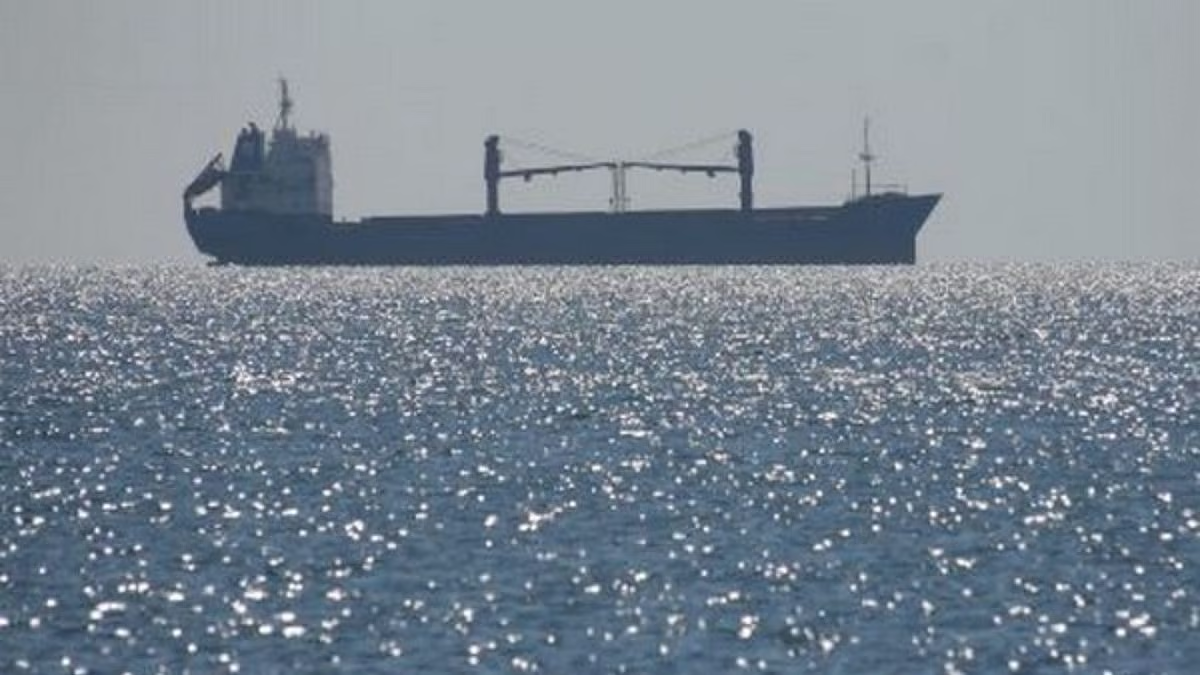
New Delhi: MEA spokesperson Randhir Jaiswal said two Indian ships had crossed the Strait of Hormuz and were heading to Indian shores. Speaking at an inter-ministerial briefing on Saturday, Jaiswal said. “Some ships destined for India have been able to cross through the Strait of Hormuz. In the early hours today, two Indian ships, Shivalik and Nanda Devi, crossed the Strait of Hormuz and are now headed to ports in India. Each of the ships is carrying in excess of 46,000 metric tons of LPG, with a cumulative total of 92,700 metric tons.”
He added. “Several of our ships remain in standby in the Gulf region. We propose to continue to remain in touch and coordinate with all concerned countries to ensure a safe and unimpeded transit for them in an effort to ensure our energy security.” The MEA spokesperson also added that India continued to remain in touch with all the important interlocutors in the region, which included GCC countries, Iran, the US, and Israel.
Speaking after Jaiswal, Aseem Mahajan, Additional Secretary (Gulf) spoke about the current state of Indian nationals trapped in the region. “We have five Indians who have lost their lives and one who is missing in an earlier incident. Our missions in Oman, Iraq, and the UAE remain in touch with the concerned authorities regarding the missing Indian national and for early repatriation of mortal remains of the deceased after completing requisite formalities.”
Mahajan also gave an update on the Iranian attack on Sohar city in Oman, where two Indian nationals had lost their lives. “Two Indian nationals lost their lives, and 10 Indian nationals were injured. None of whom are reported to be seriously injured. The embassy is also coordinating to facilitate the early return of the mortal remains of the two deceased to India.” The Additional Secretary also gave an update on the lives of Indian crew members who were on the US-owned and Marshall Island-flagged oil tanker Safesea Vishnu.
The tanker was attacked by an Iranian “suicide boat” just off the coast of Khor Al Zubair port in Iraqi territorial waters on March 12. He said that the 15 crew members on the tanker were safely evacuated and are currently residing at a hotel in Basra, Iraq. Regarding the situation of flights in the region, government officials stated that all attempts were being made to repatriate Indian civilians from the region. “On February 25 and February 28, around 172,000 passengers have returned from the region to India,” said Mahajan. He added that air connectivity from the region had been steadily improving with the addition of more flights to different cities in India.
“Flights have been operating from Oman, Saudi Arabia, the UAE, and Qatar. In Bahrain, Kuwait, and Iraq, where direct flights are not directly operating, we are assisting the Indian nationals in terms of visa extensions and transit visas to enable their onward journey via Saudi Arabia.” Regarding the situation of Iranian nationals stranded in India, Mahajan said Iranian authorities arranged a chartered flight to take them. Addressing the “Inter Ministerial Briefing on Recent Developments in West Asia”, Special Secretary in the Ministry of Shipping Rakesh Kumar Sinha said “both the LPG carriers safely transited the Strait of Hormuz late last night/early this morning and are now proceeding towards India.”
And their ports of arrival will be Mundra and Kandla, with expected arrival dates of March 16 and March 17, respectively.” With this, Sinha said 22 Indian-flagged vessels remained in the Persian Gulf with a total of 611 seafarers. However, he added that, “all Indian seafarers in the Persian Gulf region are safe, and no untoward incidents involving them have been reported over the last 24 hours.” Giving a break-up of these 22 vessels, the official further said that they comprise 6 LPG tankers, 1 LNG carrier, 4 crude oil tankers, 1 chemical products tanker, 3 container ships, 2 bulk carriers and 1 dredger.
Besides, the vessels also include one empty ballast or as vessel not carrying cargo and three dry docks or vessels that are under repair and maintenance. On the overall LPG supply situation, Joint Secretary in the Ministry of Petroleum and Natural Gas Sujata Sharma said “overall it is being managed well given the geopolitical situation and no dry-out has been reported so far.” Incidentally, the daily consumption of LPG in India is around 80,000 metric tonnes and the Centre has also increased the domestic production through the refineries by around 30 percent since March 5.
Sharma also reiterated the appeal to people to “refrain from panic booking” and only book cylinders “when it is absolutely necessary. With a major shortage of commercial cylinders also being reported from some parts of the country, Sharma said “a decision was taken to allocate a certain quantity of LPG to commercial cylinders as well”.