
Alleged fraud in paddy procurement worth ₹26.24 crore in Dindori; EOW takes action
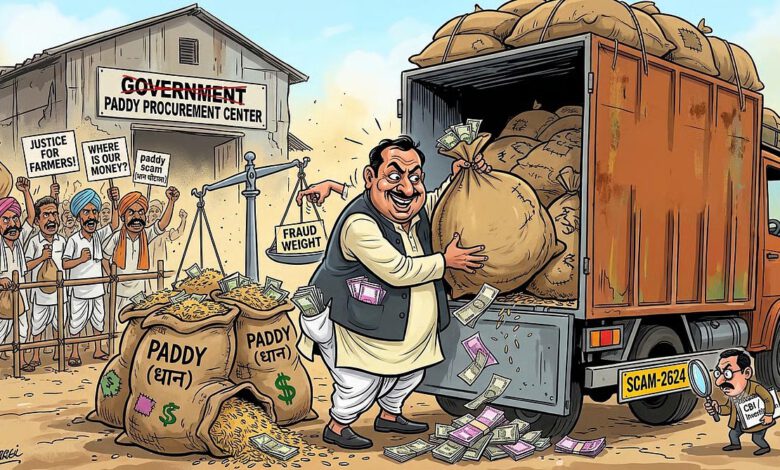
Dindori. A case of alleged fraud involving the procurement and sale of paddy has come to light in the Dindori district of Madhya Pradesh. The Economic Offences Wing (EOW) has registered a case against a paddy trader and several government employees for allegedly defrauding the state government by creating fake bills for paddy procurement. The matter pertains to the Agricultural Produce Market Committee (APMC) in Gorakhpur. It is alleged that the procurement of 122,584.50 quintals of paddy from 140 sellers was recorded on the ‘e-Anugya’ (e-permit) portal, with a total value stated at Rs 26.24 crore. The EOW’s intervention has raised serious questions regarding the procurement and trading system of the APMC.
According to EOW officials, Swapnil Khanuja, the owner of ‘Harihar Traders’—based in Harra village, Dindori district—had entered details regarding paddy procurement on the e-Anugya portal. The portal’s records indicated that the firm had procured a large quantity of paddy from 140 sellers, with the total value reported as Rs 26.24 crore. It is alleged that the state government was defrauded through the creation of forged bills related to these transactions.
The Economic Offences Wing has registered a case against both the trader and certain government employees. The alleged involvement of government staff has cast doubt on the APMC’s administrative framework and its document verification processes. However, specific details—such as the number of government employees named as accused and the exact nature of their roles—are not yet available.
The e-Anugya portal is used for managing documentation and transport permits related to the trade of agricultural produce. This digital system facilitates the maintenance of records concerning the quantity of agricultural produce, its procurement and sale, and other related commercial activities. In such a scenario, ensuring the accuracy of the information entered into the portal is of critical importance. The entry of incorrect or fraudulent data can adversely affect government revenue and the oversight mechanism of the mandi (agricultural produce market).
The quantity of paddy recorded on the portal by ‘Harihar Traders’ is reported to be over 122,000 quintals. The authenticity of the documents pertaining to the procurement of such a large volume of agricultural produce is a key aspect of this case. The details of the 140 sellers registered on the portal, the actual quantity procured, and the legitimacy of the associated bills could clarify the true nature of the situation.
It is also crucial to determine the actual quantity of paddy procured from the sellers listed on the portal. Documents related to the transactions—such as bills, payment records, mandi documentation, and transport details—could serve as vital evidence in the investigation. However, specific details regarding which documents have been examined by the Economic Offences Wing (EOW) and what evidence has been gathered thus far have not yet been disclosed.
The relevant officials and staff bear the significant responsibility of managing and monitoring commercial activities within agricultural produce markets. To maintain transparency, it is essential to reconcile the procurement and sales data recorded in the mandi system with the actual transactions. Given that a case has also been registered against government employees, the investigation into their alleged involvement has become a critical component of the inquiry.
In Madhya Pradesh, paddy cultivation is a vital source of income for farmers. A large volume of agricultural produce is traded between farmers and traders through these mandis. The use of fraudulent documents within this system can undermine the credibility of the government’s oversight mechanism. In such instances, it is necessary to verify that the digital records align with the actual commercial activities.
Following the registration of the case by the Economic Offences Wing, the specific roles of the trader and the government employees involved remain to be clarified. Questions such as how the fraudulent bills were generated, the extent of the discrepancy between the data entered on the portal and the actual procurement, and the total financial loss incurred by the state government due to the alleged fraud will likely be answered by the findings of the investigation. It is noteworthy that the total value of paddy procurement recorded on the portal is reported to be Rs 26.24 crore. However, this entire amount cannot be classified as a loss to the government or as embezzled funds. The official figure regarding the actual financial loss incurred by the state government is not yet available.
Currently, the Economic Offences Wing (EOW) has registered a case against Swapnil Khanuja—the proprietor of Harihar Traders—and several government employees in connection with this alleged fraud involving the Gorakhpur Agricultural Produce Market Committee (Krishi Upaj Mandi Samiti). Further details—such as the specific roles of the accused, the number of forged documents involved, and the extent of the potential loss to government revenue—are yet to be determined. The perspectives of the trader and the employees in question are also not yet available. The true nature of the allegations will only become clear once the investigation is complete.