
UP elections: SP-Congress tussle over seat sharing
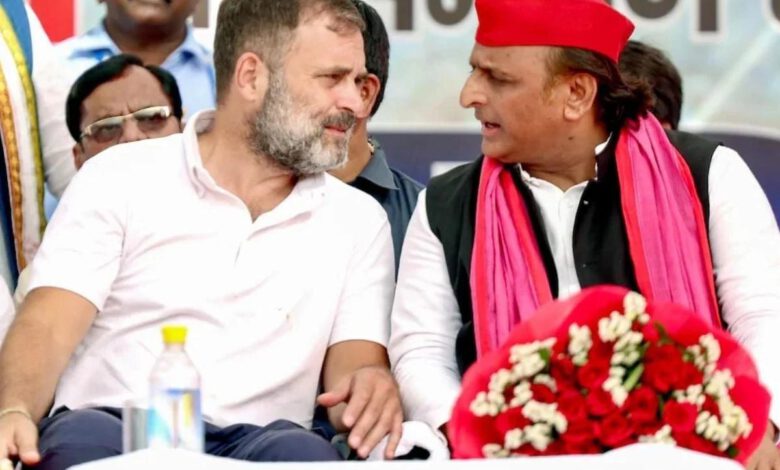
Lucknow. Before the upcoming assembly elections in Uttar Pradesh, the political tussle over seat sharing between Samajwadi Party and Congress has intensified. Amidst the election preparations, coordination of seats in the alliance seems to be a big challenge for both the parties. A day after Congress demanded 131 assembly seats, Samajwadi Party has proposed it to contest elections on only 26 seats. The huge difference between the demand and proposal of both the parties has increased the political excitement.
This proposal of SP has revealed that Congress’s displeasure has increased. Especially in the areas of traditional influence of Congress like Amethi and Rae Bareli, the offer of giving it only one assembly seat has deepened the controversy. In such a situation, it does not seem easy to reach a consensus between the two parties regarding seats before the upcoming assembly elections.
Congress wants to strengthen its organization in Uttar Pradesh and stake its claim on more seats in the assembly elections. The party’s demand for 131 seats can be linked to this strategy. Assembly elections are an important opportunity for Congress to strengthen its position in the state politics and boost the morale of the workers. However, the Samajwadi Party’s proposal includes much fewer seats than the Congress’ demand.
There are total 403 seats in Uttar Pradesh Assembly. In such a situation, Congress has expressed its desire to contest elections on about one-third seats, whereas SP has offered only 26 seats. There is a difference of 105 seats between the two parties. Such a huge difference in the number of seats could prolong negotiations within the alliance.
The dispute over the seats of Amethi and Rae Bareli is considered especially important. Both the areas have been major centers of Congress politics for a long time. Congress has had a political identity and organizational presence in these areas. In such a situation, the proposal to give only one assembly seat each at both the places does not appear to be in line with the electoral ambitions of the Congress.
For Congress, Amethi and Rae Bareli are not only electoral constituencies but also linked to political prestige. Exploring the possibility of fielding candidates on more assembly seats in these areas could be part of the party’s strategy. However, the limited number of seats offered by the Samajwadi Party has created a new challenge for the Congress.
On the other hand, it is also important for the Samajwadi Party to maintain its political strength in the assembly elections. The strategy of fielding candidates on more seats in the state and keeping your organization active in the electoral field can play an important role in seat distribution. In such a situation, it may be challenging for SP to strike a balance between the demands of its alliance partners and its own electoral priorities.
Local equations play an important role during assembly elections in the politics of Uttar Pradesh. The popularity of the candidates in each assembly constituency, social equation, activism of the organization and performance in the previous elections can influence the seat sharing negotiations. It is important to consider all these aspects while determining seats in the alliance.
The ongoing tussle over seats between SP and Congress may also impact the election preparations of both the parties. From the selection of candidates to the strength of the organization at the booth level, many important decisions depend on the final distribution of seats. If uncertainty remains regarding seats, it may create confusion between workers and potential candidates at the local level.
For the success of the alliance, along with political coordination between the two parties, mutual cooperation of the workers is also necessary. Building consensus may be particularly difficult in constituencies where both parties consider their claims strong. In such areas, one party has to retreat, which may affect the electoral hopes of local leaders.
The biggest question now is to reach an agreement on an acceptable number between Congress’s demand of 131 seats and SP’s proposal of 26 seats. The challenge before both the parties is to ensure the unity of the alliance while maintaining their political priorities. However, the initial proposal cannot be seen as the final distribution of seats.
Political circles will keep an eye on the direction in which the talks between the two parties regarding seats proceed in the coming days. Especially the decision on the assembly seats of Amethi and Rae Bareli will be important. At present there is a big difference between the demand of Congress and the proposal of Samajwadi Party. Now it has to be seen whether both the parties are able to resolve their differences and agree on a common election strategy or whether the political tussle over seats will increase further.