
Vegetable prices rise due to continuous rains, ginger and coriander reach Rs 250 per kg
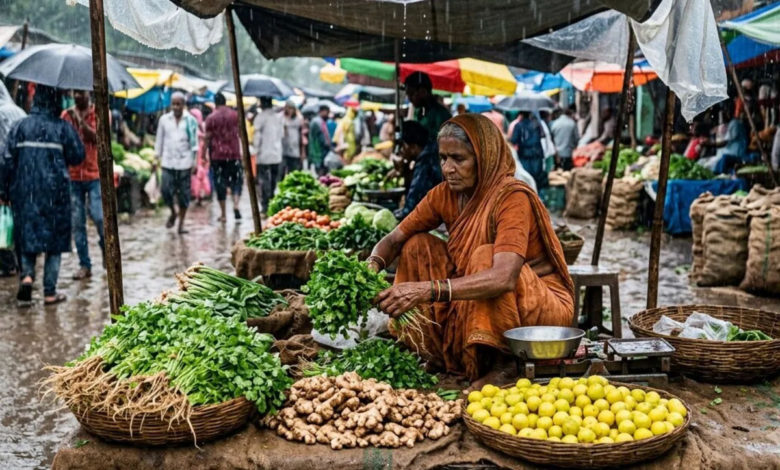
Uttar Pradesh: The effect of rain in various districts for two consecutive days is now visible on the kitchens of common people. Due to rain, the arrival of vegetables in the mandis has been affected, due to which there has been a rise in prices in the wholesale and retail markets. The prices of many vegetables have increased by Rs 10 to Rs 20 per kg in just two days. People’s household budget has started deteriorating due to rising prices of everything from potatoes, onions, tomatoes, bottle gourd and okra.
People who came to the market to buy vegetables on Saturday had to face increased prices. Now one has to pay more for vegetables whose prices were normal till two days ago. According to traders, due to continuous rain, there is difficulty in delivering vegetables from rural areas to the markets. Harvesting and transportation of vegetables from farms has also been affected at many places. This has had a direct impact on the arrivals in the markets.
The biggest discussion is regarding the prices of ginger and coriander. Their price in the market has become more than that of many fruits. While apple and pomegranate are being sold at around Rs 160 to 180 per kg, the price of ginger and coriander has reached Rs 200 to 250 per kg. In such a situation, before buying these things which are used daily in the kitchen, people are asking the price and purchasing in small quantities as per the need.
The prices of lemon have also increased the problems of the people. The price of lemon in the wholesale market is said to be around Rs 80 per kg, but in the retail market it is being sold at Rs 15 to Rs 20 per piece. Due to the continuing demand for lemon for everyday food and other household uses, the increased price is directly impacting the pockets of the customers.
The effect of rain is not limited to ginger, coriander and lemon only. The prices of many other vegetables including potato, onion, tomato, bottle gourd, lady’s finger have also increased. Generally, kitchen expenses have started increasing due to the simultaneous increase in the prices of vegetables used daily in homes. This is especially affecting those families who buy fresh vegetables from the market every day or every two-three days.
Customers who reached the market say that within a few days a clear difference has started appearing in the prices of vegetables. Earlier, vegetables were available in large quantities for the same amount of money, but now less goods are available in the same budget. Many people are giving preference to buying relatively cheap vegetables instead of expensive vegetables. The work is being done by purchasing things like ginger, coriander and lemon in small quantities.
The main reason for the sudden rise in the prices of vegetables is being said to be the impact of arrivals in the mandis. Due to continuous rain it becomes difficult to extract vegetables from the fields. Apart from this, there is also difficulty in delivering goods from rural areas to the markets. In such a situation, when the quantity of goods available in the market decreases, the pressure on prices increases. These vegetables become more expensive by the time they reach the retail market.
The inflation seen in the market after two days of rain has increased the concern of the common people. Vegetables are a part of daily needs, hence their purchase cannot be postponed for a long time. Especially the increase in prices of vegetables like potato, onion and tomato affects the budget of almost every household.
The market situation on Saturday was such that people had to pay Rs 10 to 20 per kg more for many vegetables than two days ago. At the same time, due to the price of things like ginger and coriander reaching Rs 200 to Rs 250 per kg, customers had to spend extra. Lemon is also giving a feeling of inflation as it is available at Rs 15 to Rs 20 per piece in the retail market.
Amid continuous rains, people are now keeping an eye on the prices of vegetables. The pressure on prices may reduce once arrivals in the mandis become normal, but at present the increased prices have definitely spoiled the kitchen’s calculations. Families are having to add additional money to their household expenses due to the increase in the cost of many vegetables that are needed on a daily basis.