
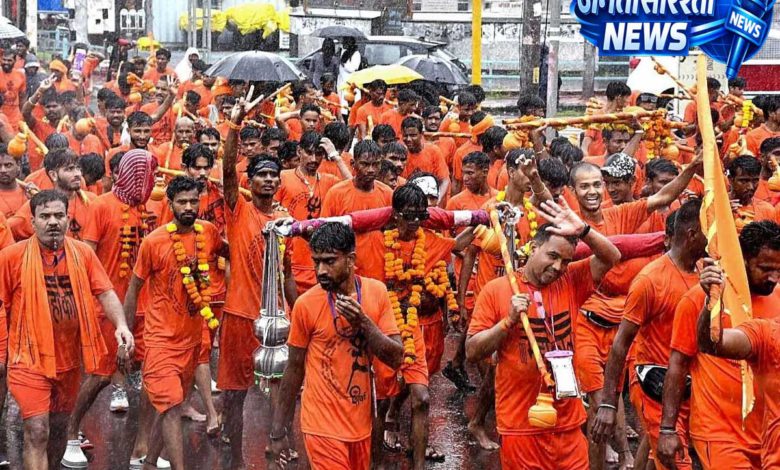
As the month of Sawan (Shravan) arrives, preparations for the Kanwar Yatra begin across several states in North India. Hundreds of thousands of Shiva devotees undertake a pilgrimage on foot, carrying holy water from the Ganges—collected from sites like Haridwar, Gangotri, Gaumukh, and Sultanganj—to their local Shiva temples. The central element of this entire journey is the Kanwar itself—a structure devotees carry on their shoulders to transport the holy water.
But have you ever wondered how a Kanwar is actually made? What kind of bamboo is used? How much does it cost, and how is it decorated so beautifully? Let’s explore the complete “inside story” of the Kanwar.
What is a Kanwar?
A Kanwar is a specialized structure with water vessels suspended from both ends; devotees balance it on their shoulders while carrying the holy water. According to religious belief, the Kanwar must not be placed on the ground during the pilgrimage; instead, a special stand is used to hold it.
The design of the Kanwar has evolved over time. Alongside simple versions, the market now offers Kanwars featuring attractive designs, LED lights, religious imagery, and modern decorative elements.
What kind of bamboo is used?
Traditional Kanwars are primarily crafted from bamboo that is slender, lightweight, yet strong. Artisans typically select bamboo that:
Is lightweight.
Has good flexibility.
Does not break easily.
Is comfortable to carry on the shoulder over long distances.
While local bamboo is used in some areas, larger markets also utilize bamboo sourced from Assam, Uttarakhand, Uttar Pradesh, and the Northeastern regions.
Nowadays, materials like fiber, PVC pipes, aluminum frames, and lightweight metal structures are also being used in Kanwar construction to reduce weight while enhancing durability.
How long does it take to make a Kanwar?
Crafting a simple Kanwar takes approximately 2 to 5 hours, whereas larger, elaborately designed ones can take anywhere from one to three days to complete. Crafting a Kanwar involves several distinct stages, including bamboo cutting, balancing, painting, and decoration.
How much does a Kanwar cost?
The price of a Kanwar depends on its size, materials, and level of decoration.
Generally, the estimated market prices are as follows:
Simple bamboo Kanwar: ₹200 to ₹500
Decorative Kanwar: ₹500 to ₹1,500
Kanwar with LED lights and special designs: ₹1,500 to ₹5,000 or more
Custom or theme-based Kanwar: ₹5,000 to ₹20,000 or more (depending on design and size)
Prices may vary based on the city, market, materials used, and craftsmanship.
How is a Kanwar decorated?
Modern Kanwars are no longer merely vessels for carrying water; they have become symbols of both devotion and artistry.
Decorations typically include:
Images of Lord Shiva, Goddess Parvati, and Nandi.
Symbols like ‘Om’ and the Trishul (trident).
Saffron-colored cloth.
Colorful flowers and frills.
Beads, lace, and decorative ribbons.
LED lights.
Bells.
Artificial flowers.
Religious messages and stickers.
Themes featuring Bharat Mata (Mother India) or the Tricolour (where appropriate).
Who makes Kanwars?
Local artisans, bamboo craftsmen, and families involved in handicrafts across various cities and towns in the country have been making Kanwars for years.
Production ramps up one to two months before the start of the Sawan month to ensure timely supply according to demand.
Where are Kanwars sold the most? Large numbers of Kanwars are sold during the month of Sawan in religious markets across Haridwar, Meerut, Muzaffarnagar, Ghaziabad, Delhi, Baghpat, Shamli, Saharanpur, Sultanganj, Deoghar, and other parts of North India.
In these markets, lakhs of devotees purchase Kanwars based on their preferences and budgets.
What should you keep in mind when buying a Kanwar?
If you are embarking on the Kanwar Yatra for the first time, consider the following points:
Choose a Kanwar that is lightweight and well-balanced.
Ensure the bamboo is sturdy and free of cracks.
The water containers should be of good quality.
The decoration should be such that it does not hinder the journey.
Avoid choosing an excessively heavy Kanwar.
If purchasing an LED Kanwar, check the battery and wiring.
Is an expensive Kanwar necessarily better?
Not necessarily. From a religious perspective, the significance of a Kanwar lies not in its price, but in the devotion, adherence to rituals, and faith associated with it. Lakhs of devotees undertake the pilgrimage with complete faith using even simple Kanwars. Expensive or elaborate Kanwars command higher prices primarily due to their decoration and design.