
Saraswati Puja is an eternal celebration of knowledge in India
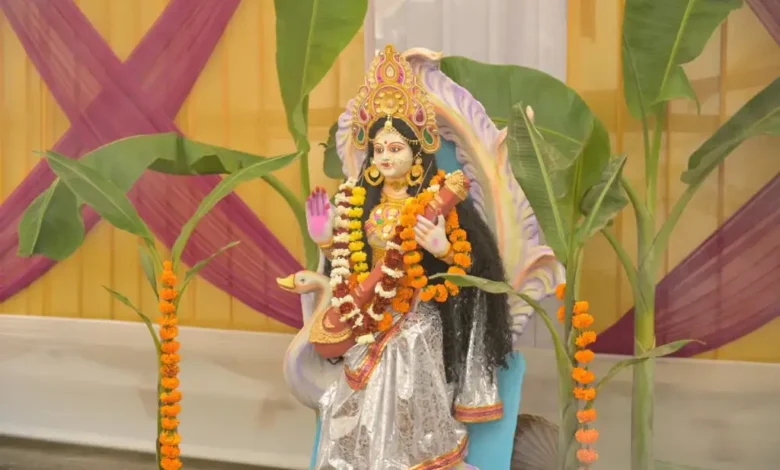
New Delhi : Saraswati Puja, also known as Vasant Panchami, occupies a tender and deeply respected place in India’s cultural and spiritual calendar. Celebrated as the day dedicated to Goddess Saraswati—the embodiment of knowledge, wisdom, music, art, and learning—the festival is not merely a ritualistic observance but a civilisational expression of India’s reverence for intellect and creativity. In a country where learning has traditionally been viewed as a sacred pursuit, Saraswati Puja becomes a collective pause to honour the mind, the word, and the arts that shape society.
The festival usually falls in late January or early February, coinciding with the onset of spring. The season itself carries symbolic weight: fields begin to turn green, mustard flowers bloom, and the air feels renewed. This natural awakening mirrors the spiritual theme of Saraswati Pooja—illumination after dormancy. Goddess Saraswati is iconographically depicted clad in white, seated on a lotus or a swan, holding the veena, scriptures, and a rosary. White, signifying purity and clarity of thought, becomes the dominant colour of the day, worn by devotees and reflected in the simplicity of the rituals.
At the heart of Saraswati Puja lies the worship of knowledge in all its forms. Books, musical instruments, pens, notebooks, and tools of learning are placed before the goddess and ritually sanctified. One of the most widely observed beliefs associated with the festival is the abstention from reading or writing on the day of the pooja, as a mark of humility before knowledge itself. Children are often introduced to learning through the ritual of Vidyarambham, where they write their first letters under the guidance of elders, symbolising the goddess’s blessings on their intellectual journey.
Offerings made during Saraswati Puja are modest yet meaningful. Fruits, sweets, and traditional preparations such as khichdi, kheer, and boondi are common, while yellow-hued foods—reflecting the colour of spring and prosperity—hold particular significance. Marigold flowers, incense, and earthen lamps complete the sacred arrangement, reinforcing the festival’s understated elegance.
While the essence of Saraswati Puja remains uniform across India, its celebration varies regionally, adding to its cultural richness. In West Bengal, Bihar, and parts of Jharkhand, the festival is marked by elaborate community pandals, especially in schools and colleges, where students take collective ownership of the rituals. Here, Saraswati Pooja carries a youthful energy, blending devotion with cultural programmes, music, and shared meals. In Assam, the festival is celebrated with equal fervour, often coinciding with educational institutions hosting ceremonies that emphasise discipline and respect for learning.
In South India, Saraswati Puja is integrated into the larger framework of Navaratri, particularly on the day of Ayudha Pooja, when tools of trade and learning are worshipped. There is Vidyarambham in states like Kerala and Tamil Nadu, which is a prominent ritual, underscoring the belief that education is both a spiritual and moral undertaking. Northern India observes Vasant Panchami with temple worship, kite flying, and seasonal festivities, blending devotion with joy.
What makes Saraswati Puja enduringly loved is its universality. It transcends age, profession, and region, uniting students, artists, scholars, and artisans under a shared reverence for knowledge. As 2025 is an era increasingly defined by speed and material success, the festival gently reminds society that wisdom, creativity, and learning remain its most sacred assets.